by Maureen | Jul 7, 2010 | Featured Articles, Food!, Franciacorta, Journal, Meals, People, Photos, Travel Blog
The grape varieties and resulting wines here in Italy are numerous and quite different than in the U.S. What better way, then, to learn about the wine I’m drinking than to take a wine-tasting class. After attending intensive language classes last winter, I figured I was ready to enroll in the preliminary class series offered by the Organizzazione Nazionale Assaggiatori di Vino (ONAV) – the National Organization of Wine Tasters.
Some of my Seattle friends have joked that the class was a bunch of people sitting around drinking wine. “Hey! How do you like this wine?” “It’s great. Pass me the bottle!”
No. It was a series of 18 lessons, 2 per week, from 9:00 in the evening ’til 11:00 or so. It was held across town and I usually got home on the subway after midnight. (I started the class in February.) The course content was very technical, including discussions of chemistry, cultivation and fermentation processes, wine types and their characteristics, defects and regulations.
And all of this was in Italian. Each session was taught by a person with a different expertise… and a different manner of speaking. On good nights I understood 80% of what was said. (At least I think so.) There were a few nights when I may have understood only 10 -20%. Most lessons were complete with powerpoint presentations, charts and graphs. What I couldn’t understand by listening I could understand by reading. I felt I was learning more than I knew before, even though I didn’t get it all.
Most evenings, we had 4 wines to taste, being given a small sampling of each but not even taking the first sip until about 10:30. We used a complex table to judge each wine for its visual, olfactory and in-the-mouth characteristics, tallying a score for each wine on a 100-point scale. We judged on clarity, tone, intensity, frankness, fineness, harmony, body, persistence and overall ranking.
Taking the class did change my understanding of and appreciation for wine. And it probably spoiled me for drinking “cheap wine”, though here in Italy I can get a pretty nice, very drinkable wine for 4 or 5 euro. ($5 or $6)
When the class was ending in late April, we were told to prepare for the final exam. Yes. A final exam! I considered not taking the test; after all, I had attended the course simply for my own interest, not to become an official sommelier.
Having convinced myself to take the exam, I then considered taking the test in English, an option offered. But no. I took the 10-question short essay test in Italian. I had to understand the question; know the answer and know how to say and write it in Italian! We then had 5 wines to taste and judge; our judgments of the wine were expected to fall within a few points of the ONAV judgments. (ONAV was serious! They had several versions of the test. We had to sit with an empty chair between us. And we had to remain silent.)
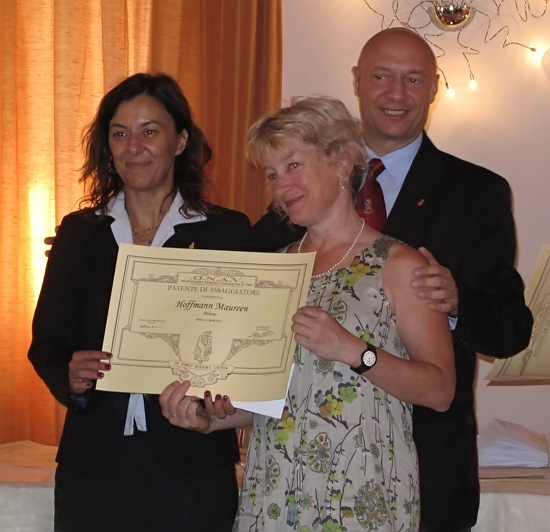
I passed! It was a little, personal triumph.
Last Sunday we had our diploma ceremony at the beautiful Ferghettina vineyard high on a hill in the Franciacorta region east of Milan. Our class was joined by classes from other locations of the Lombardia region of Italy for one grand celebration.
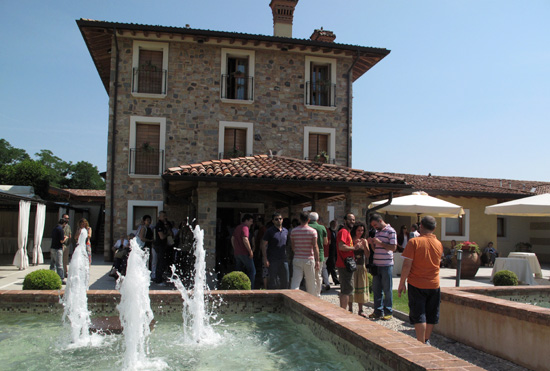
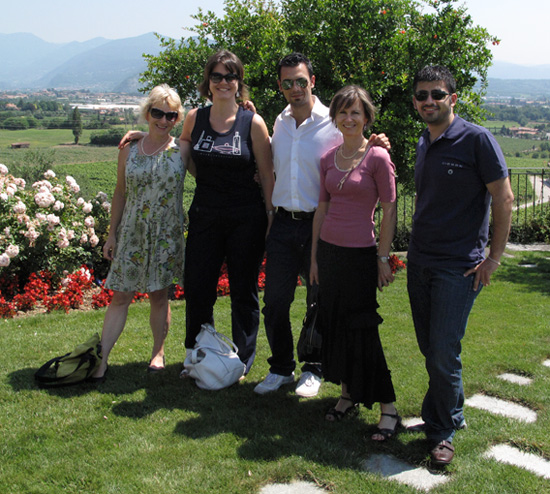
Not having a car, I could not have attended without the kindness of my classmate, Giuseppe, letting me ride along with him and Alessandro. Once there, we met up with Federica and Valentina from our class.
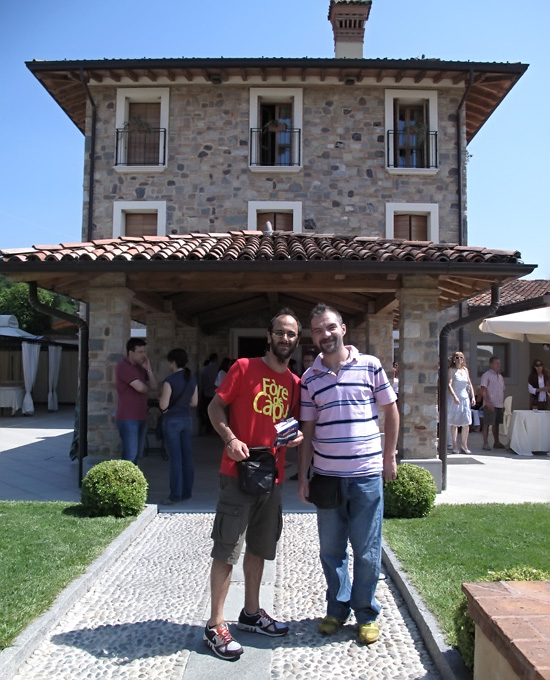
Rocco and Gianni were also there, as were other classmates.
Our names were called out individually and we went to the front to receive our diplomas.
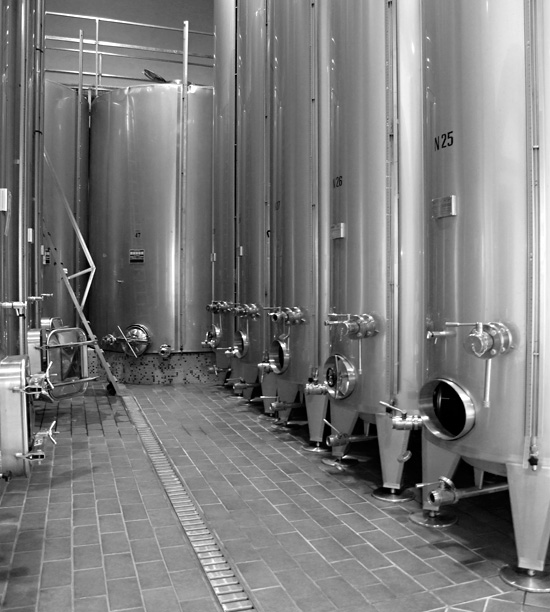
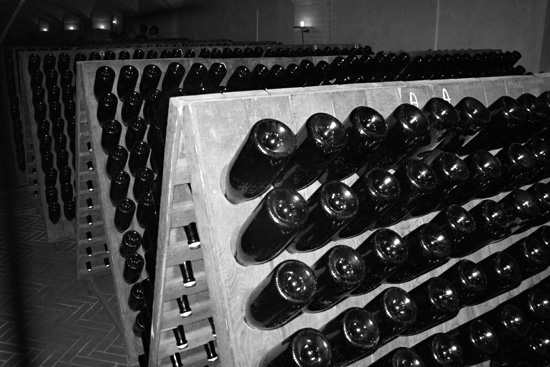
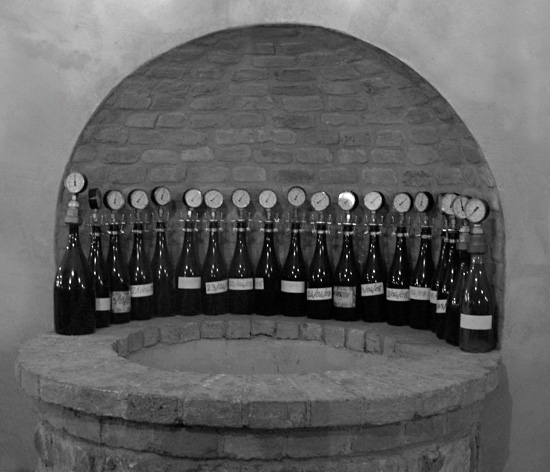
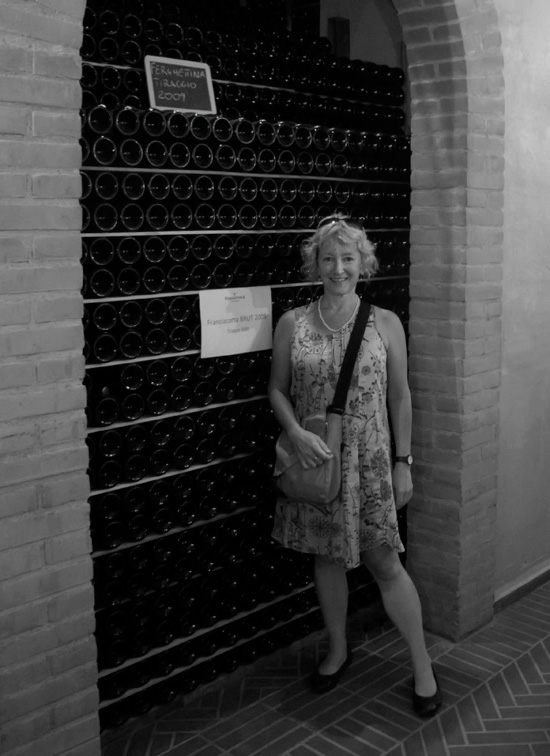
Afterwards, we were treated to Ferghettina Brut, along with typical meats, cheeses and breads. On that sweltering hot day, a tour of the winery’s cool, underground “cantina” was a refreshing break, and fascinating.
.
.
.
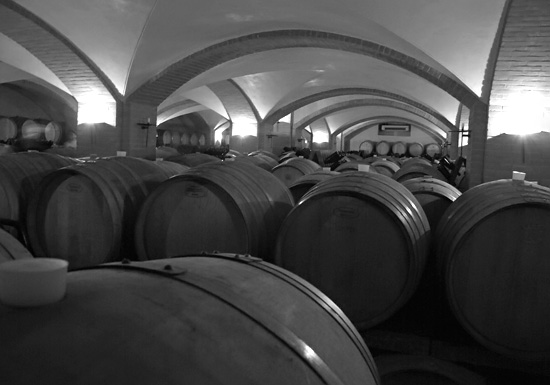
Ahh, nice and cool standing next to the 2008 Franciacorta Brut.
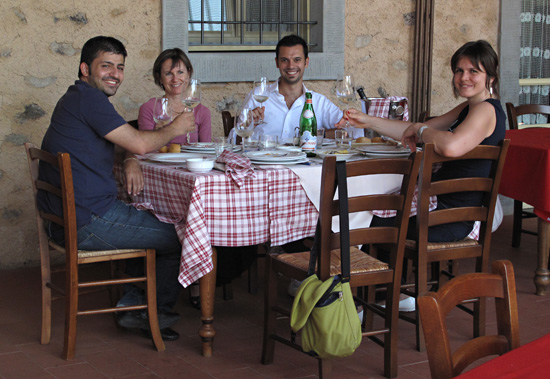
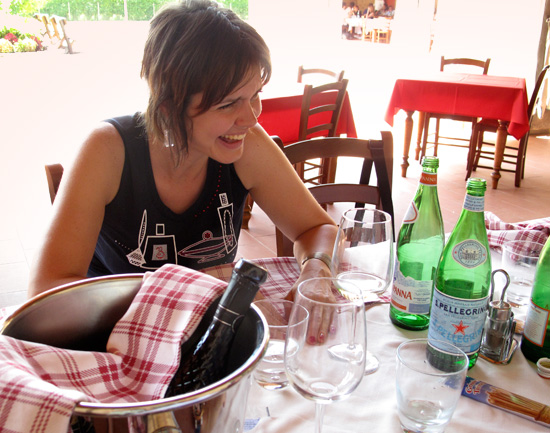
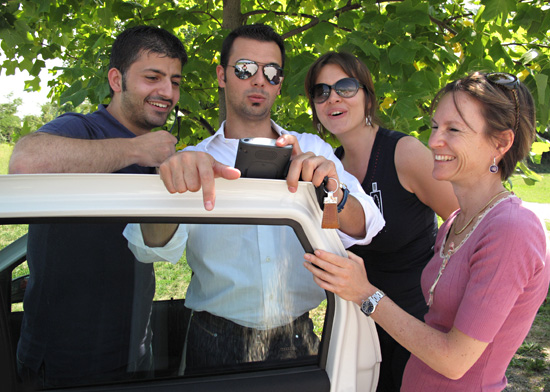
After celebrating with our other ONAV classmates, the 5 of us headed off in two cars to a place that Federica had heard about. It was a laughable, roundabout tour through the countryside of Brescia trying to find the agriturismo, Cá del Lupo. We enjoyed a light lunch on the terrace: Alessandro, Valentina, Giuseppe and Federica.
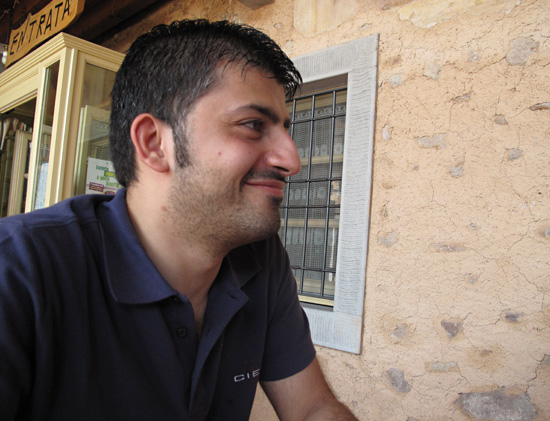
Alessandro.
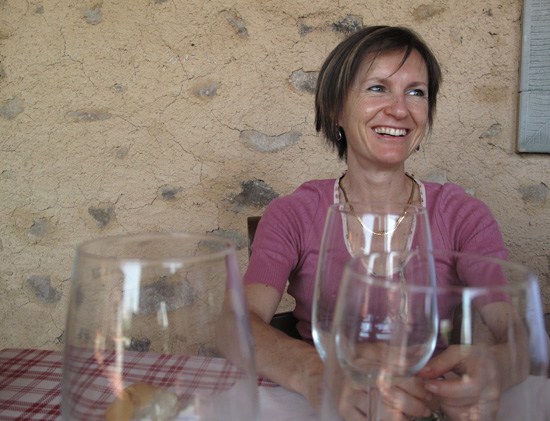
Valentina.
Giuseppe.
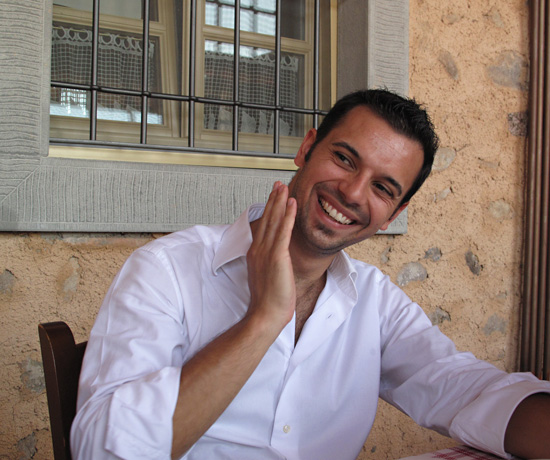
Federica.
It took much hemming-and-hawing to decide whether to go walk along the shore of Lago d’Iseo. We consulted the GPS to figure out how to get there and how long it would take.
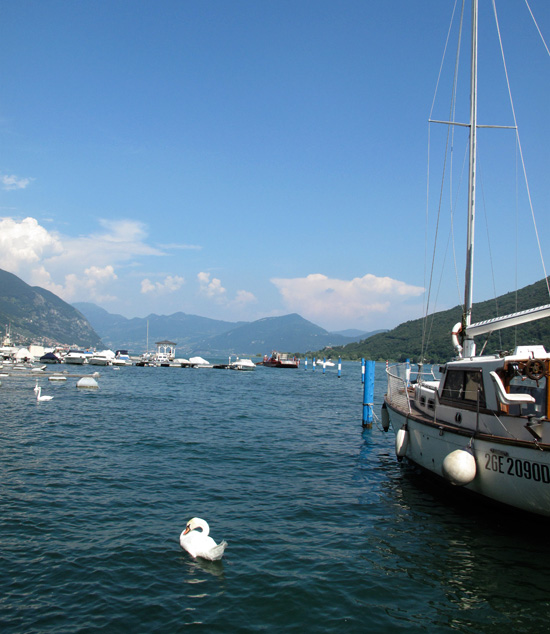
Lago d’Iseo is between Lago di Como and Lago di Garda, nestled in the ring of mountains to the north.
Alessandro and I goofed off at the cartoon characters on the lawn.
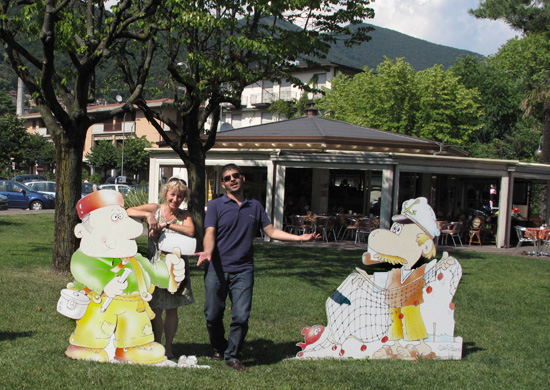
I spent my very hot Fourth of July at a winery, a farm and a lake, with 4 dear people I hardly knew. We had a wonderful time and laughed a lot. One of more of them may end up on my doorstep in Seattle some day!
by Maureen | Mar 21, 2010 | Cheese, Discoveries, Featured Articles, Food!, Introspection, Journal, Meals, People, Photo of the Day, Photos
Would you let 30 random strangers eat off your plate? Would you, in turn, eat off the plates of those 30 strangers?
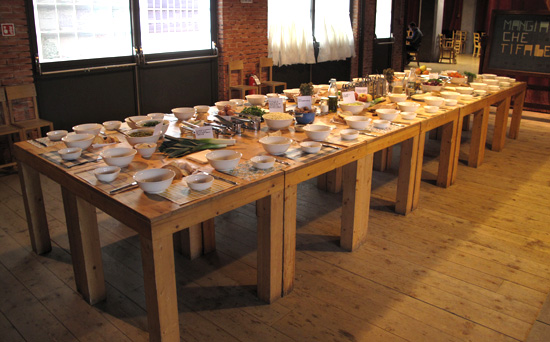
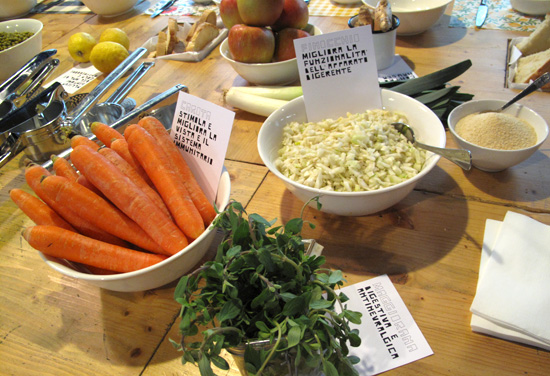
The Uovo Performing Arts Festival included one “performance” yesterday of 30 individuals, by reservation only. “Mangia che ti fa bene”, “Eat that you will feel well.” For 10 euro, or about $13.50, I walked into the room to a very long table with 30 place settings, and a variety of ingredients:
- bread
- water
- eggs
- grana cheese
- cabbage
- parsley
- apples
- beets
- sesame seeds
- pumpkin seeds
- fennel
- olive oil
- garlic
- spices
- cooked peas
- oats
- radicchio
- spinach
- fresh ginger
- lemon
- leeks
- carrots
- walnuts
- fresh herbs
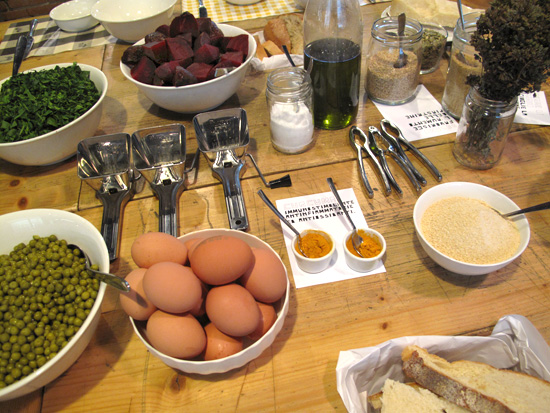
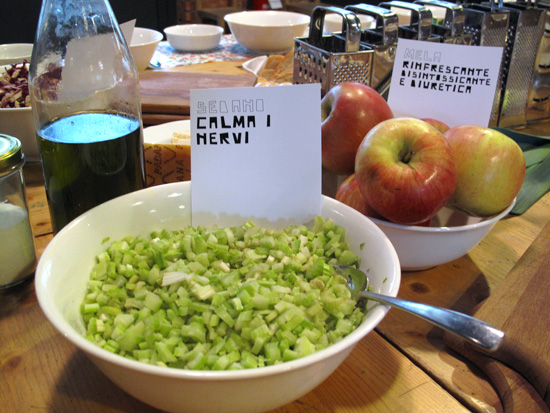
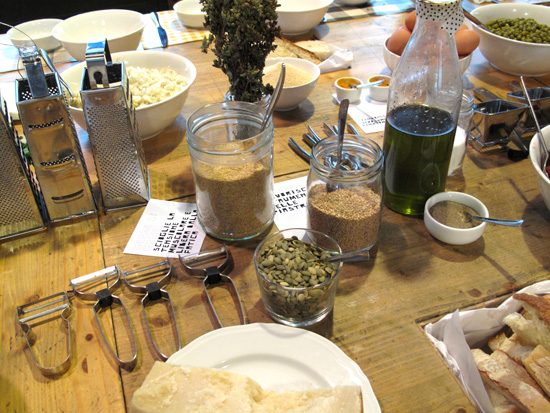
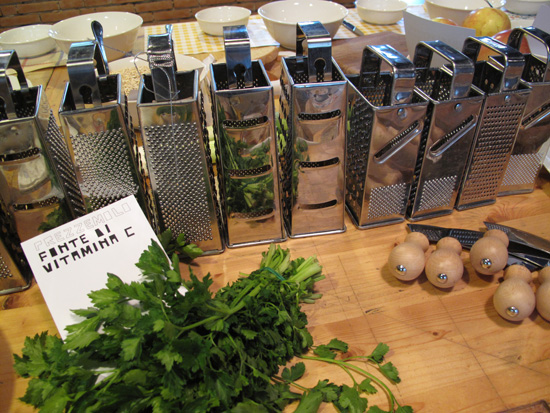
We were given limited, very loose guidelines.
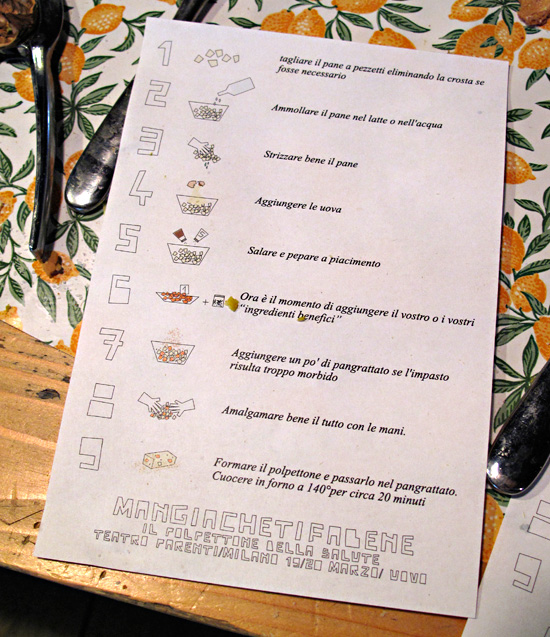
We each grabbed a plastic apron from the group taped to the window.
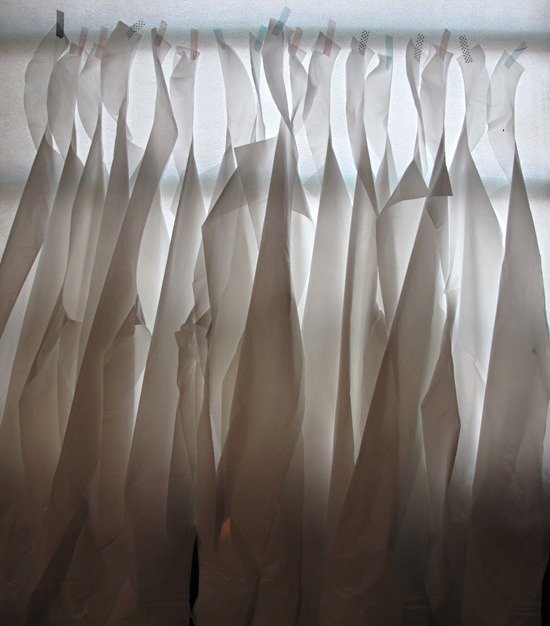
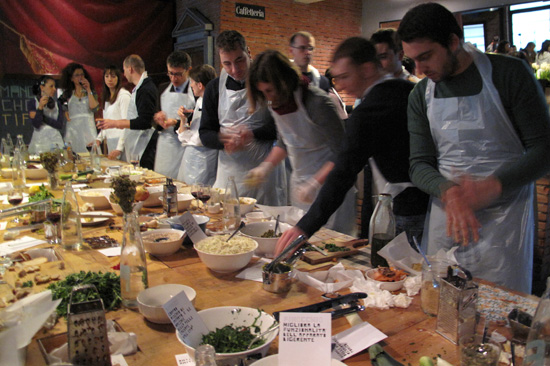
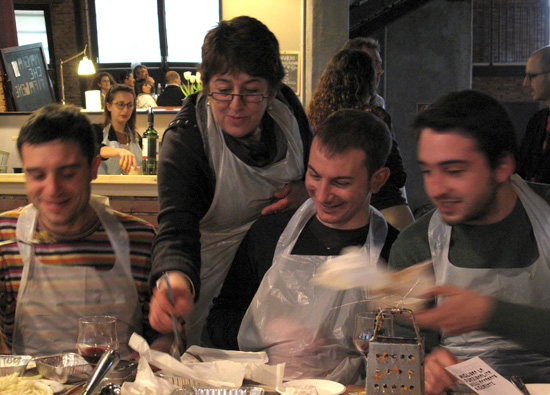
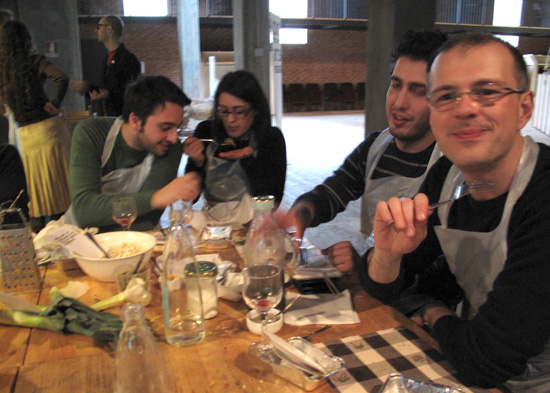
Our project was to gather whatever combination of ingredients we desired, blend them and put the mix into a paper-lined, 3″ x 5″ foil pan. The 30 of us were elbow-to-elbow at the table and we were being filmed. We had graters, sieves, knives, bowls, half-moons and cutting boards at our disposal. Notes were provided about the health-inducing properties of each food item.
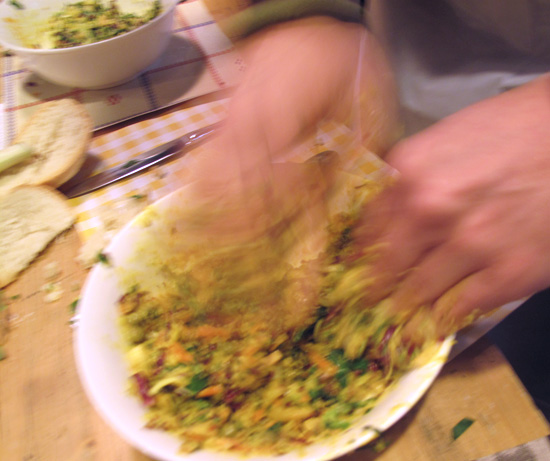
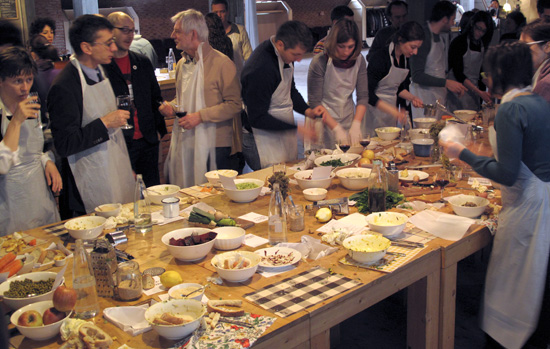
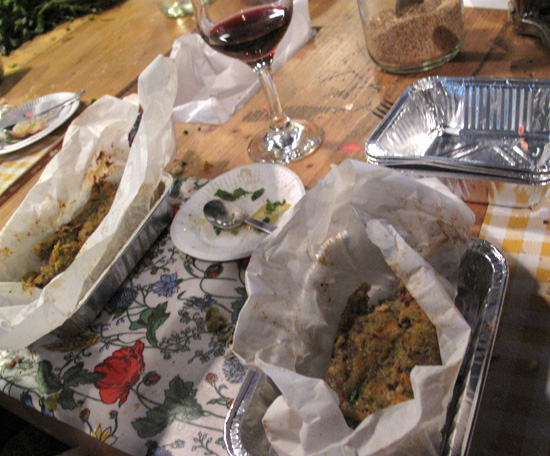
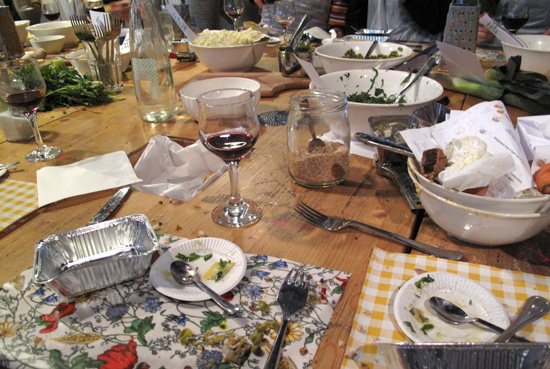
We asked for ingredients to be passed. We reached across the table. We laughed and chatted and mixed with our hands until our concoctions looked just right to us. Some pressed the ingredients through sieves for a uniform consistency. Others left chunks for spikes of flavor. Some formed loaf-like logs, while others patted their mix into flat casseroles. We bound up our creations in oven paper, scrawled our names on the wrap and sent the little tins off to be baked for 30-45 minutes.
While our dinners were baking, we were served lemon-slice salad, celery sticks with honey, and braised celeriac root. For our 10 euro, we also got a glass of red wine and some herb tea.
Trays of foil tins emerged from the oven, and the hostess called out names. One-by-one, the “performers”, the dinner guests, opened and tasted their creations. There were 30 recipes at the table. Like a groundswell, the sampling started. People reached over with their forks and sampled their neighbors’ meals, and everyone started passing their dish around for others to taste. It was remarkable the range of culinary directions we had each taken. I realized later that I could have gone in the sweet direction and combined bread, egg, apple, ginger, lemon and arrived at a dessert to contrast with all the savory gratins at the table.
I looked around, tickled, chuckling and amazed. Would this happen in the U.S.? Could it? How could I bring this experience to Seattle? To Burien? I easily tallied that the 30 people at 10 euros each only brought in 300 euros. And I looked at all the food, and the utensils, and the wine and thought that surely this was not a money-making proposition. In the U.S., liability insurance alone for a one-day event of this nature would probably be prohibitive.
And would people in the U.S. be willing to pass their dish for their unknown neighbor to sample from, and then fork a bite from their neighbor’s plate and relish the combination of ingredients different from their own?
This does give me ideas for an uncommon Thanksgiving dinner… but many in my family would likely balk at the idea. (But they wouldn’t be random strangers.)
– – – –
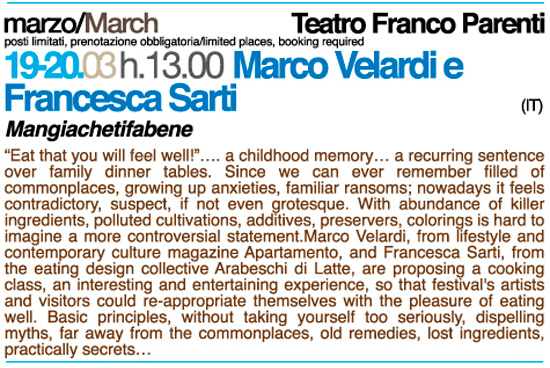
Here’s the official, “as advertised” description of the event:
The aftermath was a mess of a table!
by Maureen | Mar 17, 2010 | Discoveries, Featured Articles, Graphics, Journal, Photo of the Day, Photos
When here in Milano in the summer of 2008, I stumbled upon a Zucchi Store just a half block north of the Duomo. They sell lovely household linens (sheets and towels) and they had a curious display in the window. I didn’t understand what I was seeing, so I had to go in.
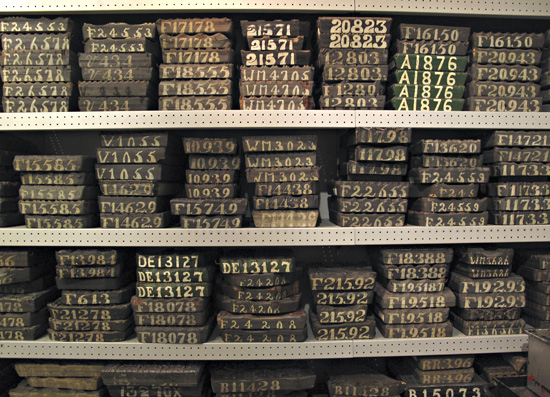
Emerging up through a very large, circular hole in the first floor was a towering stack of flat wooden blocks. What were the blocks? It was then that I found out about the Zucchi Collection of wood-and-pewter blocks for printing fabric.
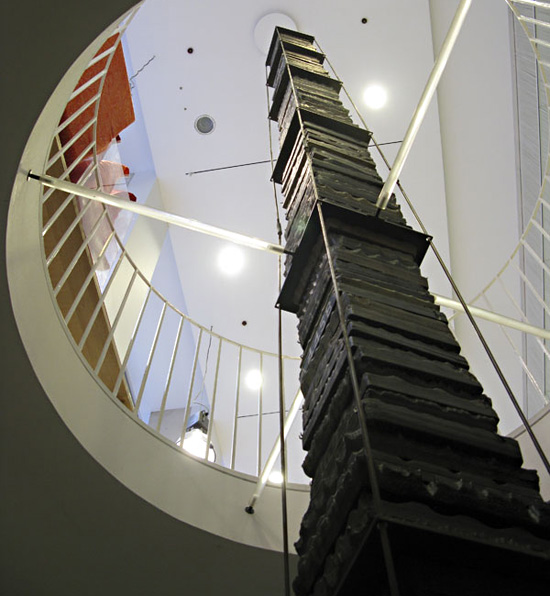
From the Zucchi Website: “The Collection’s 12,000 designs bear witness, over a period which spans three centuries from 1785 to 1935, to a fashion that was both varied and popular. Such tastes were apparent during one of the most energetic and fertile periods of European culture, which ended with the first stylistic experiments of the Art Nouveau and Art Deco movements.
“The Collection houses 56,000 printing blocks, an extraordinary number by any reckoning and one which presents concrete problems not only of space but also of storage in structures able to support the weight of many tonnes. The Collection is housed in three different storage locations: the Zucchi office in Casorezzo, the Via Foscolo location in Milan and a warehouse in Ossona.
“To make the Collection accessible not only to scholars but also to the fashion people, it was necessary to choose criteria by which the artefacts could be subdivided. The Zucchi Collection has been divided into six categories, which are identified in terms of iconographic forms: abstract, cashmere, floral, geometric, ornamental and pictorial. The Collection has been further subdivided according to the specific uses not only for the borders of the materials but also for foulards, bandanas, various ties, scarves and cravats, etc. A special data card, in computerised and paper formats, has been assigned to every series of blocks. Each of these contains various items of information about the handblock concerned, including the number of pieces which make up the structure, the design style it is capable of reproducing, its historical period and its origins. Attention has also been given to the question of conserving these structures and rightly so because the wood is sensitive material. The humidity and temperature levels require strict control and beeswax and turpentine must be applied to maintain the elasticity of the wood.”
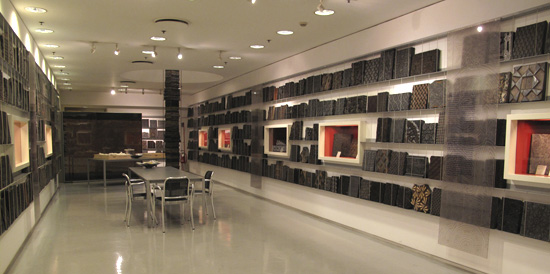
A mere fraction of the collection has been on display on the lower floor of the Zucchi Store, including floor-to-ceiling, wall-to-wall shelves holding the numbered wood blocks. (They are now in the process of moving these blocks to another location.) Note that some designs have 3-5 different blocks to create the full design. (They are all numbered alike.) Being a lover of textiles I was immediately enamored of the collection.
Fast-forward almost 2 years and now I’m living in Milano. Last Fall I found a curious and creative textile studio not far away named “L’Hub” on the Naviglio Grande, the “big” canal. One, they were selling vintage Zucchi linen and cotton dishtowels from the mid- and late-1900s. (Yes. I bought a bunch.) Two, they offer all sorts of creative textile classes including dyeing, sewing, construction, AND printing fabric with the centuries-old Zucchi blocks! Can you say “Sign me up!”?
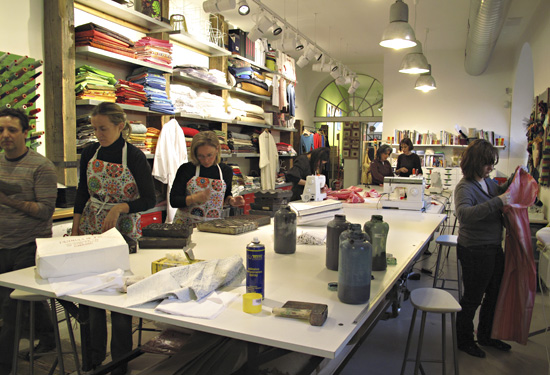
I enrolled in the 3-hour class held last Saturday afternoon, taught by artist Franco Duranti (at the very far left in the next photo). Among other things, Franco is a painter, engraver, and video artist AND since 2007, he’s been creating original works with the Zucchi wood blocks! Below is a photo of the working studio at L’Hub. Some women were taking a sewing class, while two other women were also taking the fabric stamping class.
I wanted “classic”. I had just seen the Frette Textile Exhibit a week ago. I’m enthralled by the traditional fabric handwork of generations past and am especially inspired by my Great Great Grandmother’s work, done at age 12 in 1861. She crafted a cross-stitch sampler in “Turkey Red” on cream-colored cloth, and that color combination has launched me ever since my Grandmother gave me the sampler in 1975.
On the neighboring streets (on that recent day when I was getting snowflakes in my eyes) I scouted fabric stores and came away with Italian, 100% Linen. I bought a meter of fabric and took it home to prewash.
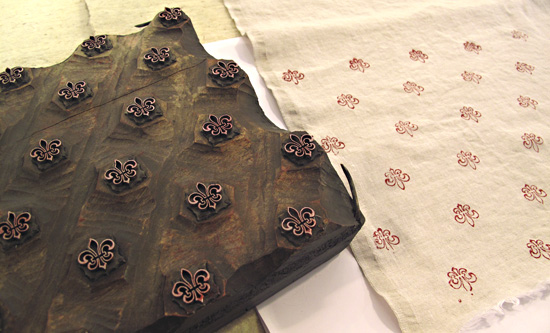
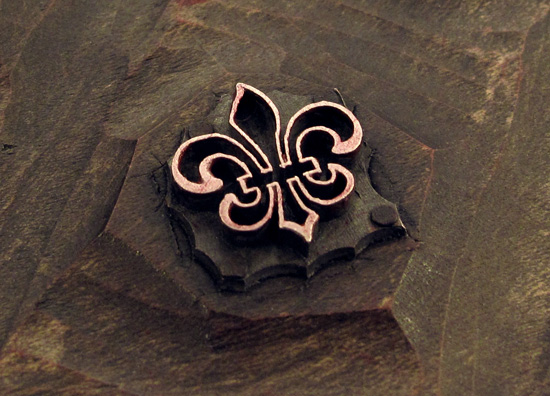
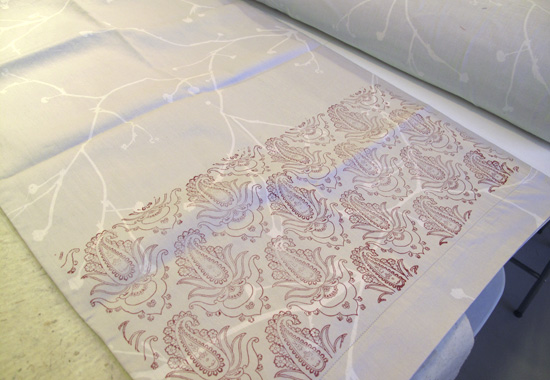
In familiarizing myself with the printing process, I chose a simple fleur-de-lis pattern printed in “carminio” – carmine red – on the linen. Note how, in this case, the block carries an “island” of cast pewter attached to the wood,
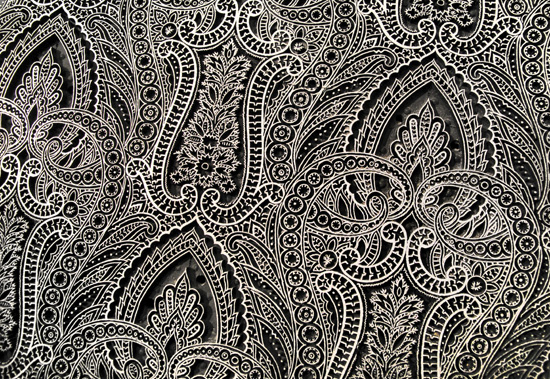
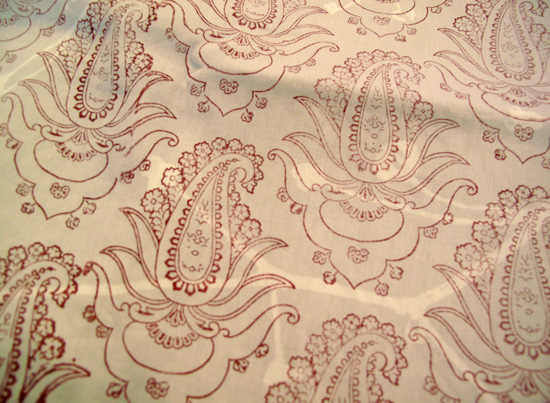
The following is an intricate, cast-pewter, paisley design from the “Cashmere” group of blocks in the collection. THIS makes my heart melt! Unfortunately, I was not able to print with this block, but printed with one I found that was as close as possible.
In gathering fabric for printing, I had also gone BACK to the Zucchi store downtown and they just happened to be having a sale! I bought two sets of sheets. One set is 100% cotton, satin finish with a subtle, printed khaki/cream pattern. I printed right over the top of the pattern to create a set of sheets like no other in the world.
I also paid a visit to the second-hand store 2 blocks away. I found white, cotton button-end pillowcases and bought all six at 2 euro each (about $2.75) When I got them home to wash them, I looked inside and noticed a… Zucchi label! Of course.
My plan now is to return to the L’Hub studio for a solo 3-hour stint to embellish the pieces I began, and to print even more.
As I wallow in Art and Design during my time here in Italy, I can’t imagine a more exhilarating addition to my list of design experiences than printing with the Zucchi handblocks at L’Hub!
by Maureen | Mar 8, 2010 | Introspection, Journal, People, Photos
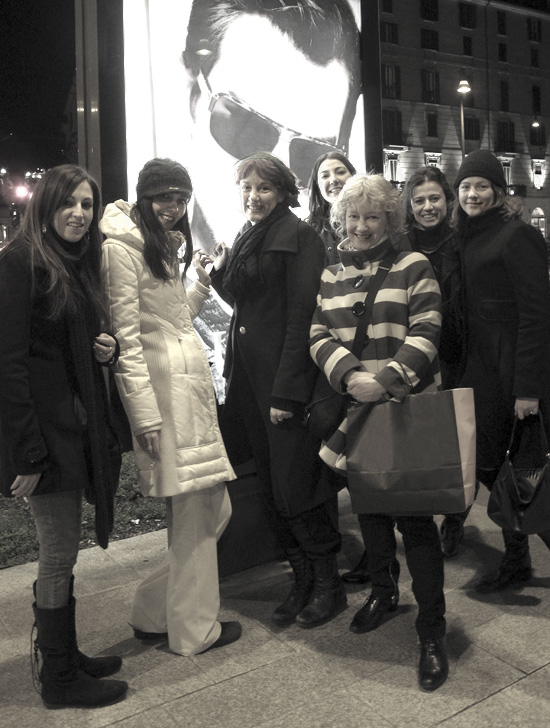
It’s been great fun to get to know the group of women from the schools here. Now and then, when a few of us are available, we’ll go out for aperitivi.
Here, from left to right, are:
- Keryn, from Australia
- Ashley, originally from the U.S. (but recently London)
- Anna, from Iceland. Now her parents are in Norway.
- Monica, from England
- Meltem, from Turkey
- Megan, from the U.S.
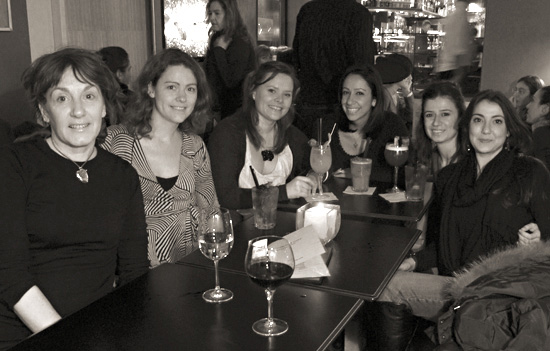
Later on, “Alex” and Ana�is arrived, both from France (seen at left, in the lower picture).
Community is created in many ways. I would recommend to anyone moving to a country with a different language, ATTEND A LANGUAGE SCHOOL UPON ARRIVAL! Classes provide social connection and language with which to step out into the community. It makes all the difference in the world.
by Maureen | Jan 9, 2010 | Cheese, Discoveries, Featured Articles, Food!, Journal, Meals, People, Photos
“Maureen, there are a few of us having some appetizers and wine. Why don’t you come join us?”
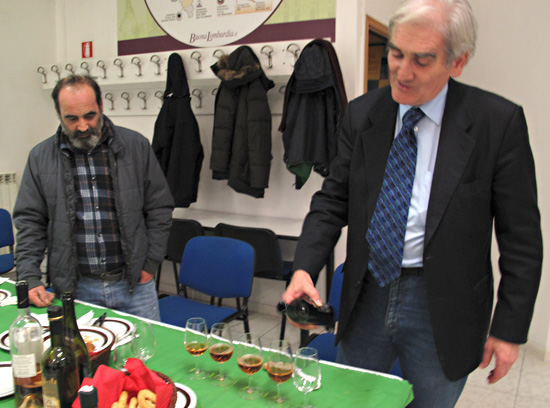
It was Mario, the regional director for ONAV, the National Organization of Wine Tasters. We had met a few times at their wine-tasting events: Prosecco-tasting, Barbera- and Barolo-tasting, Champagne-tasting. I’m going to attend their 9 week course in wine-tasting, beginning in February. Any of their gatherings, formal or casual, are opportunities to sample some diverse and very special wines… and meet new people.
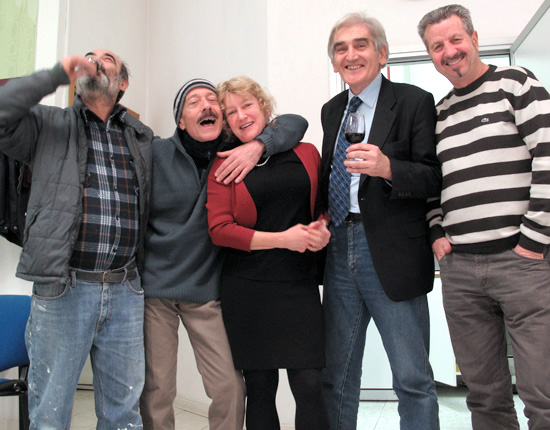
I took the Metro across town, walked two blocks and entered the ONAV classroom full of tables and chairs. These four guys – Michele, Vicenzo (giving me a choke-hold), Mario, Carlo – sat at a table cluttered with meats, breads, wine, oil and sweets. (The three are long-time friends of Mario, not with ONAV.) As you can see, it wasn’t a stuffy group.
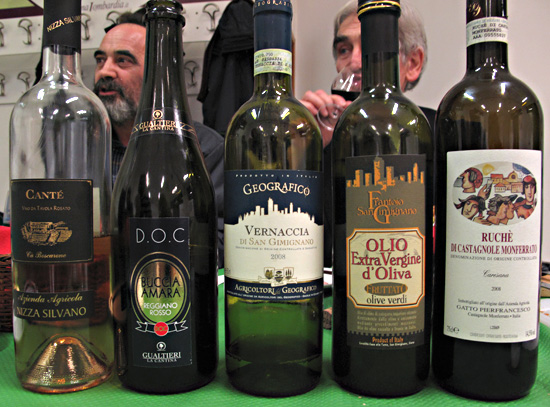
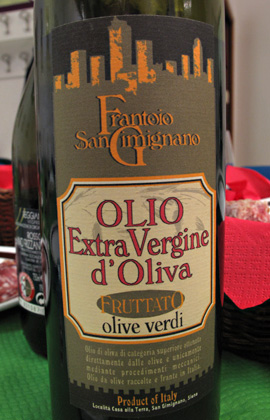
We sampled a number of wines and also enjoyed a tasting of Extra Virgin Olive Oil from the San Gimignano region.
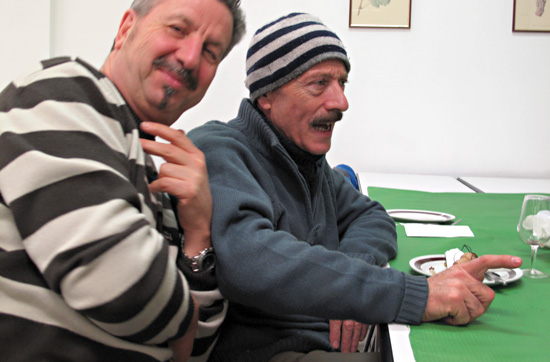
I didn’t realize until afterwards that I should have gotten a photo of Carlo in his striped sweater, with Vicenzo in his striped hat and me in my striped coat. It would have been a highly-visual photo. (Vicenzo asked if I know of any American women I could set him up with.)
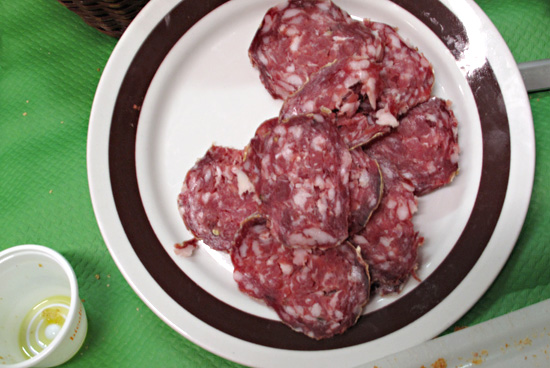
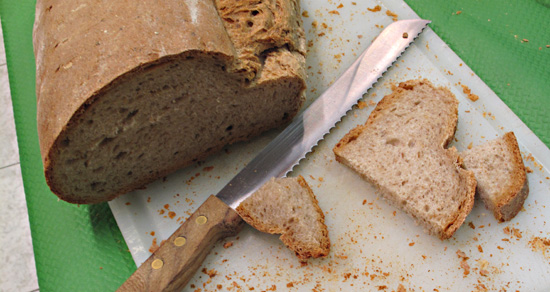
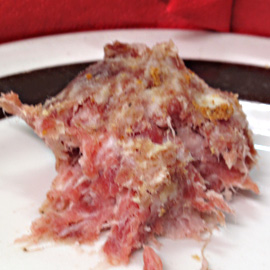 The table bore mortadella, salami and a raw, seasoned meat/fat combo that Mario simply peeled the casing off of and spread on bread. (I know the photo’s out of focus, but at least it gives you an idea of the meat’s appearance.) We ate from a large rustic loaf, a potato loaf, and Sicilian bread sticks and rounds.
There was a bone-white spread of pecorino and ricotta cheeses pureéd together. And a special treat was the “Lardo di Colonnata”, raw, salted, herbed pig lard, aged at least six months and served as thin slices on bread. Mmm, good!
(I’ve become quite fond of eating raw meats and moldy cheeses.)
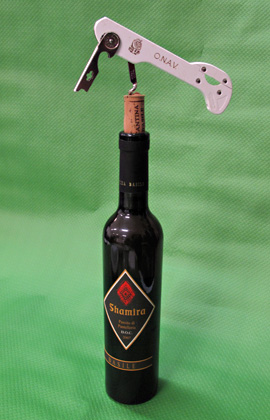
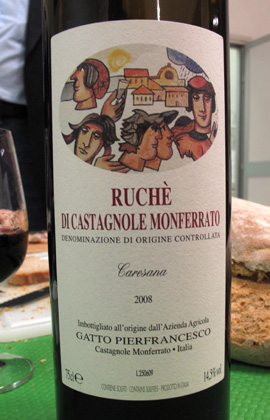
We drank a sparkling red, a white, a rosé. The most “startling” wine was the deep red Ruché (Roo-kay); I had never tasted anything like it with its very distinct flavor. (I’ll have a better vocabulary to describe it AFTER I take the class.) You could ask for Ruché* at your local specialty wine shop, but its very low production makes it unlikely that you’ll find any.
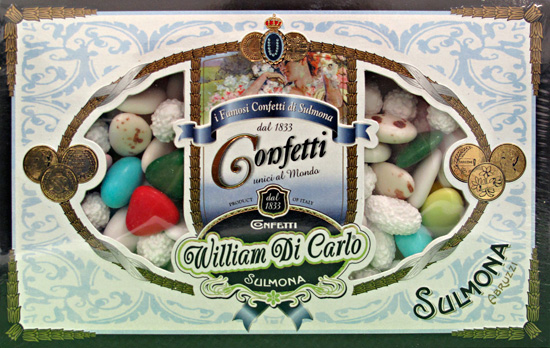
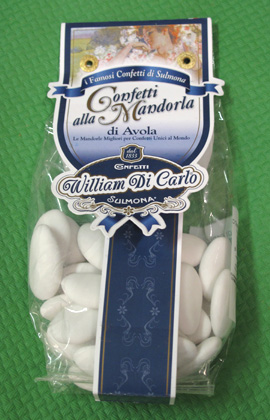
Our little post meal sweets were dried figs and apricots from Sicily, and almond pastilles that are frequently offered as favors at weddings. (In the States, too.)
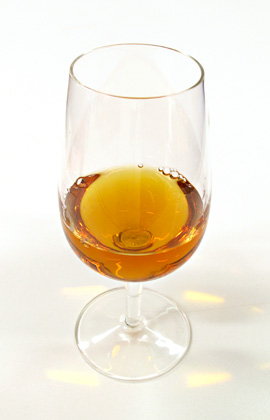
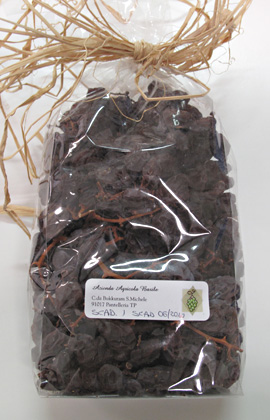
The very special end-note to the evening was a wonderful Passito di Pantelleria from the tiny little Island of Pantelleria, Italy, between Sicily and Tunisia. Passito, made from dried and shriveled moscato grapes, is a gorgeous amber color and a drink that requires every sip to be savored. I couldn’t keep my nose out of the glass; the scent was divine.
Below, on the right, is a bag of the not-fully-dried, shriveled moscato grapes used for making passito. You can eat them much like raisins.
Ruché (from Wikipedia):
Ruché is a red Italian wine grape variety from the Piedmont region. It is largely used in making Ruché di Castagnole Monferrato, a small production red varietal winewhich was granted Denominazione di Origine Controllata (DOC) status by presidential decree on October 22, 1987. The current DOC recognized area of production for the wine, covers only about 100 acres [[40 hectares) of vines around the villages of Castagnole Monferrato, Refrancore, Grana, Montemagno, Viarigi, Scurzolengo andPortacomaro.[1] Ruché di Castagnole Monferrato is, therefore, one of the lowest production varietal wines in Italy. The grape is also grown to some extent in the neighboring province of Alessandria.
There is some debate about the origins of the Ruché grape. One theory is that the varietal is indigenous to the hills northeast of the town of Asti. Another theory is that the grape is a local variation on a French import. It has been grown in the area for at least one hundred years but has only recently been marketed and consumed outside of the immediate vicinity of its production. Ruché di Castagnole Monferrato tends to be medium bodied with notes of pepper and wild berries and floral aromason the nose.[2] The wine is often characterized by moderate acidity and soft tannins. In the Piedmont region it is often paired with slow-cooked beef, northern Italian cheeses and mushrooms.
by Maureen | Jan 1, 2010 | Featured Articles, Journal, Paris, People, Photos, Travel Blog
New Year’s Eve. “Capodanno” they call it here. Fireworks are going off in the distance.
Having just come back from the energy of Paris, I don’t feel compelled to go downtown tonight, but will follow my tradition of spending the evening writing. Part of that act is the reflection on the past year, and for 2009 the novelty is in the last 6 months, since I moved here to Milano in June.
When I decided to move here, I very consciously wanted to have relationships. I wanted to form friendships and know people. I didn’t want to remain on the outside surface, as tourists do, but rather touch hearts and have mine touched. I left behind my treasured communities in Seattle, and came here where I had none.
Reaching this 6-month mark, I started to think about all the people I’ve gotten to know in big ways and small. I see people at school. At some of the stores I frequent. I’ve met some while traveling. And now, even see familiar faces while just out walking in the neighborhood. I’m creating what I wanted!
Allow me to introduce you to some of the many people I’ve either enjoyed a single, rich conversation with, or have had the pleasure to create a friendship with:
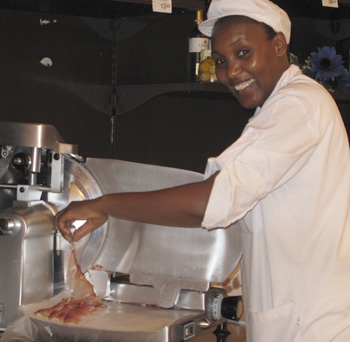
JUSTINE – Kenyan. I met Justine soon after I arrived and now I shop at that store a mile away just so I can say “hello” to her. Here she is cutting prosciutto for me.
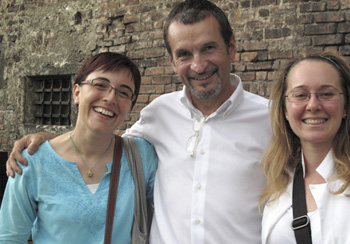
EVELINA, BRUNELLO & GLENDA – Italian. These are the three I work most closely with at NABA.
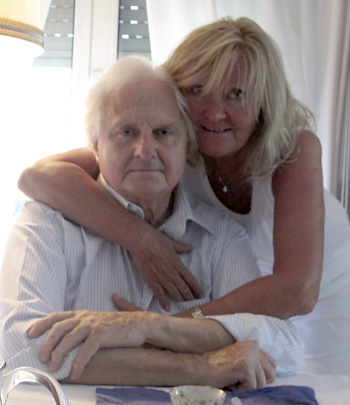
PIOTR & EWA – Polish-German and Polish. We met in the summer when our tables were an inch apart and I was eating octopus. We’ve been getting together once a week or so ever since! Eva is a Pharmacist and Piotr is a retired conductor from Teatro alla Scala.
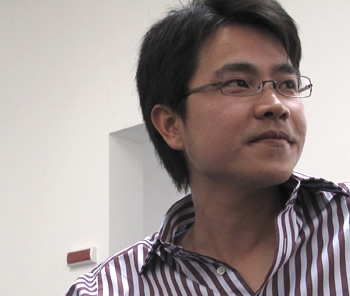
NARIN – Thai. Architectural faculty member from Chulalongkorn University in Bangkok.
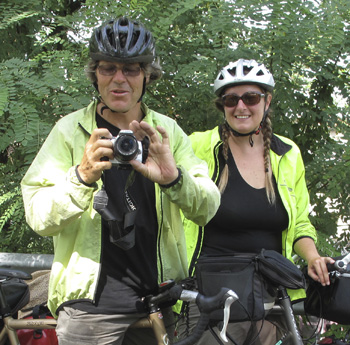
PETE & ERIN – Australian. We met on the bike trail in the morning, and they slept on my fold-out bed that night! They were biking around Europe for 6 months and relying on the kindness of strangers.
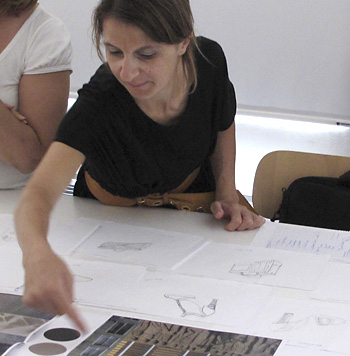
ORIETTA – Italian. Concept researcher and trend forecaster in fashion and accessories. An instructor at NABA.
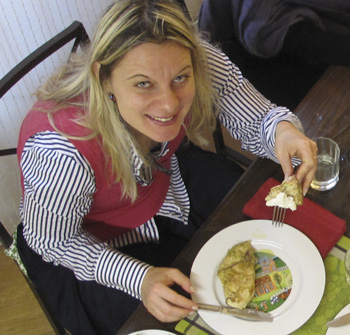
LYDIA – Swedish. Lydia makes the way smooth for NABA’s agents.
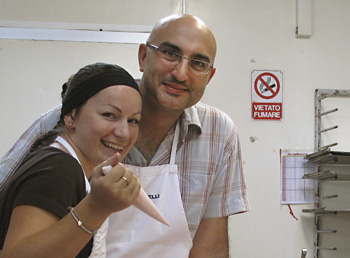
DOMENICA & PAOLO – Italian. They have the Spezia Pasticceria that creates those incredible pastries I’ve shown. They’re two blocks away from me, and we met when he did a search on the pastry shop and found my blog. They make the best pastries in town.
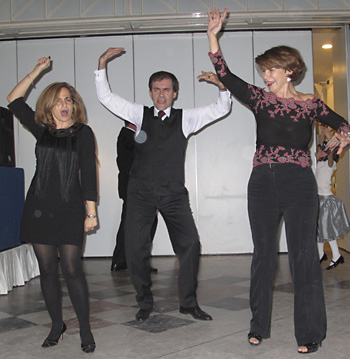
ANASTASIA, EMANUELE & ENCARNA – Greek and Spanish. Emanuale is the Consulate General of Greece. We shared a table and the dance floor at the Thanksgiving Dinner.
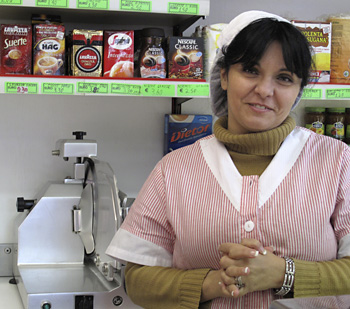
ENZA – Italian. Born in Sicily, raised back-and-forth between there and Australia. She and her husband own the corner grocery where I buy my water, and we chat.
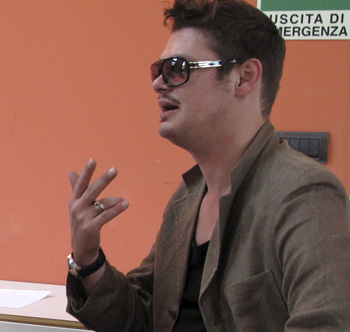
TOMA – French, but has lived in Italy for years. He’s established in fashion and teaches at NABA.
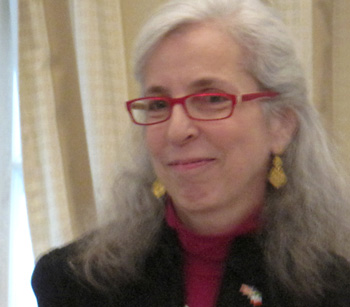
BARBARA – President of the Benvenuto Club.
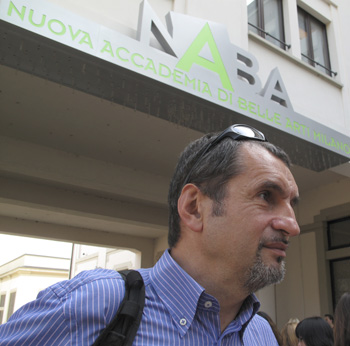
BRUNELLO – Italian. Vice President of NABA.
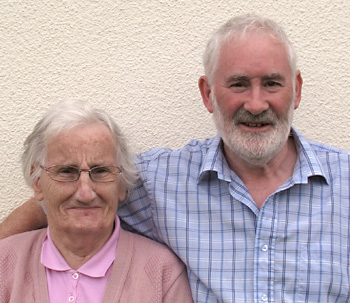
LILY & TOM – Irish. My cousins from my family’s historic homeland in Fermanagh County, Northern Ireland.
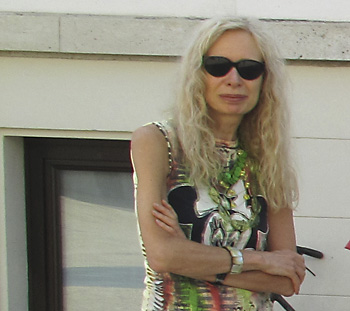
LEE – British, but she’s been in Italy a long time. Lee’s been working in fashion for about 30 years. She was my Fashion Design instructor in 2008 at NABA.
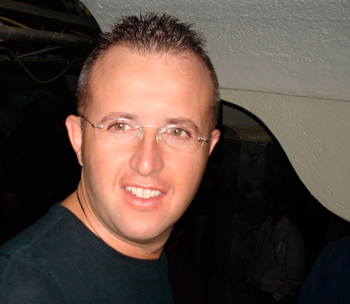
CIRO – Italian. A One-man Chamber of Commerce for the town of Casamicciola on the Island of Ischia.
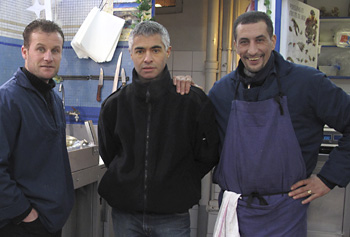
SAM, PATRICK & MOMO – French and ? These three are fishmongers down the street from my hotel in Paris. Patrick, in the middle, speaks some Spanish, so between that and sign-language, we all had some laughs.
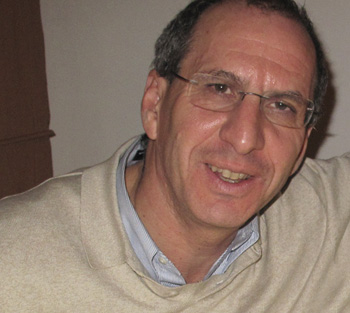
DAN – American. From Ohio University, working with NABA. Executive Director and Professor of Geography.
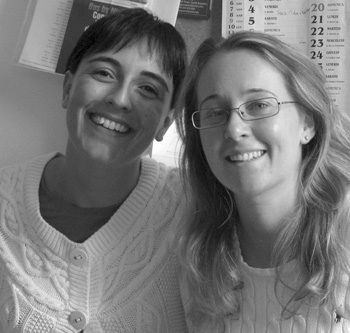
EVELINA & GLENDA – Italian, though Glenda lived in the U.S. for 8 years. These two coordinate the myriad details of the NABA summer and semester programs.
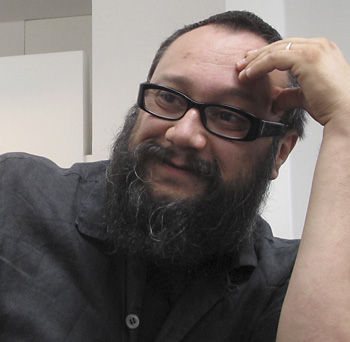
LUCA – Italian. We’ve discussed “Italian Design Methodology” and the differences in teaching methods between Italian schools and U.S. schools. Luca is NABA’s Design Program Coordinator.
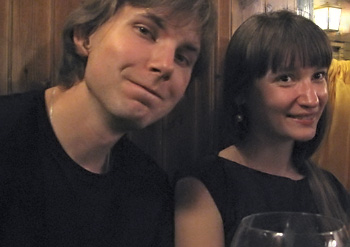
DIMITRI & VERA – Russian. Architects, instructors at NABA.
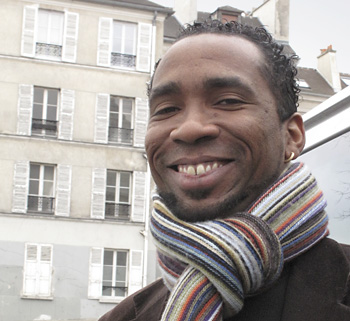
ENIEL – Cuban. Moved to Paris 5 years ago and speaks some of 5 or 6 languages. Loves history and was my personal tour guide in Paris.
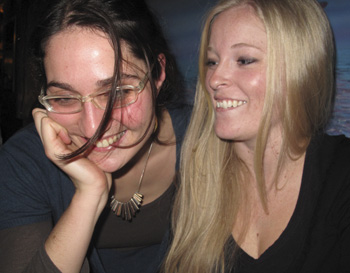
MADALENA & EMILY – Italian and Australian. Madalena lives in the mountains near Milano, and teaches Italian language courses. Emily is a student in my class.
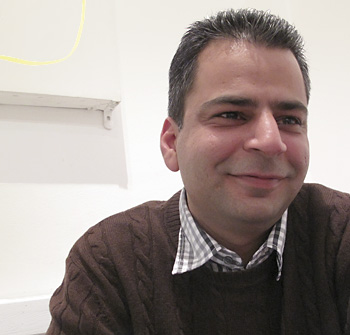
AHMAD – Pakistani. Living in Venice and assisting his brother with his restaurant, “Noemi”.
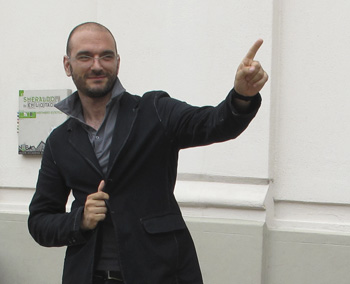
FRANCESCO – Italian. Architect and instructor at NABA. He’s engaging and involved with the students.
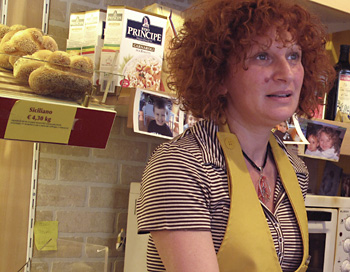
GISELLA – Italian from Sicily. She has a Siciliano bakery just down the street. Sometimes I’ll buy little regional specialties from her.
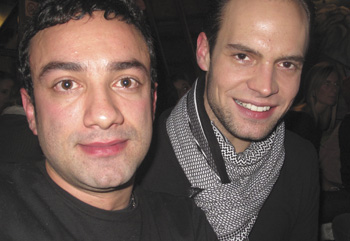
HASSAN & SEBASTIAN – Iranian and German. We’ve been in Italian language classes together.
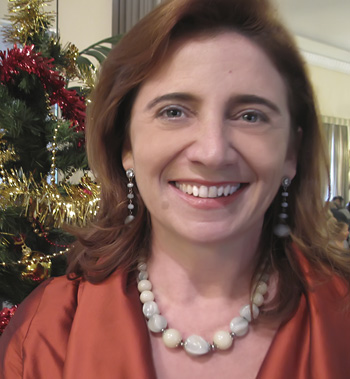
IDA – Italian. We met at the Benvenuto Club Christmas Bazaar, which is a fund-raiser for several local charities.
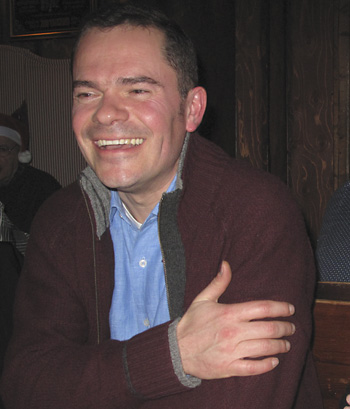
JAMES – British. He’s opened up a shop here selling textiles and is taking Italian language classes, too.
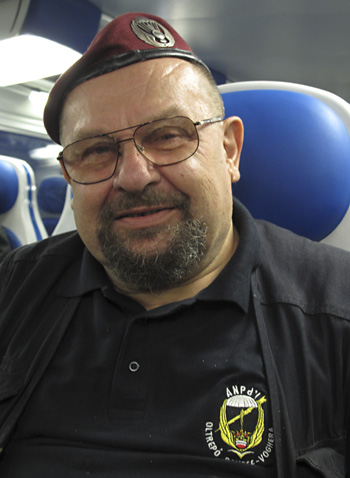
ROLANDO – Italian. We met on the train to the airport. I was on my way to Seattle. He was on his way to an EU gathering of parachutists from 10 different countries. He was in the Army in the mid-60s. He pulled B&W photos of his father out of his suitcase to show me.
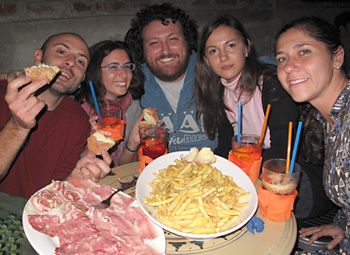
MARZIA & FRIENDS – Italian (Sicily), Russian and ? Marzia’s on the right and after we had gone out for “apperitivi”, we met up with her friends at another restaurant. Marzia is also with NABA.
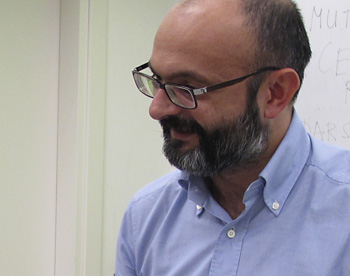
REMO – Italian (from the south). A Materials Engineer. We’ve had some good conversations and I sat in on some of his design classes at NABA and accompanied them on field trips.
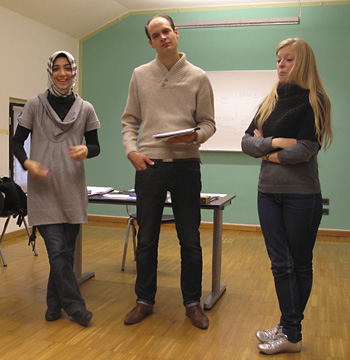
OZDAN, SEBASTIAN & EMILY – Turkish, German & Australian. In this photo, they were doing a skit in our Italian language class.
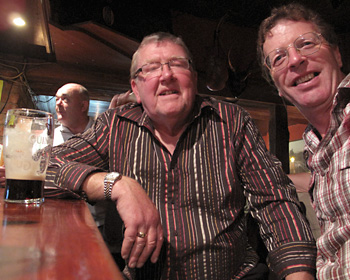
NORM & JOE – Irish. My Guinness drinkin’ buddies in the far northern reaches of Ireland.

JAN – Norwegian. He got talked into wearing a “Babbo Natale” hat at the Scuola Leonardo language school’s Christmas party.
by Maureen | Sep 2, 2009 | Ireland, Journal, Quips
I know. Long time no post… I haven’t posted much in the week since I got back from Ireland even though I have a hundred ideas of things I want to write about and post photos of! Oh, the images! Stone Circles, Malin Head, Crana Knits, Crockawaddy Glebe, Thatched Roof Houses, Old Stone Buildings, the Fermanagh Tour, Grianan Ailigh, Distant Cousins, Great-Grandma’s Birthplace…and “The Road to America”! (And all of those things mean nothing until I actually SHOW you!)
And then there are the 7 HUGE muskrats I saw along the canal the other day when out for a ride. They weren’t river otter at all like I had originally thought. There was one granddaddy muskrat twice as big as my head!
The “Italian Contemporary Society”, “History of Design” and “Italian Language” classes at NABA have to be wedged in there somewhere, too! The Fall 2009 Semester began this week and it’s great to see people back on campus, and to see Milano lively again. It got awful lonely around here in the month of August.
But, you know…there’s such a thing as WORK! First things first.
by Maureen | Jun 30, 2009 | Featured Articles, People
The opening of NABA’s Summer Session! The campus is abuzz with the anticipation of 85 new students here for two- and four-week programs. They will study Fashion, Graphics, Photography, Interiors and Product Design. They will volley their ideas across the courtyards. NABA students will collaborate in their classrooms, chat over lunches and take their curiosity out into the city. They will mine Milano for all the sustenance and inspiration it offers.
The vitality and energy of this community adds a charge to the air. There is palpable, creative expression around campus. Faculty members bring their passions to the classrooms and staff share the enthusiasm.
For those ardent students, relentless in their desires to learn from everyone and everything around them, how could there be a richer sweet spot to occupy? NABA feeds the voracious student.
1st Session:
June 29th to July 10th
Introduction Level
Introduction to Interior Design
Introduction to Product Design
Introduction to Graphic Design
Introduction to Fashion Design
Introduction to Fashion Marketing
Introduction to Fashion Styling
Introduction to Fashion Accessories
Intermediate Level
From Haute Couture to Pret-a-Porter: Paris/Milan
Lighting Design Studio
Landscape Architecture Studio
Advanced Level
Costume Decoration and Painting
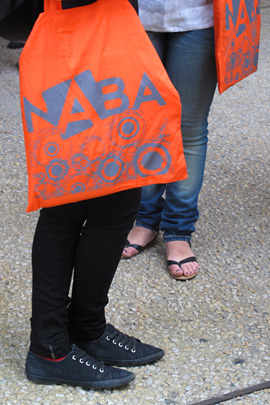
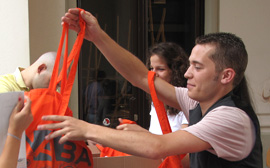
Each student received a “Welcome Bag” filled with an International Student’s Guide, maps, schedules and student resources.
2nd Session:
July 14th to July 24th
Intermediate Level
Interior Design Studio
Product Design Studio
Fashion Styling Studio
Fashion Accessories Design Studio
Fashion Journalism Studio
Fashion Merchandising Studio
Fashion Photography Studio
Fashion Textiles and Fibres Studio
Graphic Art Design for Fashion Studio
Photography and the Moving Image Studio
Advanced Level
Jewellery Design for Costumes
4-week session:
June 29th to July 24th
Advanced Level
Digital Set Design
4-week session:
June 22nd to July 3rd
Advanced level course in Theatre Lighting Design
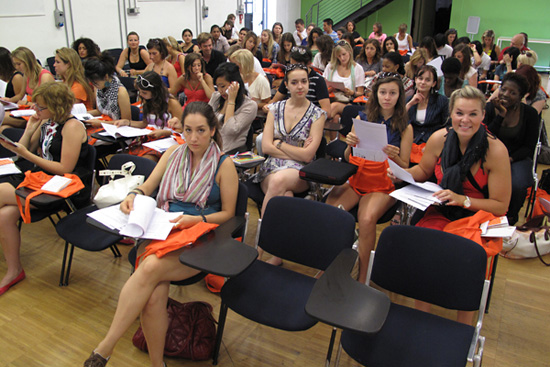
NABA students gather for the Welcome & Orientation Presentation.
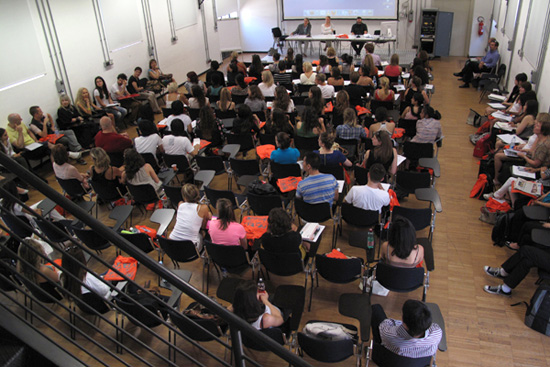
Students were oriented to the school, its services and surroundings and the City of Milano.
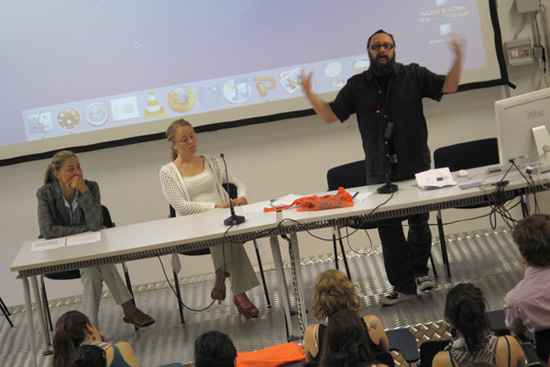
Luca Buttafava, NABA Special Programs Coordinator, along with other faculty and staff, encouraged students to embrace the richness offered here in Milano, and charged them with the excitement of design.
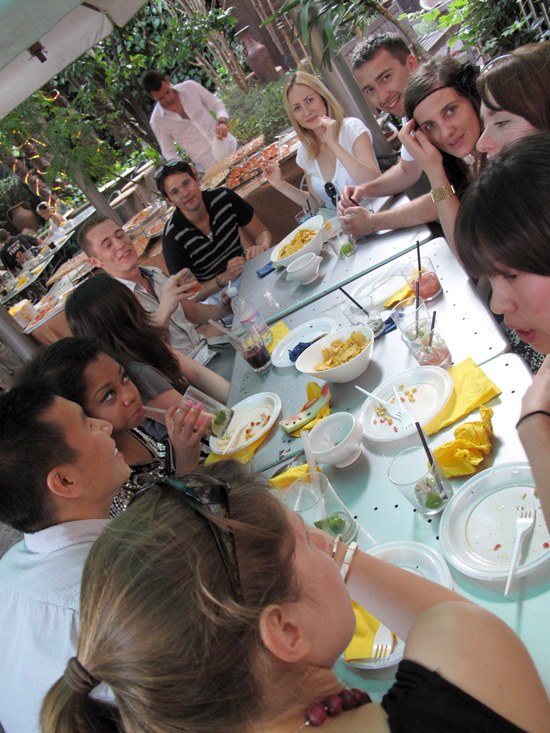
Students were hosted at an end-of-the-first-day “Apperitivi”, a casual mingling party with food and drinks so the students could get to know one another.
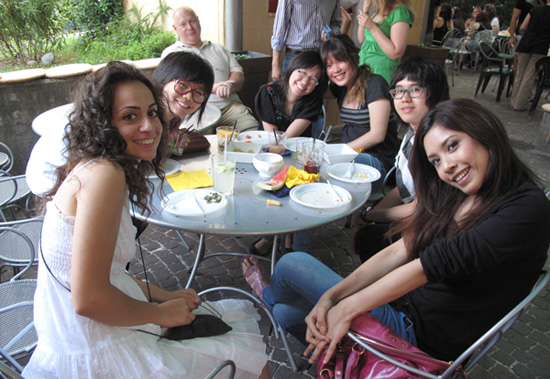
A group of students from Chulalongkorn University in Bangkok, Thailand, enjoy the apperitivi party hosted by NABA.