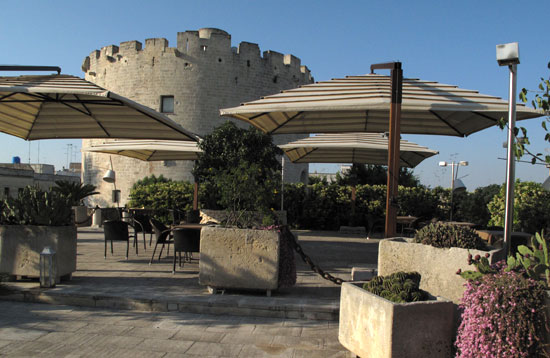
In 1419, when they built this castle, they weren’t planning ahead for wifi reception in the rooms. Three-foot thick stone walls don’t lend themselves to today’s wireless technology. I’m staying at Torre del Parco, in the town of Lecce, in the region of Puglia, almost at the very tippy-tip of the “heel of the boot”.
I arrived in the late afternoon, after 7 hours on trains, then took off walking into the historic center for dinner and a stroll on what turned out to be a balmy evening.
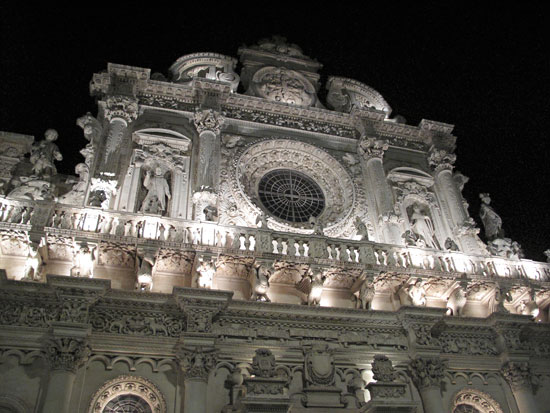
The Basilica di Santa Croce was brilliantly lit against the night’s deep sky.
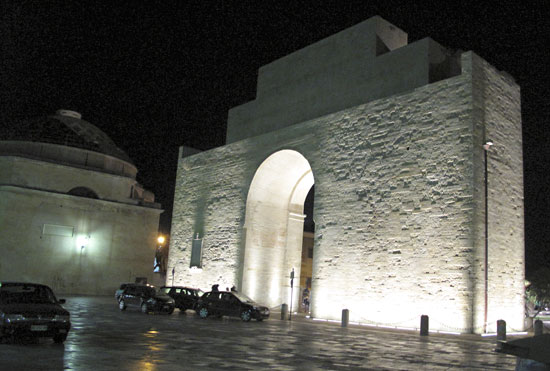
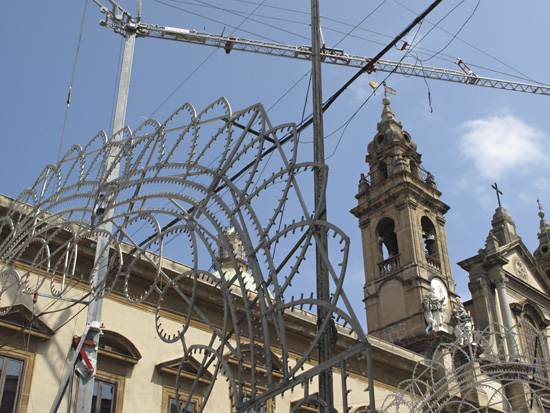
Porta Napoli (Arco di Trionfo) is in such stylistic contrast the the rest of Baroque-laden Lecce!
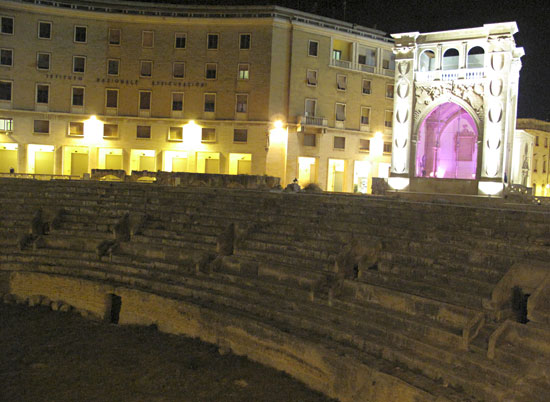
Lecce’s contemporary town square surrounds a Roman amphitheater, half of which is still buried under the church, Santa Maria delle Grazie. The Church of San Marco stands at its side. (I think that every city should have a Roman amphitheater smack in the middle of it! They have concerts and theater performances in the elliptical ruins during the summer months.)
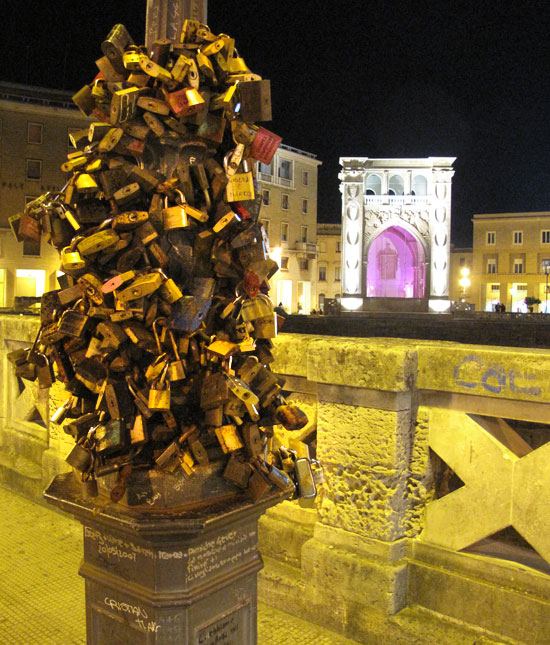
Lovers’ locks and the pink arch.
Now I’m sitting in the castle lobby (do castles have lobbies?) 8 feet from the Mac on the reception desk. HERE I have wifi! But if my communications in the next few days are sparse, you’ll know one reason why.
From Lecce I’m going on to Alberbello to stay in a traditional stone hut, a “trullo“. They probably didn’t build those with wifi reception in mind either.
Gee. This is the most “unplugged” I’ve been in a long time!
Training along the Ionian Sea shoreline: Red poppies. Cactus. Olives & grapes. Palms & pines. May is a lovely, ideal time to be traveling here, sunny, pleasantly warm. A breeze from the sea and no mosquitoes. But I look out and can imagine the late-summer heat and its sweaty days. I can conjure the oppressive closeness of the Mediterranean humidity and the desire for cold water and moving air. This late spring is a golden time for citizens to savor.
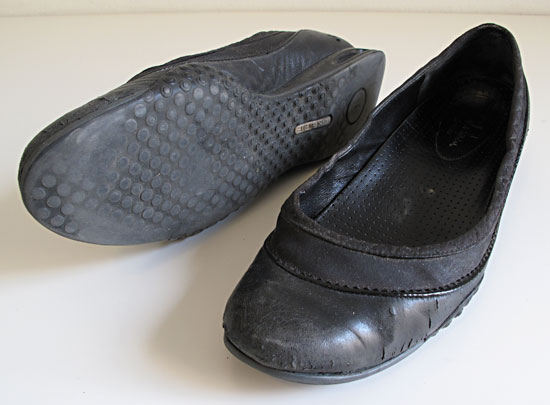
These old shoes have been through a Venetian deluge in San Marco Square, and foot-swelling heat in the Roman Forum. They’ve taken me on the Via dell’ Amore dirt trail in the Cinque Terre and the Via Montenapoleone high fashion district of Milan. I’ve worn them with skirts and dresses, pants and shorts. On the beach and in business meetings. They are both slippers and dance shoes.
I’ve logged many kilometers in these old shoes, and by the time I finish this journey, they will have walked me through 12 of Italy’s 20 regions, plus taken a train ride through 4 more.
I bought these shoes for my first trip here in 2008. They are a Cole Haan, black, flat, ballerina-style with Nike Air soles. They cost about $140 and I’ve more than gotten my money’s worth! Women’s shoes usually have little support or cushion, and to find a comfortable shoe that also has a classic style is difficult. I recently found another pair of the same shoe – in muted olive – but since they’re not broken in, I left them behind in Milan for my time there.
Three days ago, halfway through my time in Sicily, I noticed that the sole was starting to peel away from the right toe. Uh-oh! Yesterday in Catanzaro, I found a little hardware store – una ferramenta – described what kind of glue I needed, and bought a tube of super-duper Bostick. I glued the toe and wedged the shoe in the dresser drawer of my presidential suite hotel room, to clamp the shoe as it dried. A little glue. A little polish… Good as new. Maybe they’ll see me through the other 4 regions before I retire them.
– – –
22 May Update.
I just photographed my dear, old shoes and looked at them really up-close-and-personal. I think it’s time for them to go to the great shoe heaven in the sky. They are REALLY worn (and they’re very slippery on wet cobblestones)!
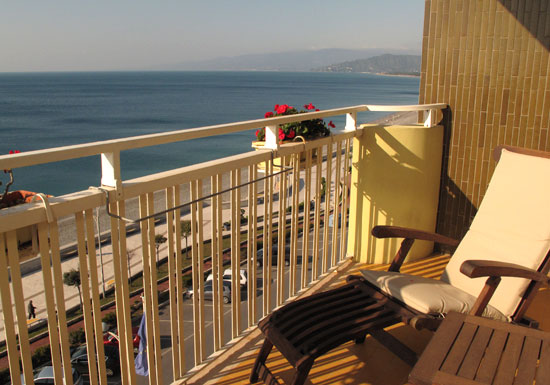
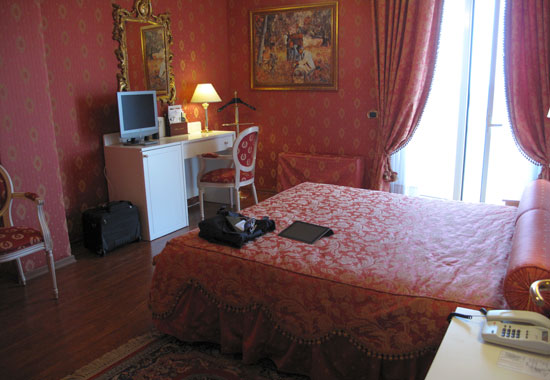
It’s no joke that I’m in the “presidential suite” at the Palace Hotel, in the region of Calabria, the town of Catanzaro Lido. The waves of the Ionian Sea are rolling in just off my private balcony. I could throw a stone (hard) and it would land in the water, on the other side of the Via Lungomare – the road along the sea. I will sleep with the sound of incoming saltwater tonight.
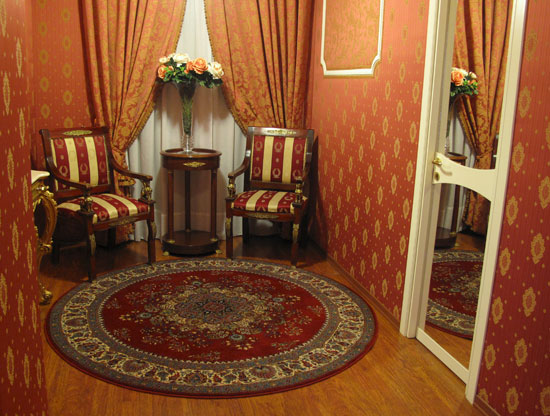
When one “leaves their options open” or “plays it by ear” sometimes there aren’t many options left, thus, the Presidential Suite, with it’s brocade-clad, padded walls. But after the raucous three nights in Cefalu and Taormina Sicilia, I needed some quiet and something unlike Disneyland.
Last night I slept a much-needed, holy sleep. Today I amused myself with exploration. First thing, I went to the little travel agency next to my hotel to buy my ticket for a long train ride tomorrow. At the agency, I met Valentina and Aurelia, and a man they know from Naples. We all laughed and talked for half an hour and it was the kind of personal connection I needed. (When I returned to my room tonight, Aurelia dropped by a beautifully packaged gift of some homemade soppressata. How dear! I happened to have brought some “Seattle Spices” along with me in case I needed a gift, plus some personal note cards, so I wrote out some notes to the two women and stopped over to drop them off.)
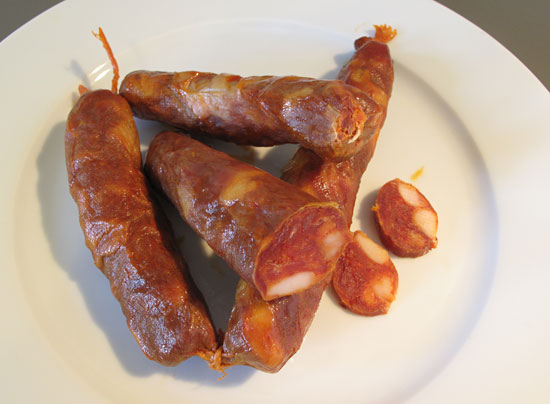
Aurelia’s Soppressata is delicious, with a slight smokey flavor:
After the travel agency, I hit the road… and then stood there. I found the newsstand where I could buy a city bus ticket, then I found the bus stop and asked a young guy if I was in the right place to go to the city of Catanzaro (the part up on the hill). I was at the right stop and the bus was “10 minutes away”. Hopeful and anxious passengers started gathering, and waiting, and complaining. Congested traffic on narrow streets in Catanzaro Lido was almost comic. (Imagine two cement mixers passing each other! They did so in the extra width of an intersection, likely well-practiced.)
As I waited with everyone else, I was pleased that I was having a snippet of REAL daily life of a Catanzaro citizen. (There wasn’t a tour group in sight.) An hour after waiting, I got on the bus with just a small, general map of the two Catanzaros, and absolutely NO idea where I was going, what I would see or when I would get off. How lost could I get? I could always get a cab if it came to that.
I marvel at the systematic chaos that is traffic in Italy, and especially here in the south. It all seems to work, but slowly. There are very few stop lights and much bravado, and it took forever for the full-size city bus to make it through Catanzaro Lido. We stopped at the train station, then through little pocket towns like beads on a string that seem to comprise greater Catanzaro.
We kept winding up toward the hill top. What was I looking for? People. Curious sights and signs. Something to catch my eye. History. I could find the duomo – cathedral – on my little map, but couldn’t determine where we were in relation to each other.
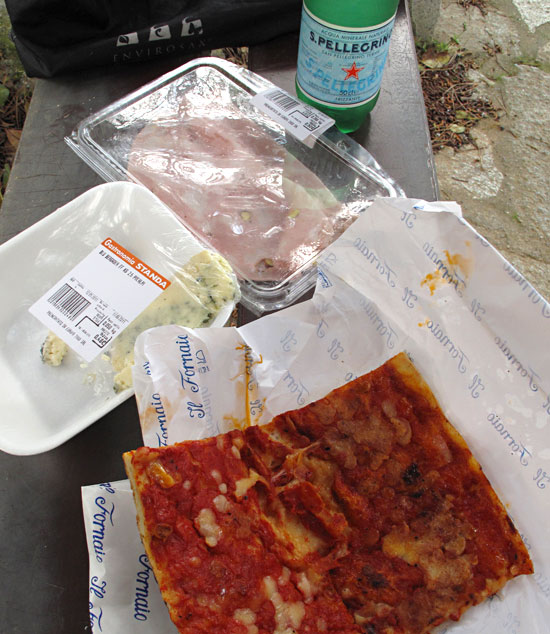
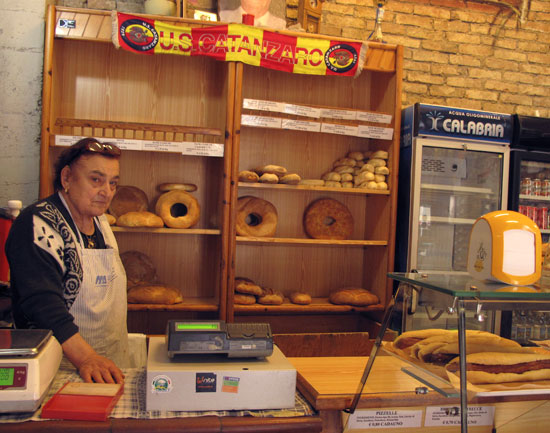
I rode until the near-northernmost point of the city and got out at lunchtime. In a little grocery, I bought toothpaste, shampoo, 50 grams of mortadella and a sliver wedge of some lovely blue cheese. At the neighboring baker’s, I bought a square of focaccia with tomato sauce, which they heated for me. I carried my stash through the city amidst 10-story apartment buildings and scrawny, stray cats, and found a little park bench in a windy spot. I lay the meat and cheese onto my focaccia, folded the whole thing in half and had an amazing sandwich, washed down with San Pellegrino.
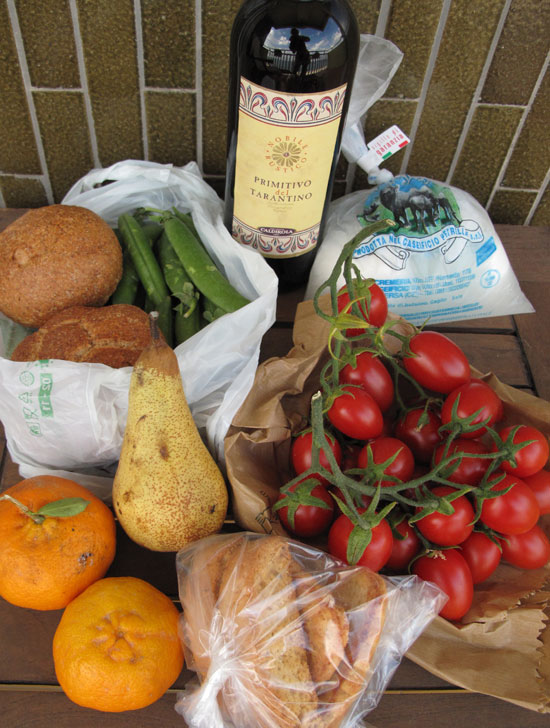
Since it had taken nearly 2 hours to get UP to the top, by 3:00 I figured I’d better start heading back down to the hotel. It was a quicker journey somehow, and I got off at the west end of town to walk, look, shoot and shop for dinner and my train lunch tomorrow. It’ll be a 7-hour journey tomorrow, with one shuttle ride, three coarse, regional trains and two quick train transfers. There’ll be no time or place to buy food, so this afternoon I stopped at the bakery for a couple of fresh rolls, at the meat shop for fresh buffalo mozzarella, at the produce vendor for fresh peas in-the-shell, datterini tomatoes, two mandarins and a pear, and the pastry shop for a couple of biscotti. That ought to be a lovely train lunch!
How did I pick Catanzaro in the first place? I was in Sicilia and just had to get out of Taormina. I was heading east to Puglia and Catanzaro was in between. It’s also the hometown of my first Italian “professoressa”, Enza. And… quite simply, I was able to find a hotel room available.
Tomorrow, from the ball-of-the-foot here in Calabria, to the heel in Puglia.
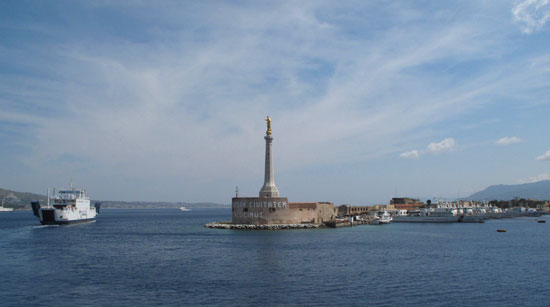
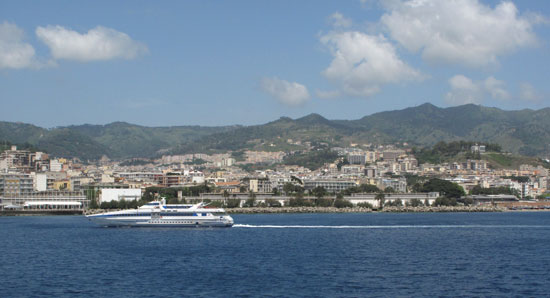
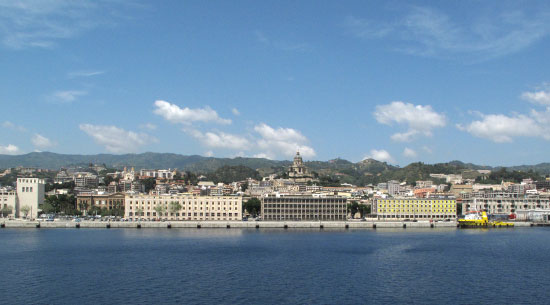
Haven’t you always heard of “the straits of Messina”?
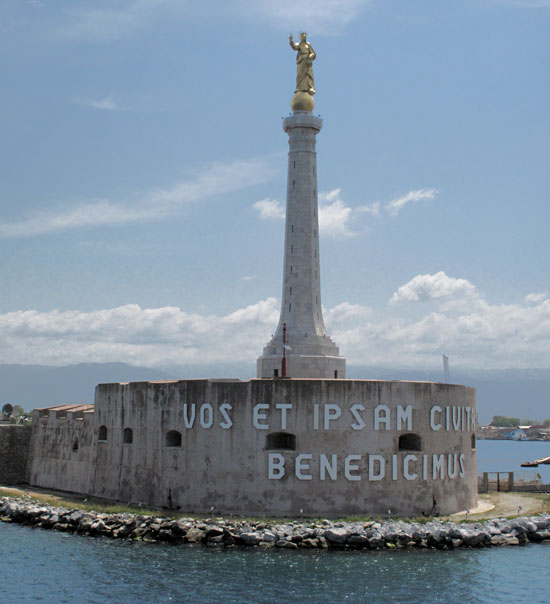
Today I took a train from Taormina, about halfway down the east coast of Sicily, up to the northeastern point of the large island, at Messina. I wondered how this would work, since my train ticket included going up the northwest-facing shoreline of Italy. There was about an hour and a half of finagling, I’ve been told longer than usual, but they split the eight-car train into two parts, and then individually pushed the two halves onto a large ferry. We eventually got back underway across the waters of the Straits of Messina. I was riding ON a train ON a boat! How cool is that!?
While underway, I went up onto the passenger deck to enjoy the view and the breeze.
At the snack bar, I bought “arancini”, a deep fried rice ball filled with Ragu sauce and cheese – a Sicillian typical food – plus some sparkling water with which to wash it down. The sun was shining, the water was calm.
Now I’ll have to Google “The Straits” to see what it says.
I need an attitude adjustment. I just don’t do “the tourist thing” and am feeling finished, ready to go home. Without someone to taste wine with at the enoteca, to share a filet of grilled swordfish or a plate of caponata, without someone to marvel with over the historic sites and curious details, this all stays inside my own head, and for what?
Yes, of course I can gawk at the old palazzi, the stone walls, the ruins. Of course I can enjoy and photograph yet another cluster of drying laundry, photogenic in the sun against an old door.
But I want to share! Increasingly, I want to say “ooo, ahh” with someone. It’s pouring rain in Taormina, which seems appropriate to my mood.
I’m ready to return to Milano where I am less a tourist, and can have a daily life, tra-la-la. High-end designer shops along the main via here just gross me out. How can I explore real Sicily without a car and with my travel companions away on their own?
– – –
May 9 Journal Entry. Taormina.
I bristle at this tourist crush. “Oh, but I am not like the rest of them! I am different!” Oh really?! But I am a tourist. I just happen to speak some of the langage… but I am still a tourist…
But, truth is, I don’t “belong” here. I am simply going from place to place, shooting a few shots of the local scenery, paying for a noisy room and dinner.
–
I arrived in Taormina Giardini Naxos, by train, down by the water. The city of Taormina is high up on the hill and one must either walk up, take a bus or taxi. It wasn’t until a few minutes into the steep drive that I realized the “taxi” wasn’t a legit cab. He had the taxi sign on top of the car, but no computerized trip counter. No signs. No licenses. No radio. I had found my way onto a non-cab cab. He was simply an enterprising citizen with a taxi sign on top of his car (though not lit). I calculated what the trip was worth to me, what I’d be willing to pay, and when we safely arrived at my hotel, high up the winding hill, he asked for 15 Euro, which I gladly paid. Everyone’s gotta make a buck. He just doesn’t (have to) pay taxes on his.
– – –
May 10 Journal Entry. Taormina.
Increasingly, what I seek in travel, are the connections with people, even when momentary. I walked into a little embroidered linens shop selling handkerchiefs, blouses, tablecloths and doilies. I was seeking a simple but special gift. I walked out with the gift, and a conversation with the elderly shop-owner, amidst time-stained, creased fabrics, embroidered by hand. We talked about fabric and sewing, about commercial and industrial cities in the U.S., about language and life. What a glory to be able to do so! They must tire of the repetitive tourist inquiries reducing them to cashiers in the kitsch shops. (It’s a living for them, all because they have beauty and old buildings nearby, but is it satisfying?)
It’s the layering of history, so pervasive throughout Italy, that stuns me every time I make a turn and come upon some incredible, very old site/sight. It usually leaves me speechless.
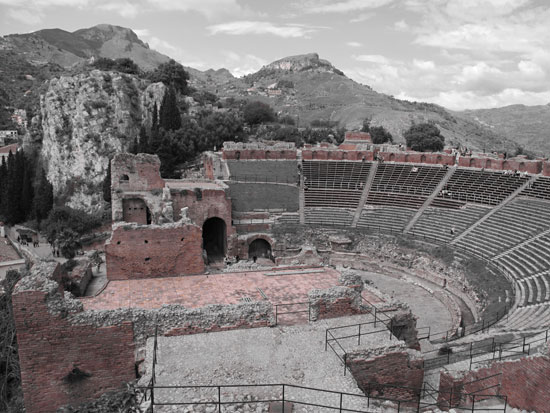
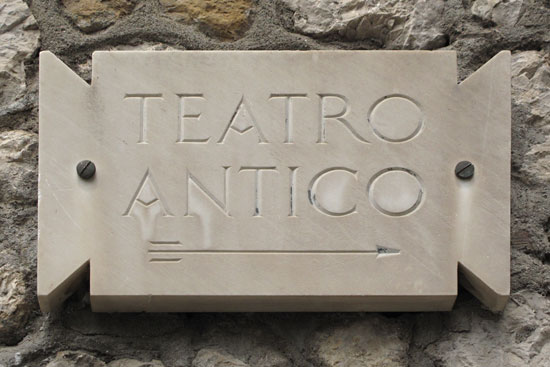
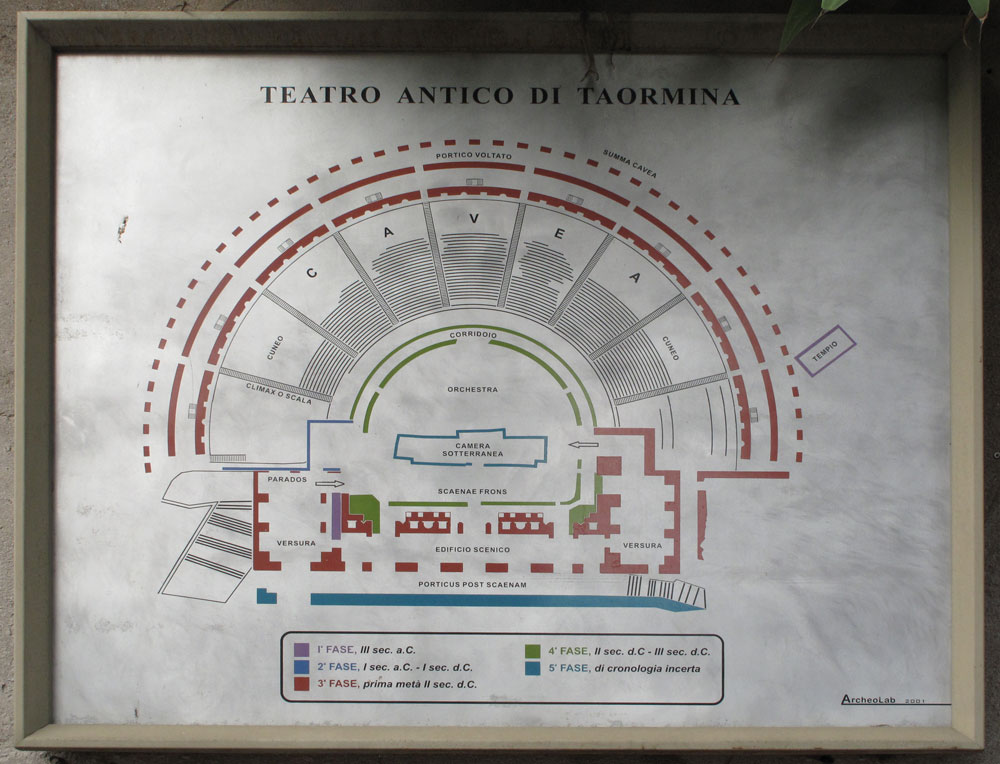
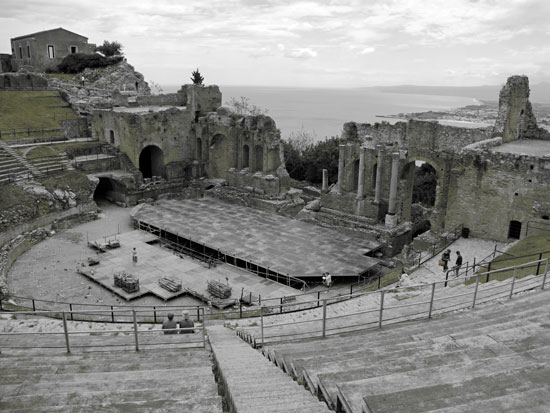
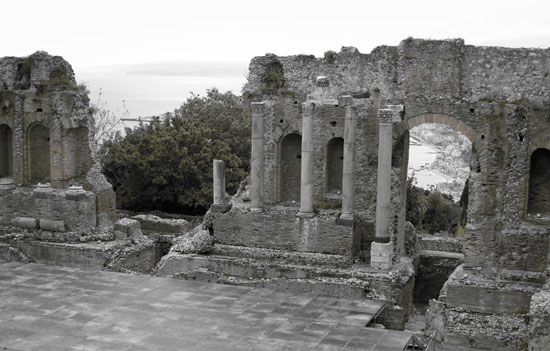
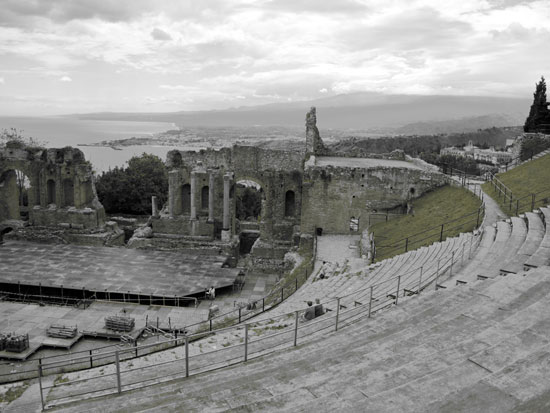
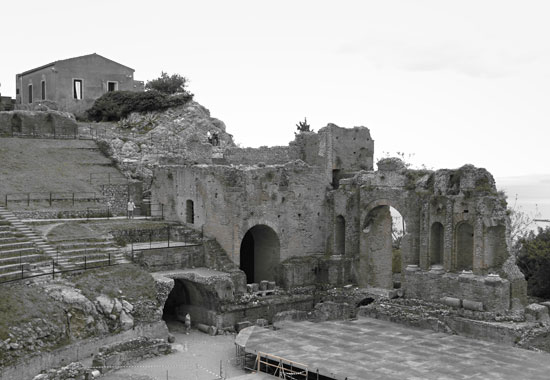
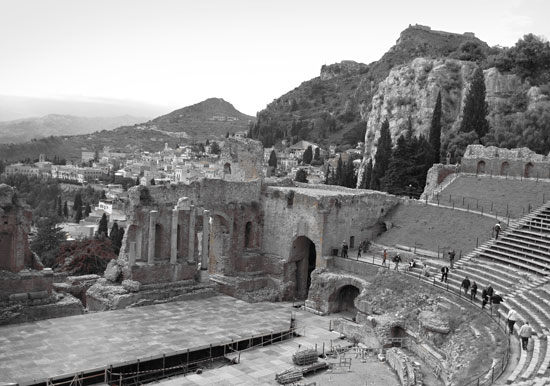
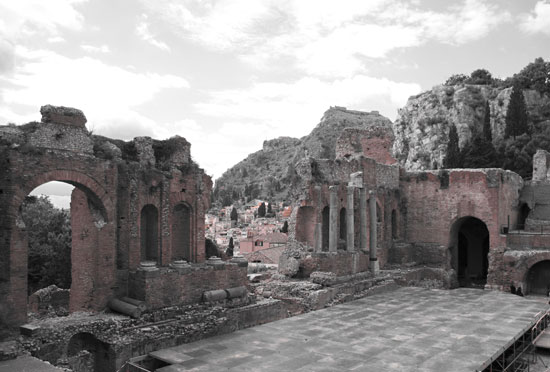
“The Ancient Theatre of Taormina (“Teatro Antico di Taormina” in italian language) is an ancient greek theatre, in Taormina, southern Italy, built early in the seventh century BC.
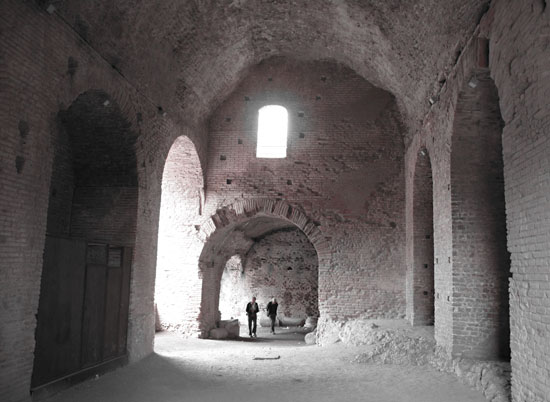
“The most remarkable monument remaining at Taormina is the ancient theatre (the teatro greco, or “Greek theatre”), which is one of the most celebrated ruins in Sicily, on account both of its remarkable preservation and of the surpassing beauty of its situation. It is built for the most part of brick, and is therefore probably of Roman date, though the plan and arrangement are in accordance with those of Greek, rather than Roman, theatres; whence it is supposed that the present structure was rebuilt upon the foundations of an older theatre of the Greek period.
“With a diameter of 120 metres (after an expansion in the 2nd century), this theatre is the second largest of its kind in Sicily (after that of Syracuse); it is frequently used for operatic and theatrical performances and for concerts. The greater part of the original seats have disappeared, but the wall which surrounded the whole cavea is preserved, and the proscenium with the back wall of the scena and its appendages, of which only traces remain in most ancient theatres, are here preserved in singular integrity, and contribute much to the picturesque effect, as well as to the interest, of the ruin. From the fragments of architectural decorations still extant we learn that it was of the Corinthian order, and richly ornamented. Some portions of a temple are also visible, converted into the church of San Pancrazio, but the edifice is of small size.”
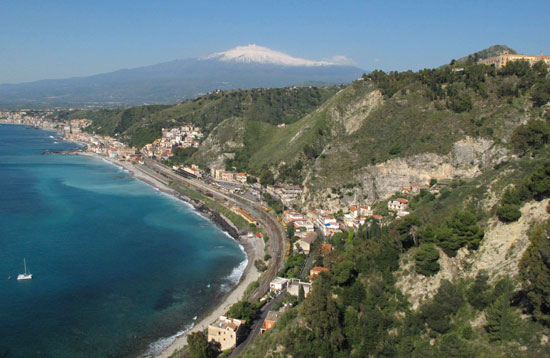
Along the eastern shore of the large island of Sicily, south of Messina, in view of Mt. Etna to the west, lies Taormina high above the shore of the Ionian Sea. It offers ancient Greek history and contemporary souvenir shopping. Mediaeval stone buildings and current luxuries. Whether one walks behind the tour groups along the heavily-trod Corso Umberto, or takes off into the hidden back walkways, Taormina covers the range. In this town, I found a different polish than in Cefalú, and certainly Palermo.
Sitting in a hotel lobby using the wifi network. Italian game show on the TV next to me. Don McClean singing “American Pie” on the sound system. I hear more American Pop music here than Italian, both oldies and contemporary. It always amuses me, but doesn’t introduce me to Italy’s sounds.
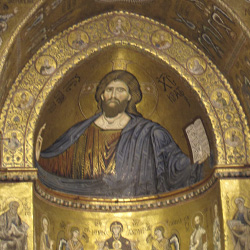
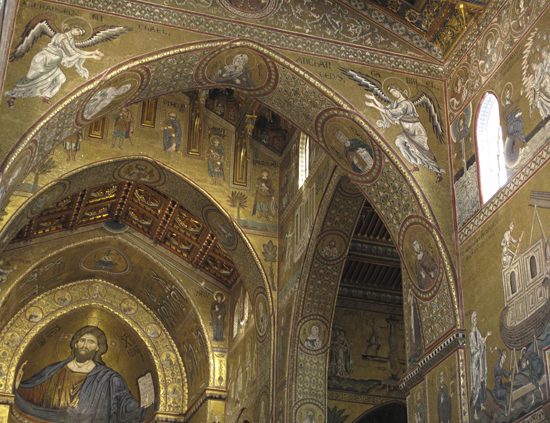
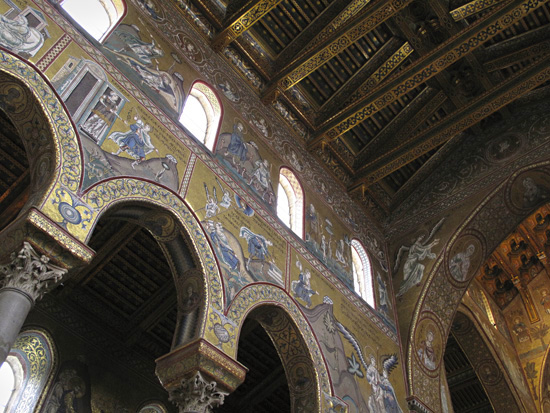
Hardly a long drive as-the-crow-flies from Palermo, but a long time through traffic, Monreale is southwest from Palermo, and is worth the trip whether flying-like-a-crow or driving. The gold mosaic duomo interior will make your jaw drop. The bakery staff in town will make you want to stay at least a week laughing and chatting. The town streets will charm you. Ahh… Go.
– – –
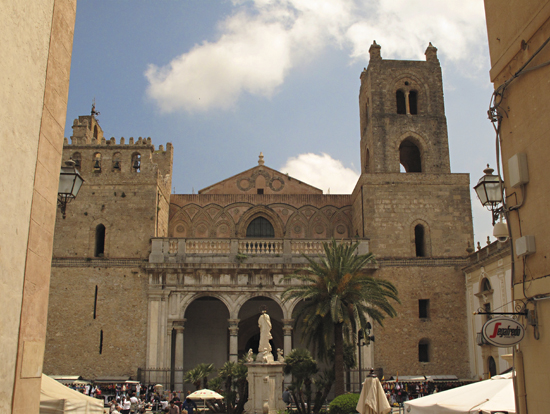
From Wikipedia: “The Cathedral of Monreale is one of the greatest extant examples of Norman architecture in the world. It was begun in 1174 byWilliam II, and in 1182 the church, dedicated to the Assumption of the Virgin Mary, was, by a bull of Pope Lucius III, elevated to the rank of a metropolitan cathedral. The church is a national monument of Italy and one of the most important attractions of Sicily.”
From the front, the Duomo doesn’t give you much of a hint of what’s inside…
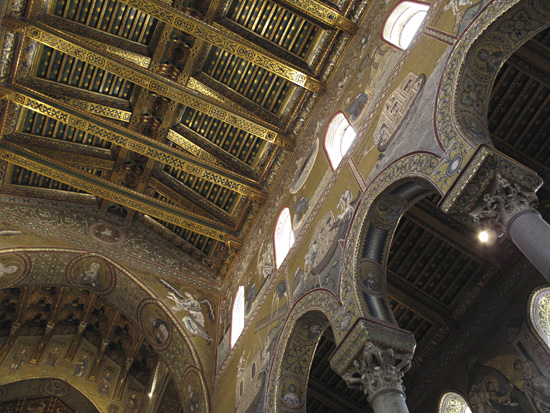
…but step inside, to the gold mosaic interior, and you’ll pick your jaw up off the floor.
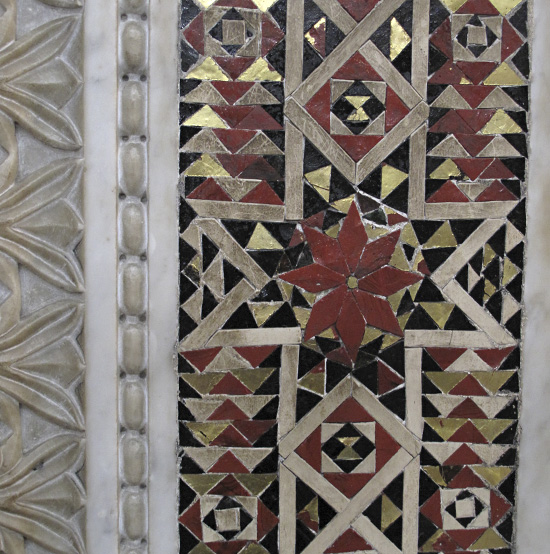
These little mosaic pieces are about 1/4″ to 3/8″ or so across. Imagine the whole interior surface of this church (and others) being covered like this!
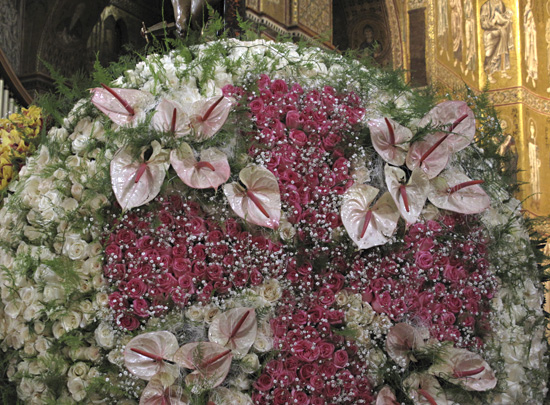
One of the several floral bouquets inside was almost a mosaic in itself.
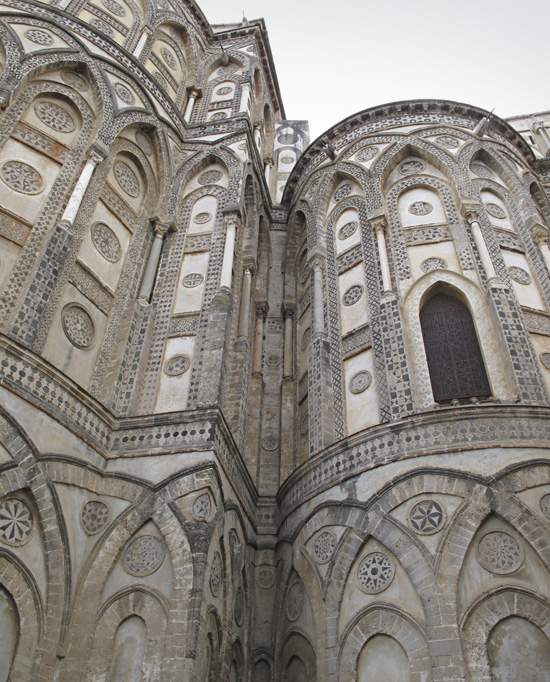
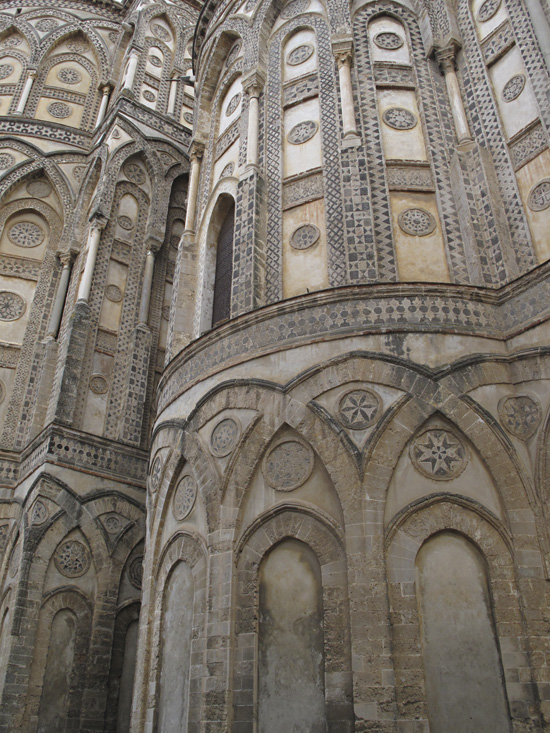
The backside of the Duomo and its monastic building, on a little side street, are richly embellished!
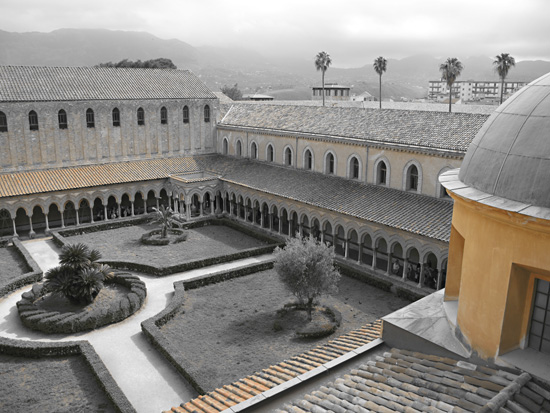
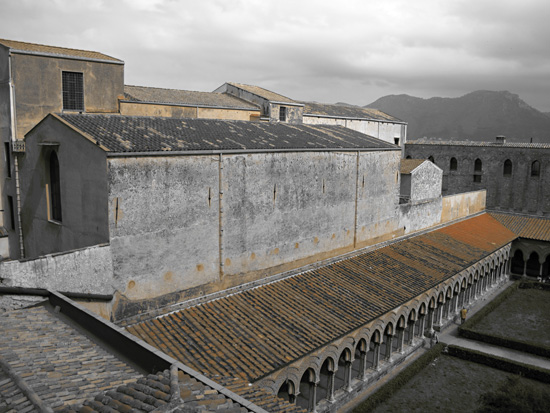
“The archiepiscopal palace and monastic buildings on the south side were of great size and magnificence, and were surrounded by a massive precinct wall, crowned at intervals by twelve towers. This has been mostly rebuilt, and but little now remains except ruins of some of the towers, a great part of the monks’ dormitory and frater, and the splendid cloister, completed about 1200.”
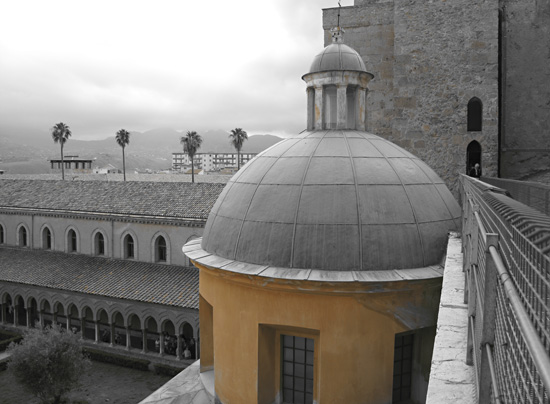
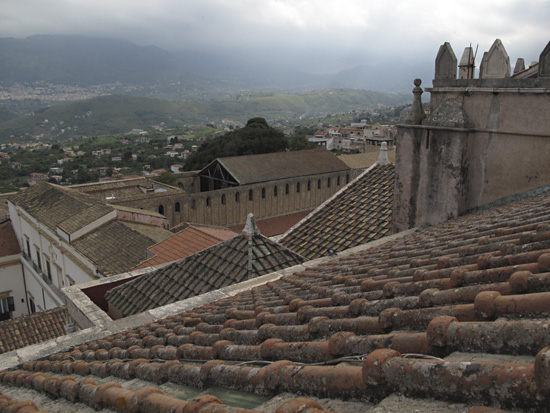
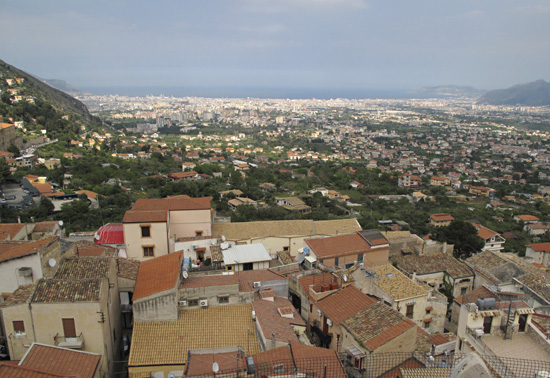
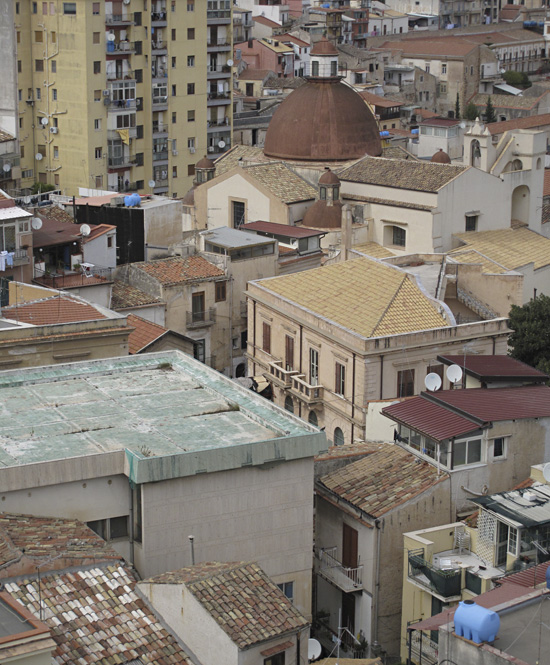
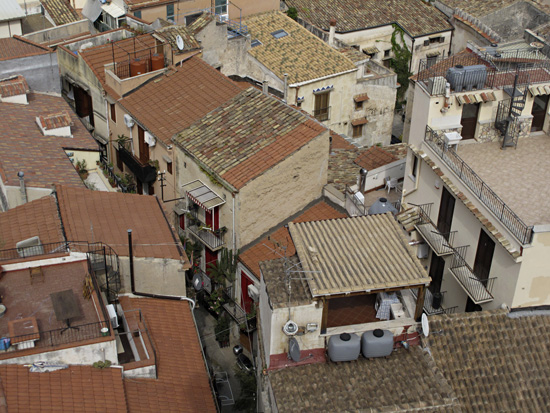
In any city, find a highpoint for the greatest overview. In Italian cities, that often means climbing the narrow stone staircases to the top of the duomo. Some cathedrals have elevators, but the old worn stairs and walls are worth seeing, if you can make the climb.
Looking out over the rooftops, Palermo is in the distance at the shoreline.
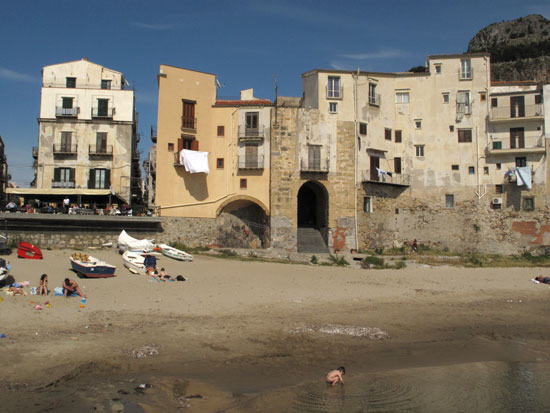
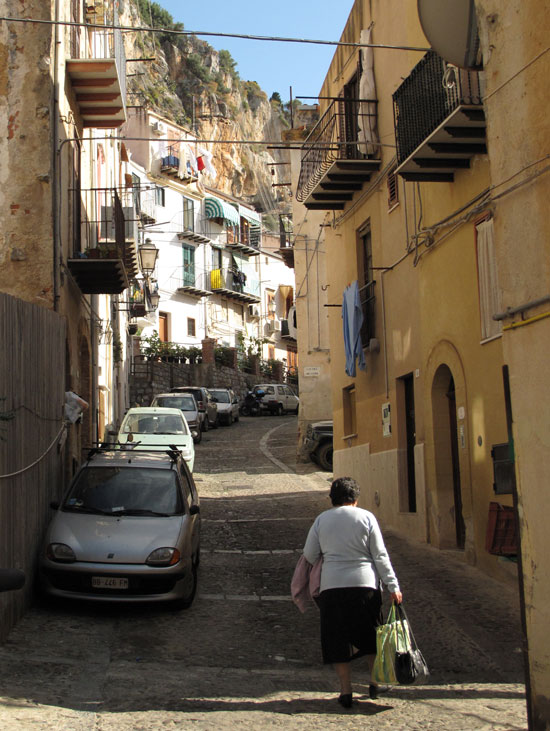
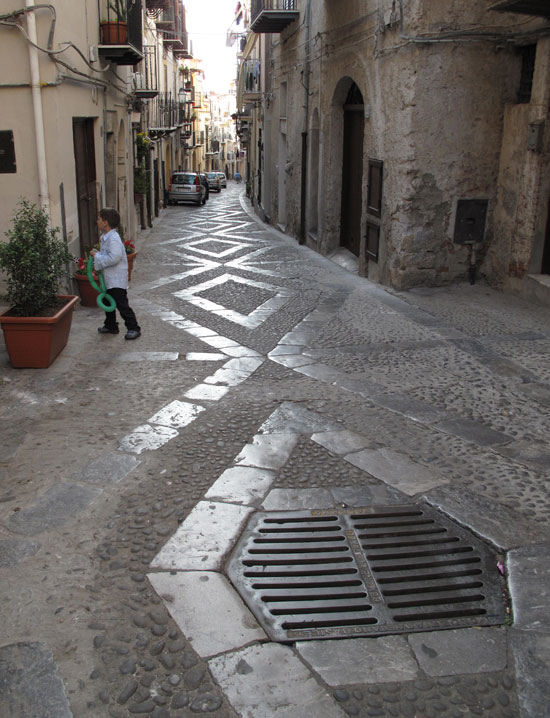
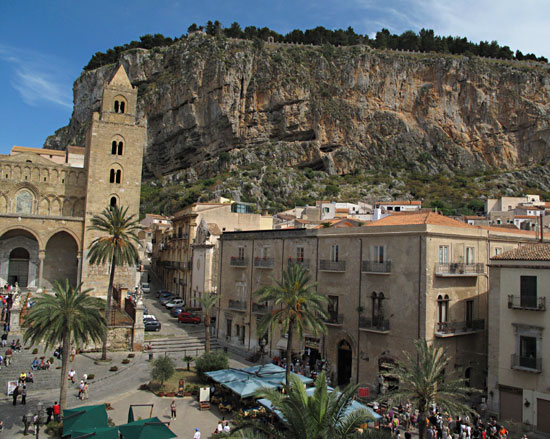
8 May – In the “centro storico” – historic center – of this little seacoast town east of Palermo, on the north shore of the island of Sicily. The narrow, climbing, maze-like streets remind me of the towns of the Cinque Terre, rooted into the spaces at the bases of their hills. Navigation must come of childhood exploration. How could one possibly give directions home?
Cefalù is FULL of tourists: elderly Europeans speaking German, French, Danish… some Italian. They are here in crowds with cameras. How can I find myself bristle when I, too, am a tourist? But I want to get away from them and the shops selling knick-knacks, and see the atypical sight. I lose myself on the side streets. Go to the hill tops that require a healthful youth the elders lack. I take the “roads less traveled” and marvel that they never stray from the most-worn path. As in Venice, get off the main drag and find solitude and visual treasures.
– – –
9 May – I had the absolute noisiest B&B room imaginable in Cefalù (Hotel Villelmi). Granted, I had a little balcony and access to a rooftop terrace that looked right out to the Piazza del Duomo and “La Rocca”. But the rowdy crowd of tourists and locals expressively chattered late into the night. Then, early in the morning, 4:00 or 5:00, workers used every sort of process or equipment to clean that piazza. Pressure-washers, mini street sweepers, manual laborers. And the recycling trucks came to pick up the 1000s of wine bottles emptied the day before. The bottle bins were right outside my window.
And as much as I like spring birdsong, I have never heard such loud and sleep-preventing birds as those this morning! And then, at 7:00, the duomo bells chimed 1, 2, 3, 4, 5, 6, 7, 8, 9, 10, 11, 12 times, 3 repetitions of this in rapid succession, as if to say “get up, get moving, get out now!”
Hmmm. Proximity to a Piazza del Duomo is not such a great idea.
– – –
9 May – I’m traveling the regional train along the shoreline toward Taormina: “the straights of Messina” at my left! The straights are something I’ve always heard of, but I have no recollection of what I’ve heard. I’ll have to look them up.
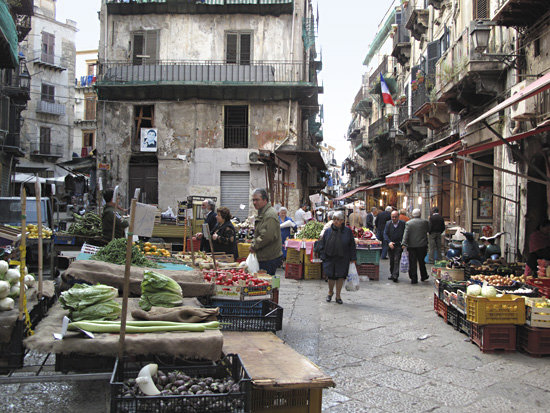
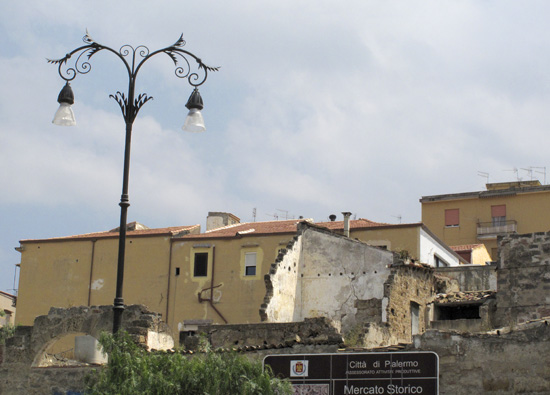
Palermo is renowned for its old street markets, some of which have been in the same spot as early as the 10th century! As far as I know, each one is open every day (except Sunday). Some vendors have enclosed shop spaces. Others set up and take down every day.
La Vucciría – the most famous food market in the city.
Ballaró – the oldest food market in the city.
Casa Professa – selling second hand goods, new and used clothing, adjoining Ballaró.
Il Capo – selling fruits, vegetables, clothing and shoes. (This market was just a block from my B&B Kemonia.)
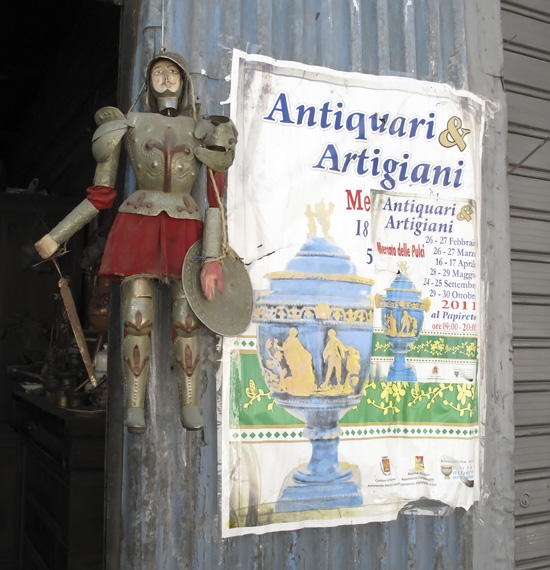
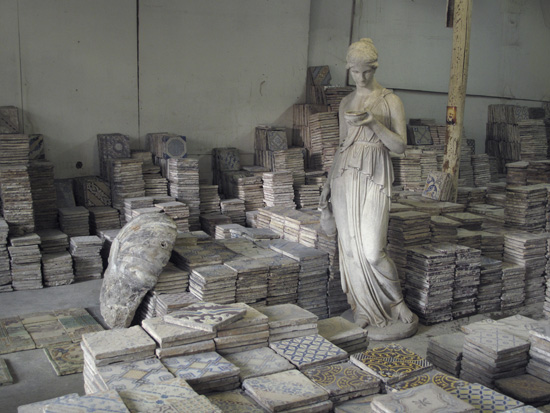
Mercato delle Pulci – flea market selling dusty furniture, crystal, porcelain, lamps, frames and tiles.
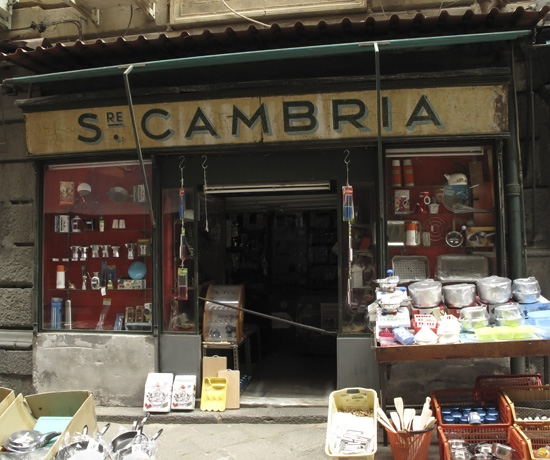
Lattarini – selling metal goods, tools, clothing and cloth.
– – –
The “Ave Maria” fruit stand, right in front of a niche honoring Mary.
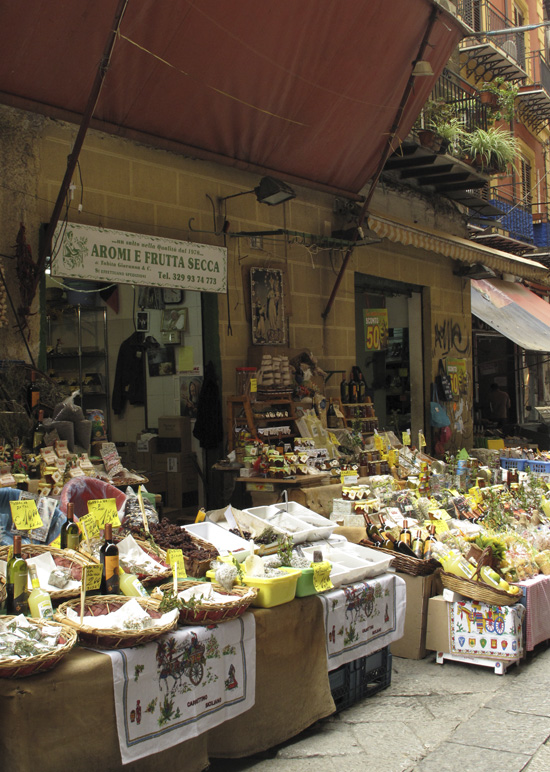
“Aromas” (maybe herbs?) and dried fruit.
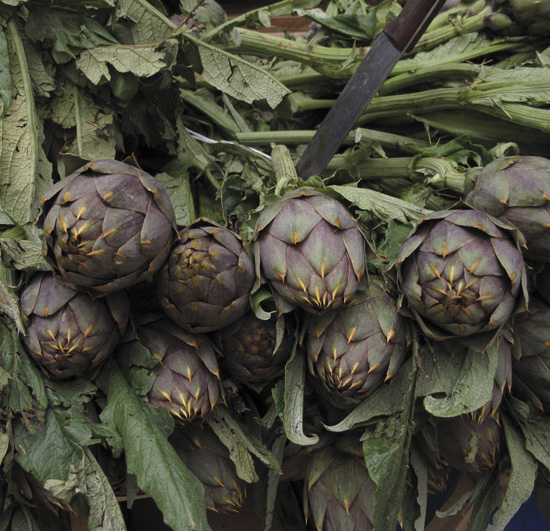
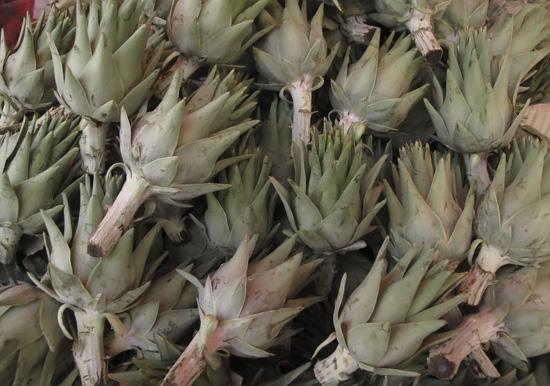
There are more types of artichokes here than I’ve ever seen.
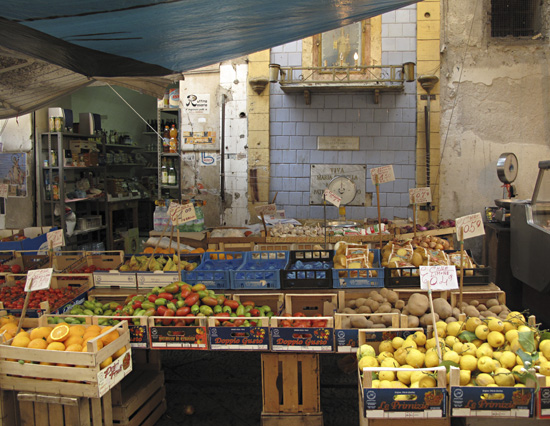
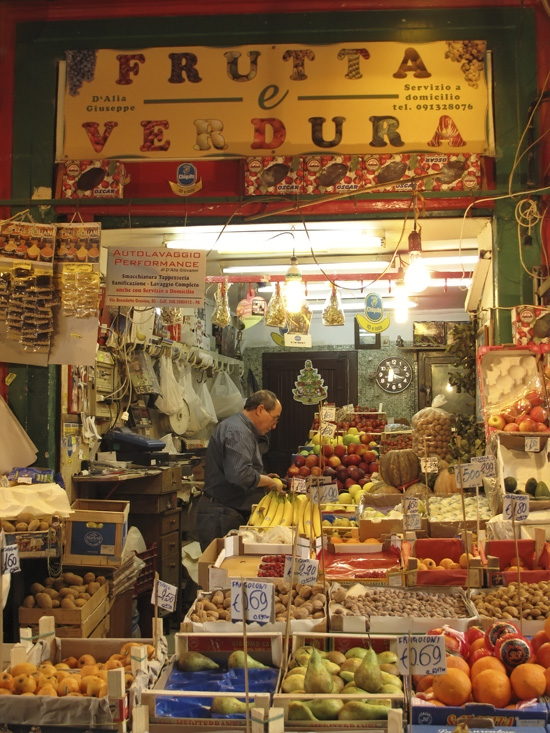
“Frutta e Verdura” = “Fruits and Vegetables”.
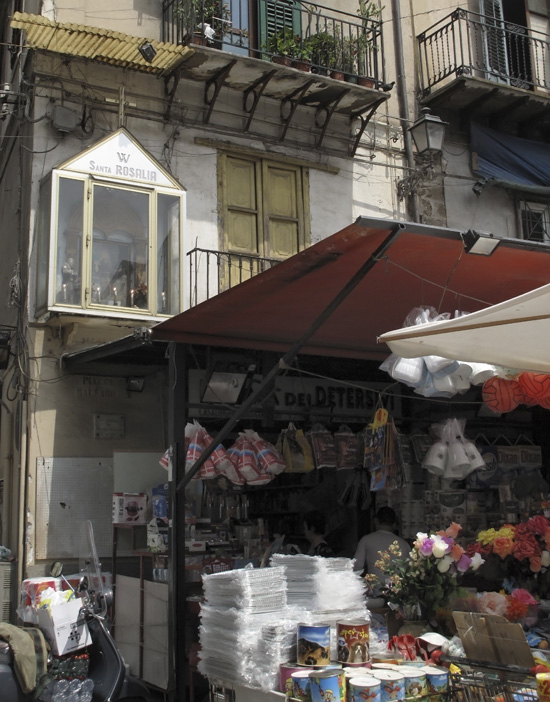
Some vendors sell general housewares, this one in front of the niche honoring Santa Rosalia, the Patron Saint of Palermo.
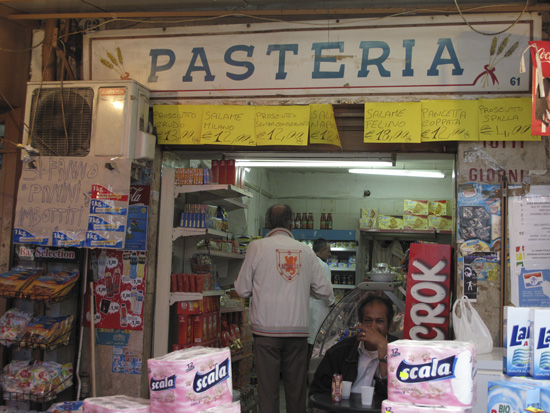
Looks like they’re selling toilet paper, cured meats and sandwiches. Whatever it takes to make a euro.
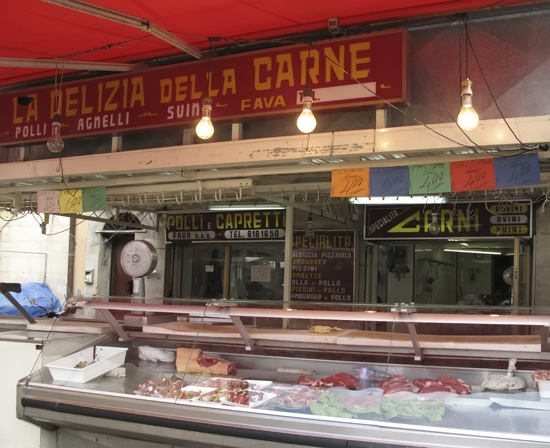
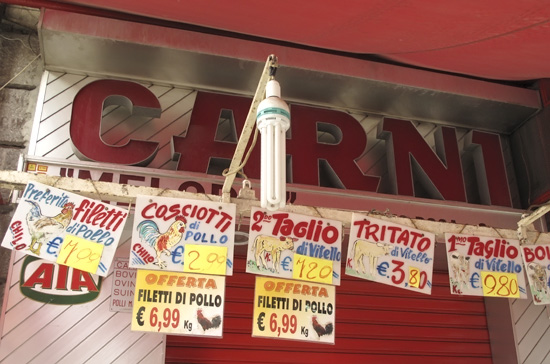
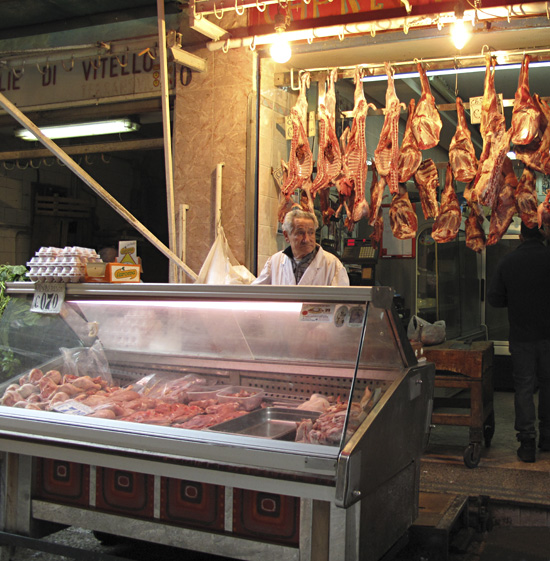
“The Delights of Meat”. A butcher and seller of fresh meats is a “Macelleria”.
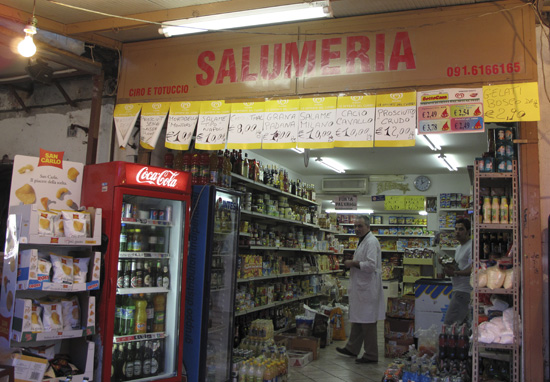
A seller of cured meats is a “Salumeria”. The two don’t usually overlap.
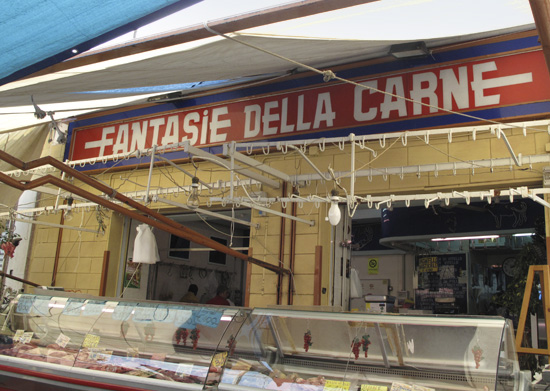
“Fantasies of Meat”.
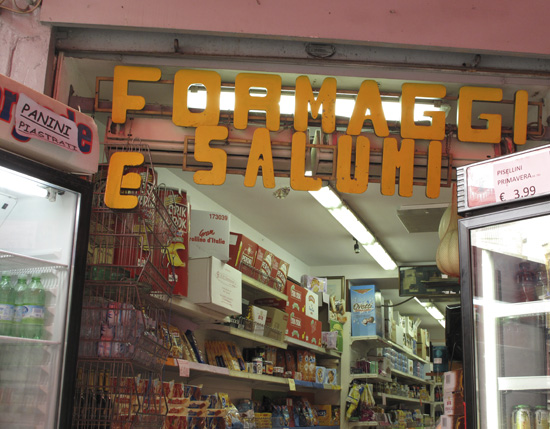
Cheeses and “salumi”, cured meats.
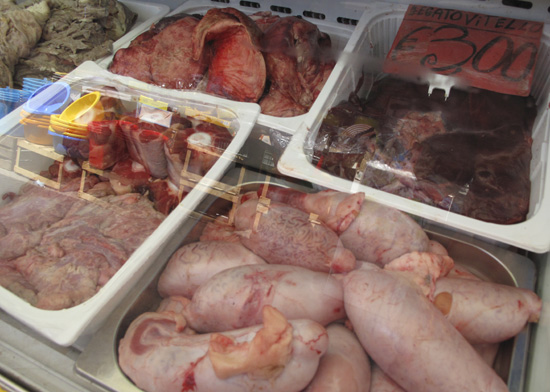
I recognize tripe, veal liver and oxtail. I don’t recognize the organs in the lower right…
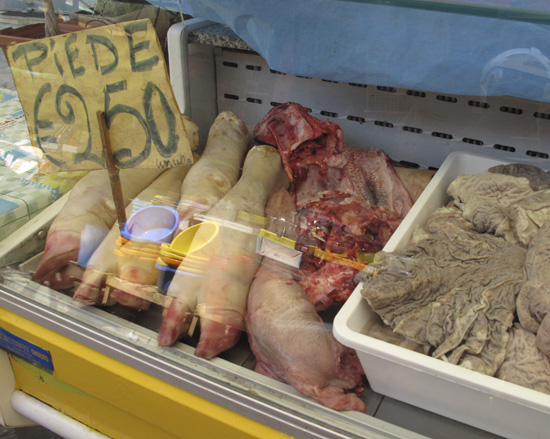
Feet and tripe. (In Firenze – Florence – the tripe is simmered and served up as a sandwich as “Lampredotto“, the regional specialty.
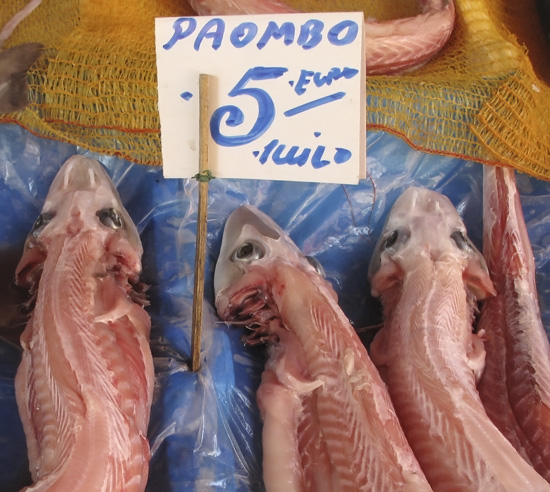
I’ve done a lot of fishing and eaten a lot of fish, but there are fish here that I don’t have a clue about! I don’t know their flavor, their boniness, their best preparation. So… I just buy one and cook it simply the first time to get a sense of it. (But there are some that I don’t have any idea how to begin with.)
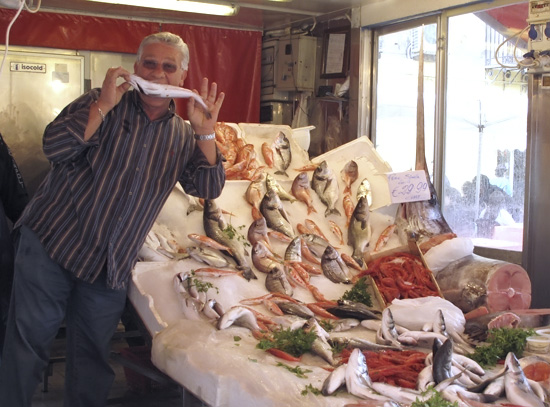
Here’s a fishmonger hamming for the camera.
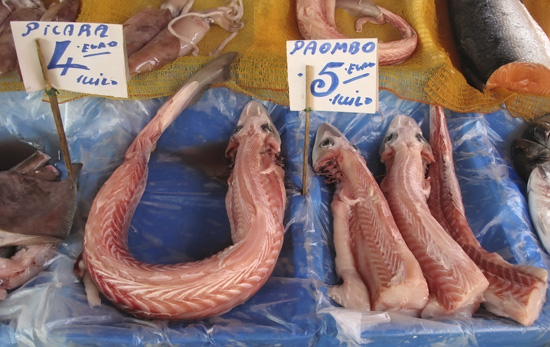
Why is this fish skinned? What’s the meat like? (What was the skin like?)
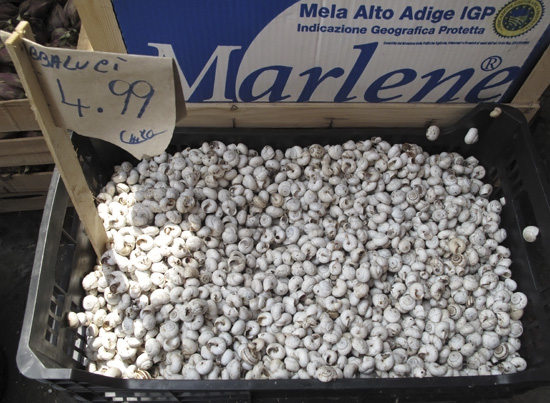
“Babbaluci“, and we’re not talking escargot. Some are getting away!
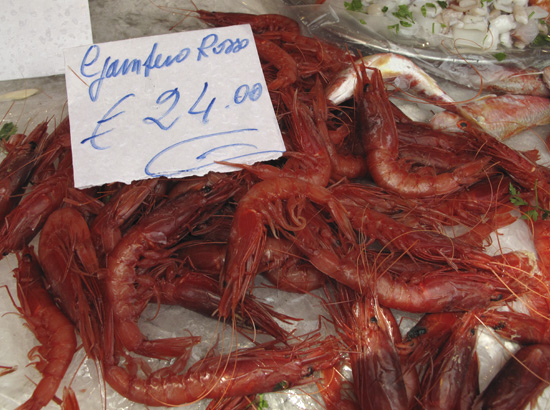
Gambero Rosso – Red Shrimp ONLY from that area. Also served raw (though a little slippery for my taste).
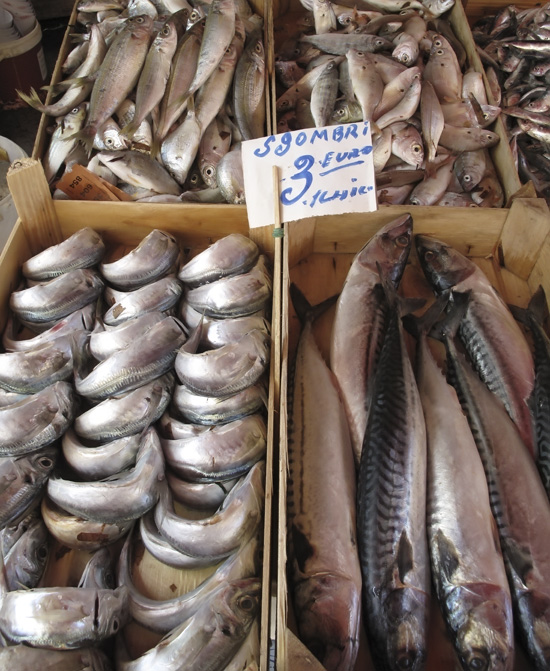
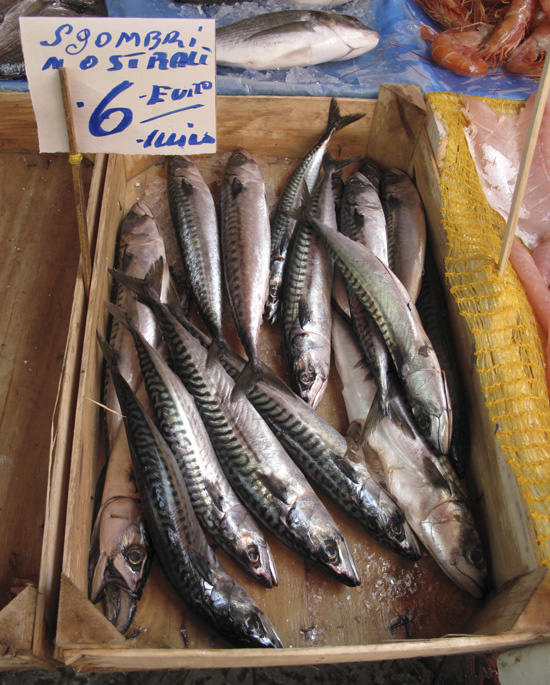
Hmm. The “Sgombro” are sold for both 3 euro per kilo, and 6 euro per kilo! (But the “nostrali” are “our own”).
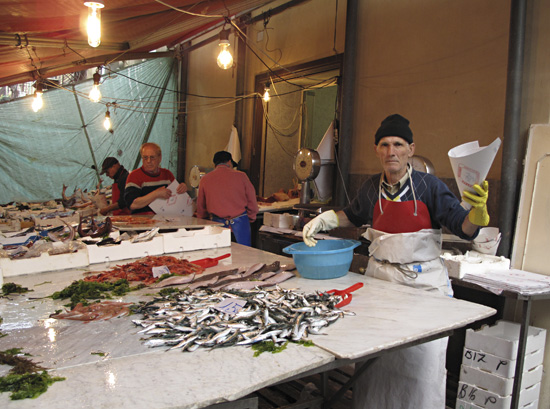
This fishmonger was reaching into his bucket and splashing water onto the fish to keep it moist. He kept posing as a “water-splashing fishmonger”. Note the paper cone in his hand. That’s what they form and package the small fish in. (Fruit vendors do the same thing for small fruit.)
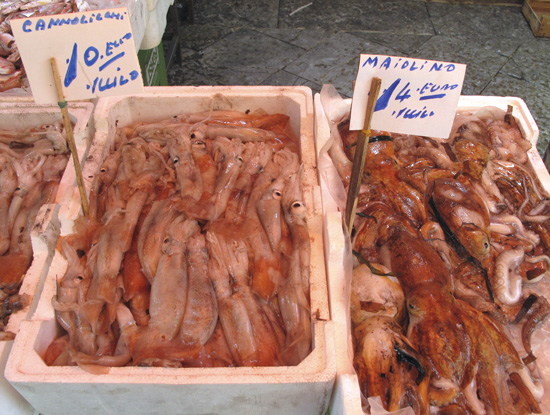
There are more squid and octopus relatives here than I can figure out. The line starts to be blurred for me between one and the other. And they all have names I don’t recognize.
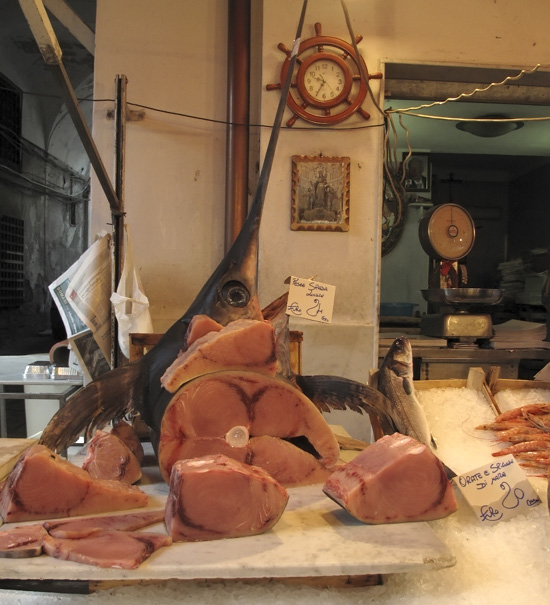
Swordfish – Spada – is very common around here. A great display is always made of the head and sword.
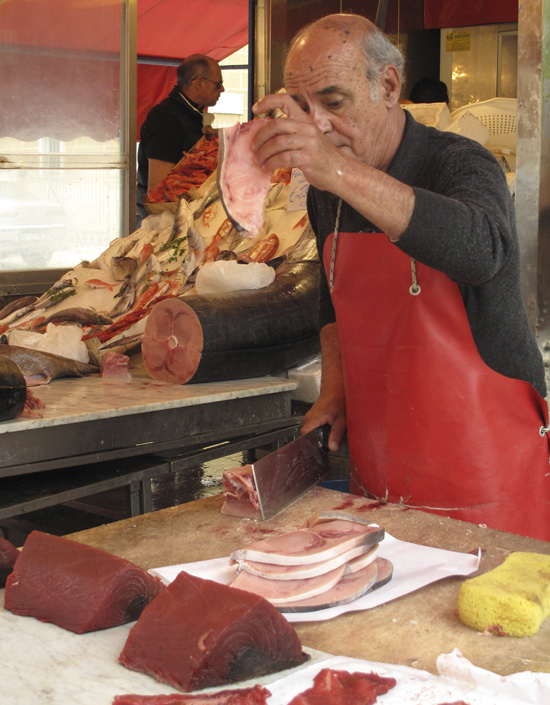
Compare the difference between the swordfish’s pale pink and the tuna’s deep red. One cooks up to white, the other to mid-gray (although served nicely raw).
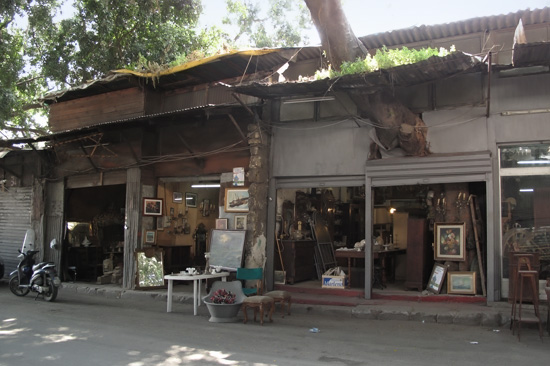
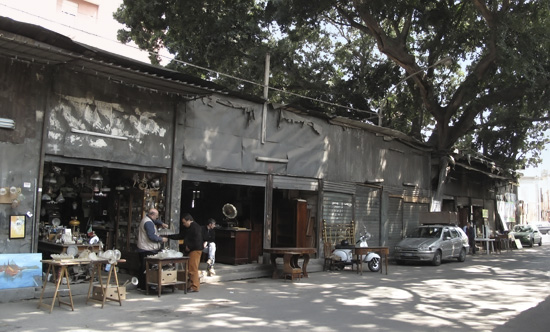
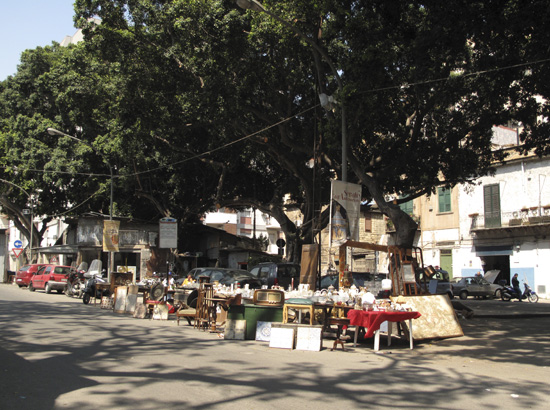
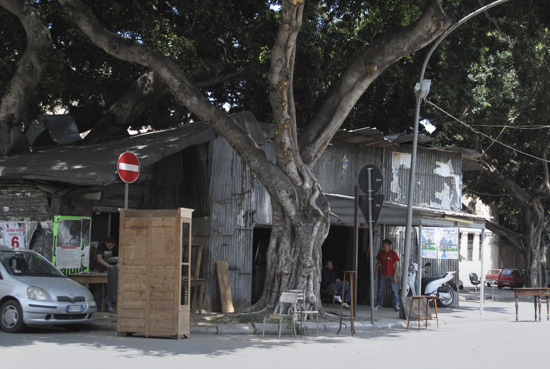
The Mercato delle Pulci caught my eye before I had identified it as the market. (“Pulci” means “fleas”! Flea market!) It’s built of tin and wood shacks encrusted over the years around giant tree trunks. The vendors sell dusty furniture, crystal, porcelain, lamps, frames, tiles and whatever odds and ends they can make a euro off of.
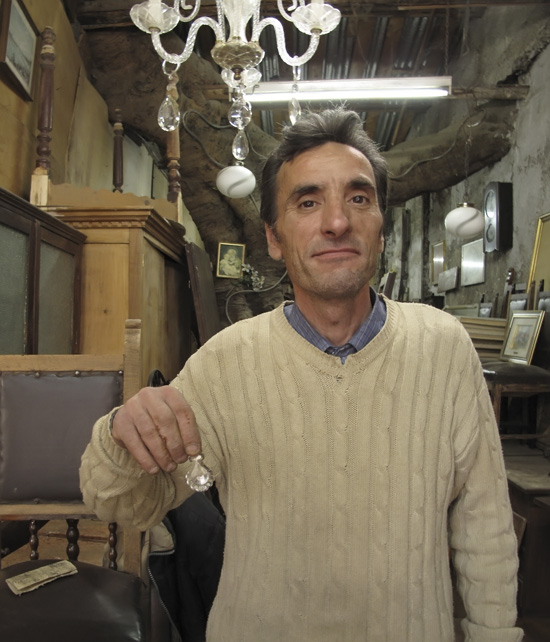
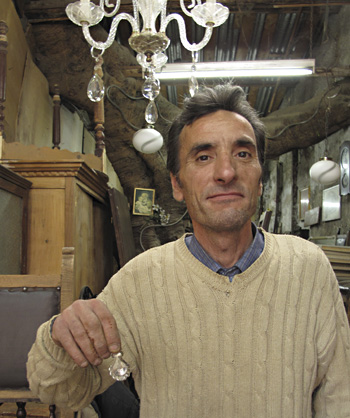
I talked to Bruno in one little space, who gave me a crystal teardrop pendant to carry around as a “porta fortuna” – a “fortune carrier” or good luck charm. It’s riding around in my coin purse now. (Note the tree trunk behind him, in the middle of his shop!)
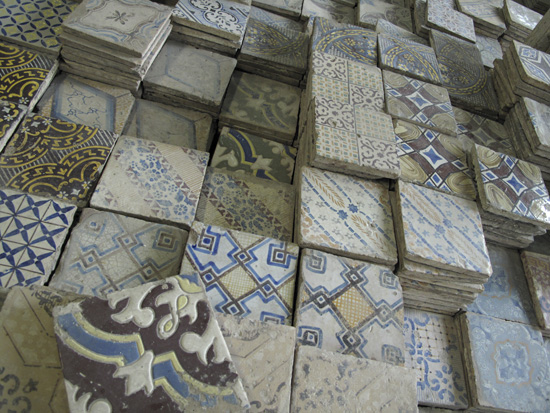
I also enjoyed the tile seller’s shop, with thousands of old maiolica tiles! (How old did he say these are?…)
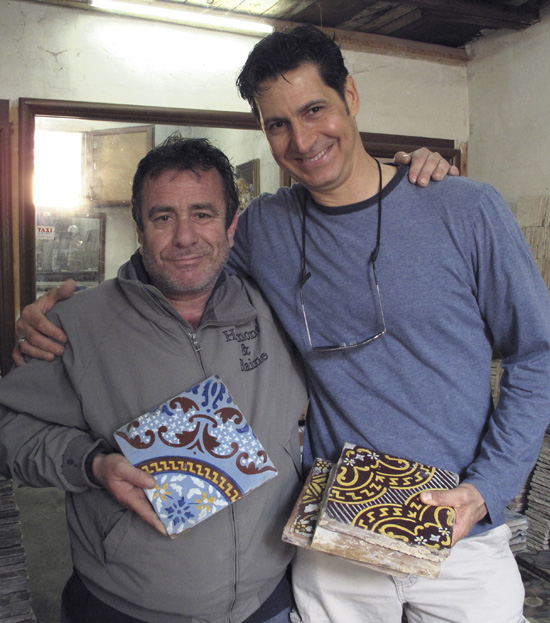
The tiles are so beautiful that I took Richard to Bebbé, the vendor. Richard and his Dad, Peter, were traveling in Sicilia from NYC, and were in Palermo at my B&B. We enjoyed dinners and exploration together. Richard bought four tiles to take home. (Doesn’t he look pleased?!)
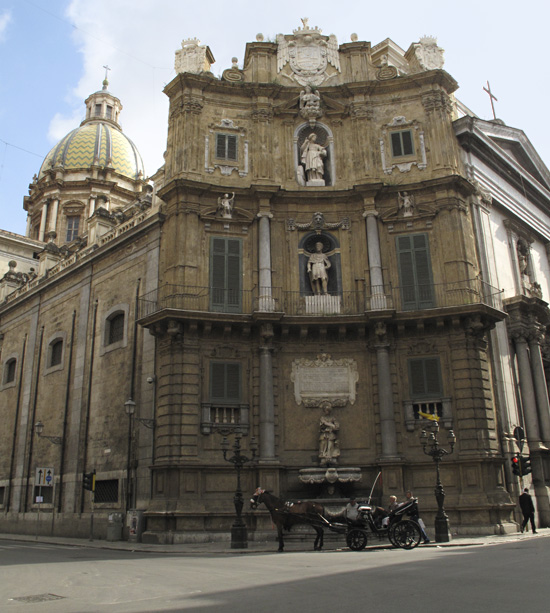
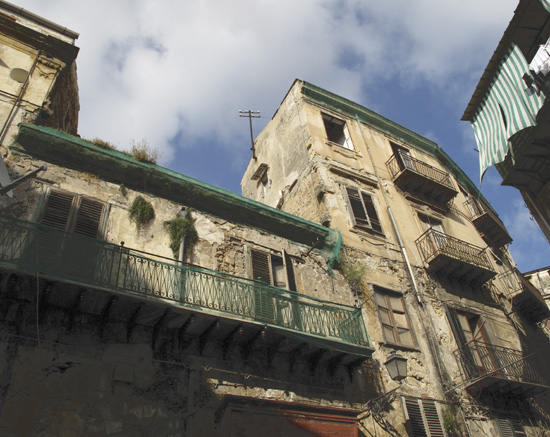
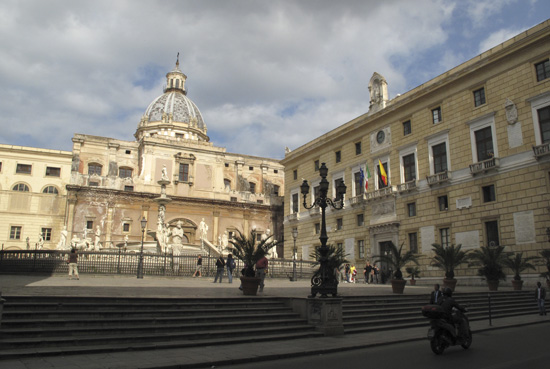
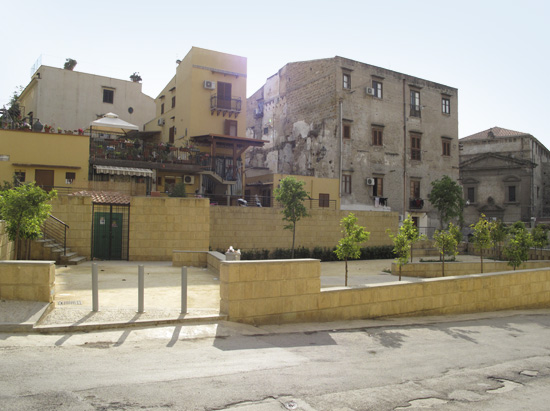
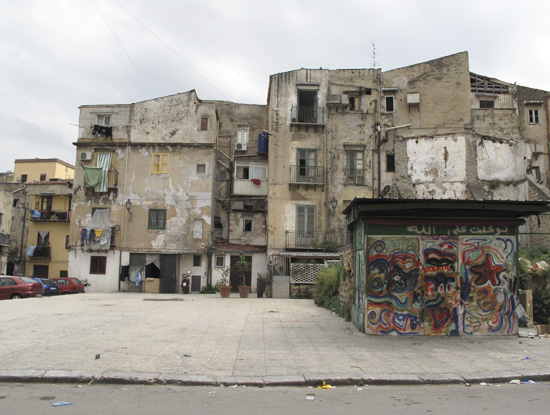
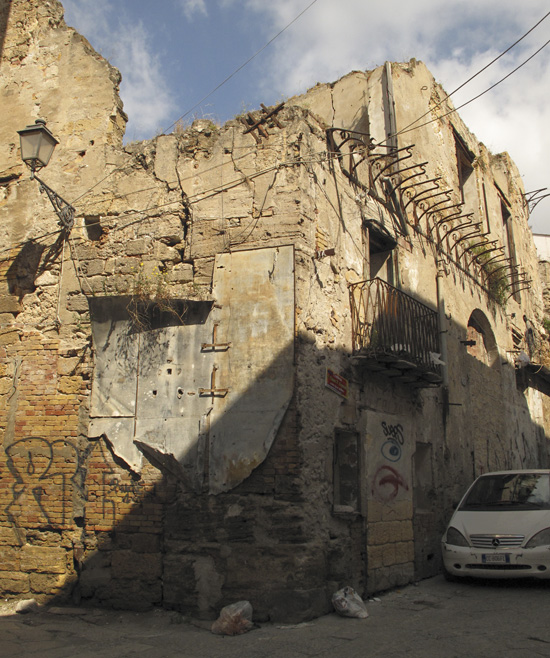
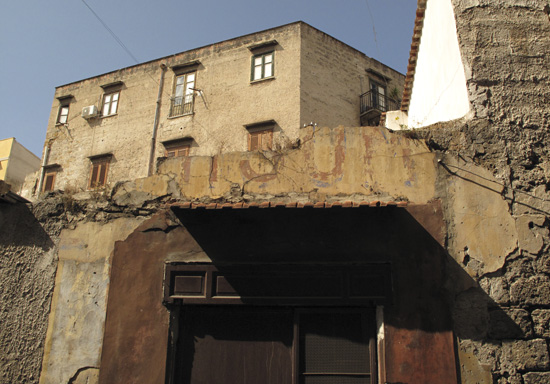
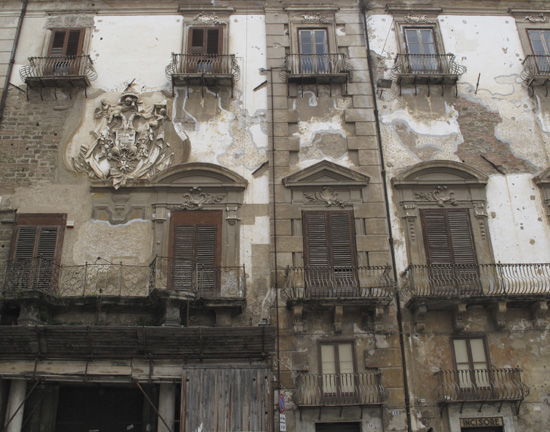
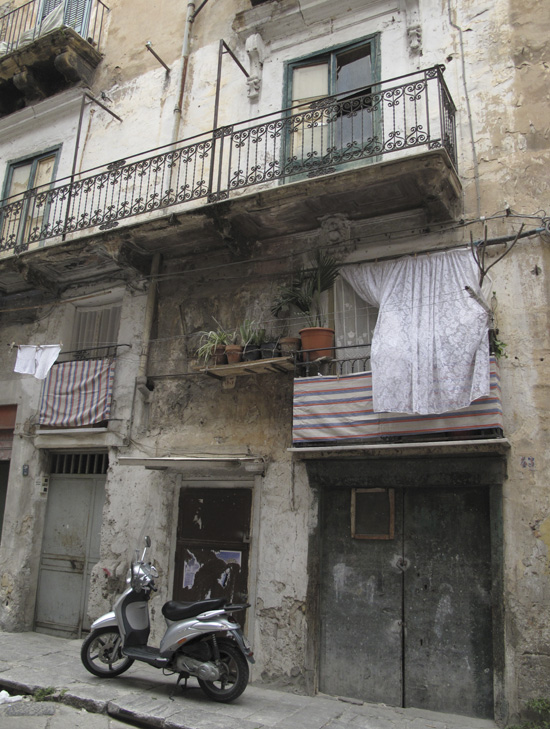
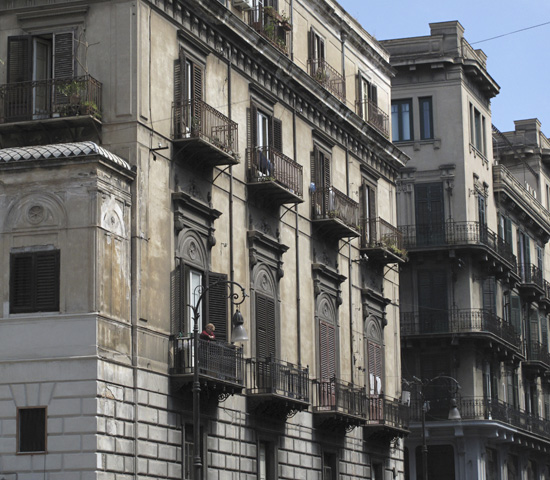
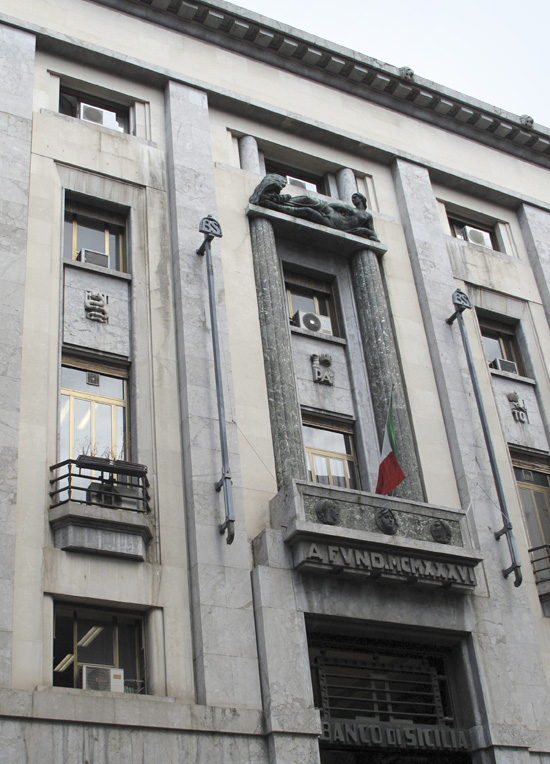
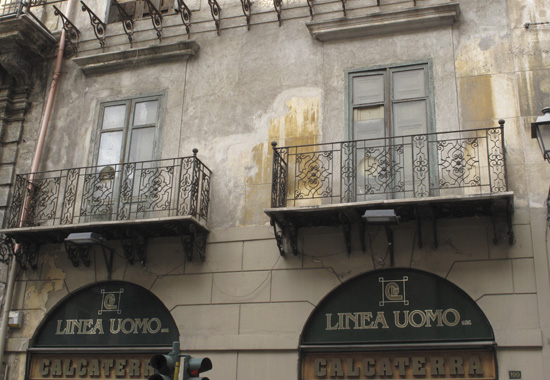
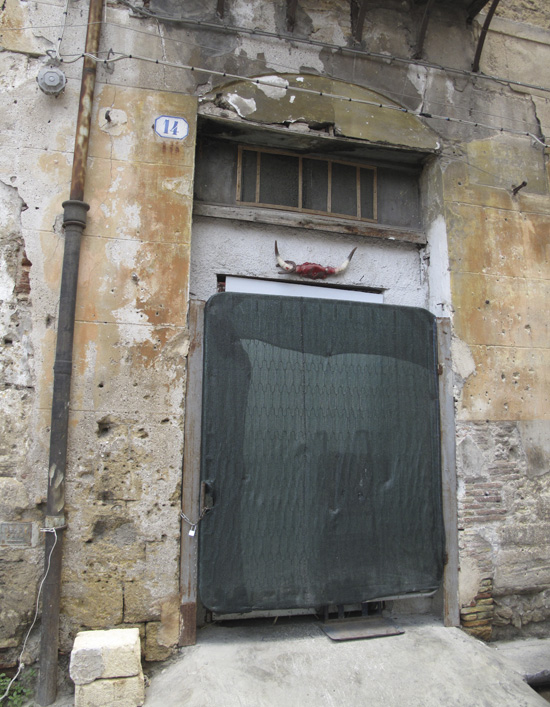
“Contrasts”. That word describes Palermo best of all. (Probably in more ways than I’ve yet discovered.) Contrasts in style, in degree of polish and repair, in level of “refinement”. The juxtapositions are jarring at times in Palermo.
The “Quattro Canti“, the Four Corners were “laid out on the orders of the Viceroy the Duke of Maqueda between 1608-1620 by Giulio Lasso at the crossing of the two principal streets in Palermo, the Via Maqueda and the Corso Vittorio Emanuele. The piazza is octagonal, four sides being the streets, and the remaining four sides are Baroque buildings the near identical facades of which contain fountains with statues of the four seasons, the four Spanish kings of Sicily, and of the patronesses of Palermo. The facades onto the interchange are curved, and rise to four floors; the fountains rise to the height of the second floor, the third and fourth floors contain the statues in niches. At the time the piazza was built, it was one of the first major examples of town planning in Europe.” (From Wikipedia.)
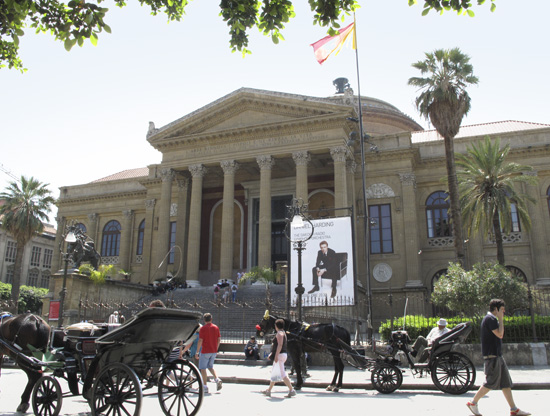
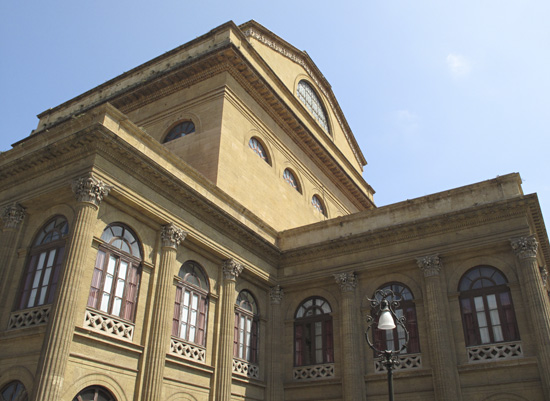
The grand-scale “Teatro Massimo Vittorio Emanuele is an opera house and opera company located on the Piazza Verdi in Palermo, Sicily. It was dedicated to King Victor Emanuel II. It is the biggest in Italy, and one of the largest of Europe (the third after the Opéra National de Paris and the K. K. Hof-Opernhaus in Vienna ), renowned for its perfect acoustics.” (From Wikipedia.) Construction began in the late 1800s.
The inscription across the front, above the columns, states “l’arte rinnova i popoli e ne rivela la vita”, “Art renews the people and reveals life.” A strong affirmation of the importance of the arts in our lives.
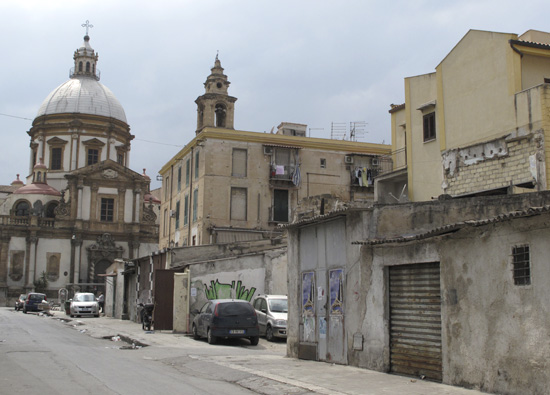
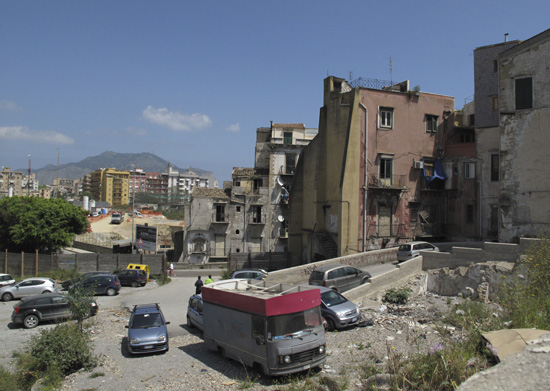
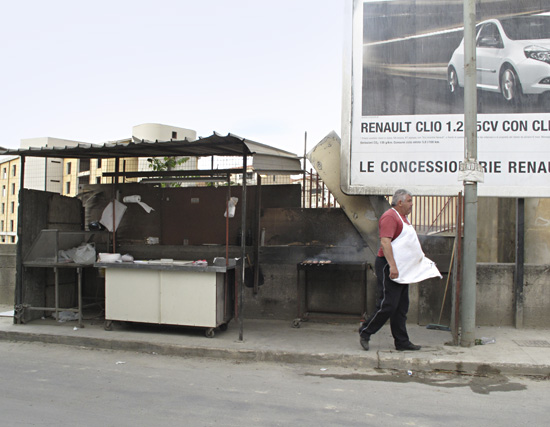
This tumble-down block is just a couple of blocks from the Palazzo Reale, the Royal Palace. There’s a billboard toward the lower left of this photo, which is where I ate the skewered, grilled veal guts.
Chiesa di San Giuseppe dei Teatini. Church of St. Joseph of the Teatines.
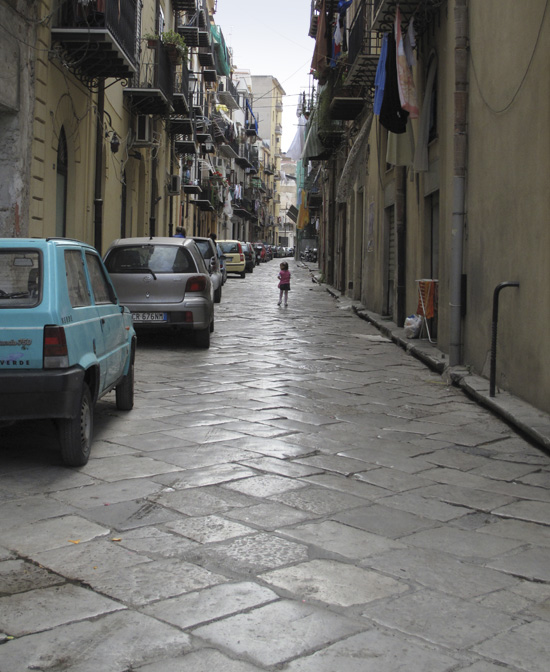
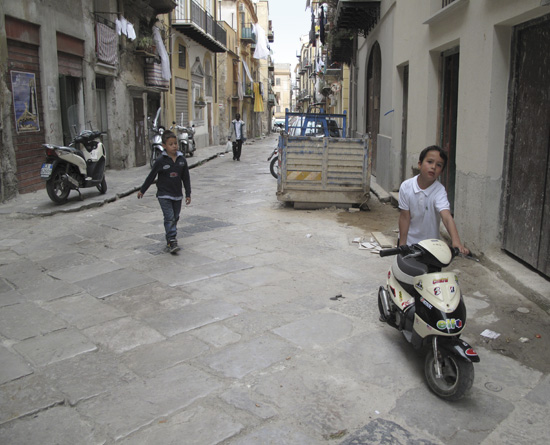
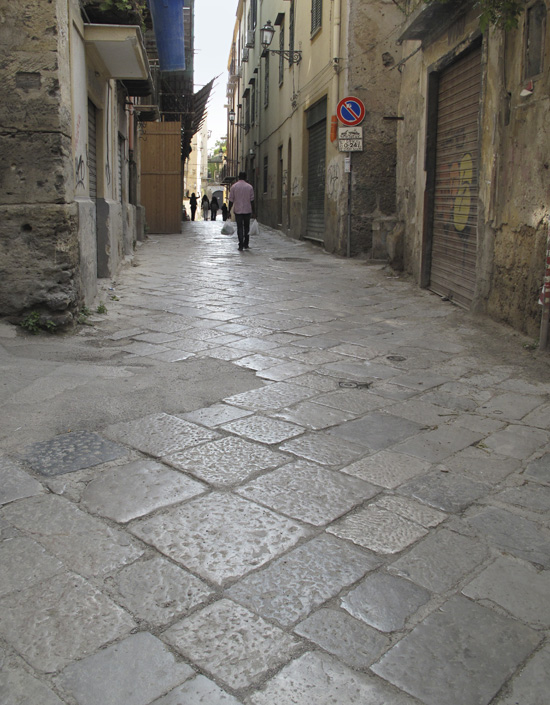
Kids grow up on these chinked, polished paving stones. And they start out with mini-scooters at a young age!
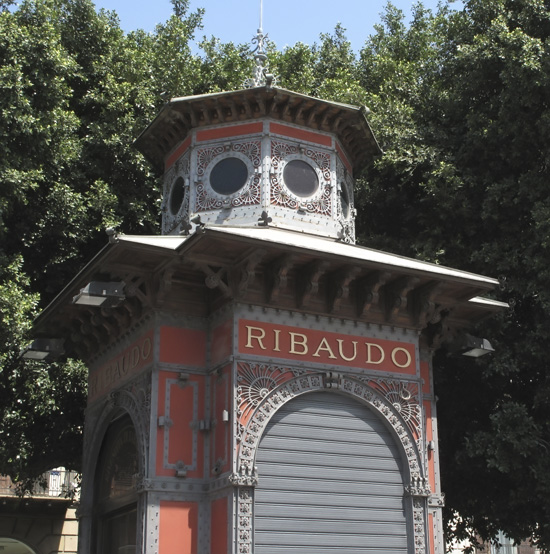
A kiosk at the street corner in front of the Teatro Massimo.
Yet another street corner.
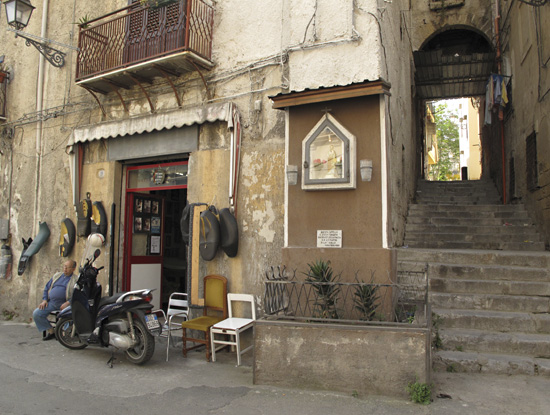
This little shop repairs scooter seats. Most of the little businesses seem quite specialized.
In short, I love Palermo, and look forward another visit. It offers plenty of dazzling sights to wow any visitor. But it remains “unpolished” (to my eye). It is genuine and without pretense, as were the people I was fortunate to chat with.
I traveled in the south of Italy having heard many comments about the stark differences with the north. But I wanted to form my own impression, so I suspended judgement and simply walked, saw, talked and felt the nature of the place.
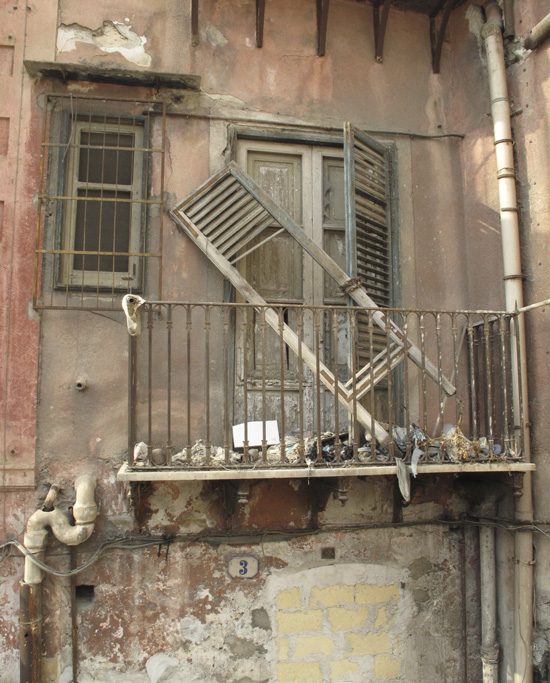
Palermo is, indeed, “gritty”, and not just because of station construction as I was told. It’s gritty in temperament and surroundings. There are far more half-tumbled-down buildings. Far more disrepair. Is it from a generally lower income? Perhaps. That’s what I’ve heard, but not knowing the stats, I can only guess at that conclusion. Is it from a lack of pride in the Palermitani surroundings? I really doubt that! (And who would I be to come in for a few days and judge that they are lacking in pride?! Ha!)
I really covered territory, on foot, around Palermo! Sure, I followed the main avenues, but I especially walked into small, very local neighborhoods where people were simply going about their days. Tourism was not their efforts’ focus, and therefore, I wasn’t met with the look of boredom or disdain that I found in other cities focused on gleaning travelers’ funds.
And perhaps it’s naiveté, but at no time did I feel my personal safety was in question as a single woman traveling alone. By glancing at some of the areas I entered, one might think they were unsafe places to be. But my radar never sent me any alerts.
Palermo gave me visions that stunned me with history and beauty. It also gave me contrasts, which tell the non-fairy-tale story of the place. Palermo is unscripted and organic and I like the truth of it.
– – –
I had booked the B&B Kemonia for two nights, but within an hour after arriving, I changed it to 4 nights. It was an ideally-situated, very cozy home base, and Riccardo, the owner, was a dear and very helpful with his recommendations. My room, 5 floors up, had a lovely balcony looking out over the city street and the hill beyond.
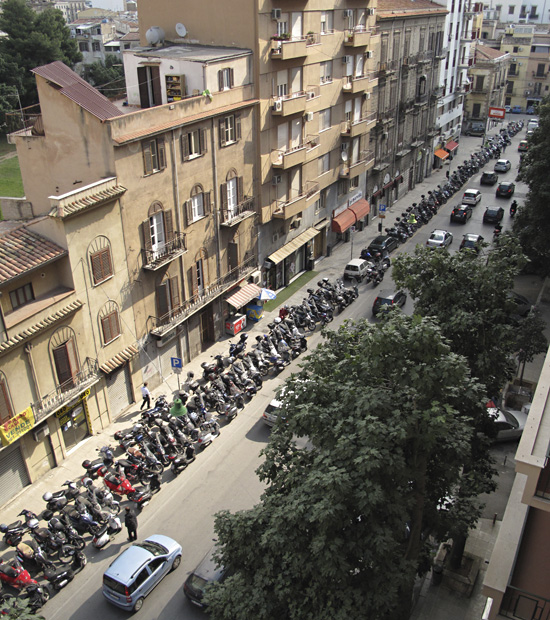
From my balcony, I looked down to the long string of scooters parked in their designated area.
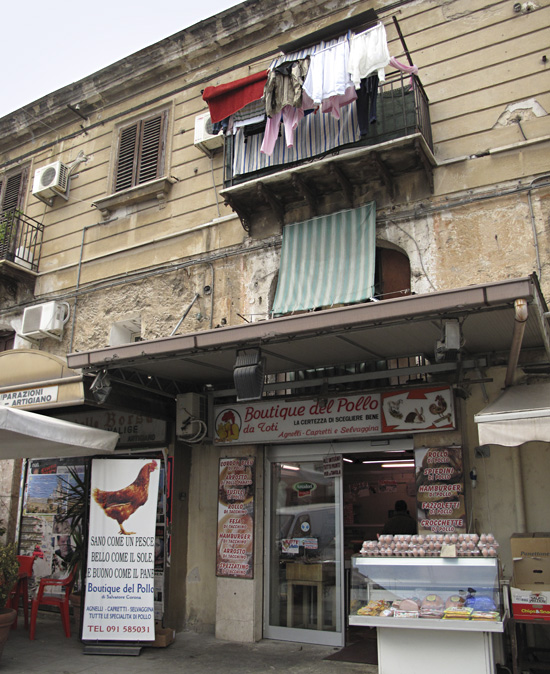
Just down the street from the B&B, close to the large, Capo market, is “The Chicken Boutique. Healthy like a Fish. Beautiful like the sun. Good like bread.”
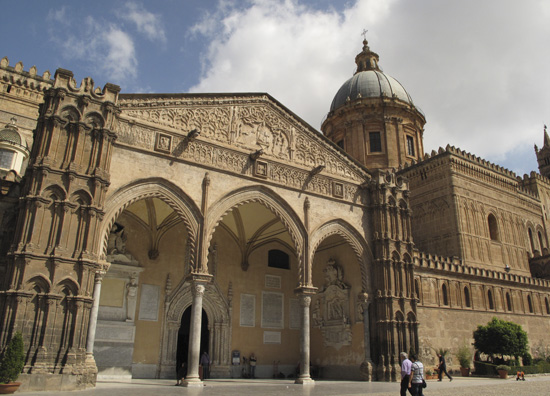
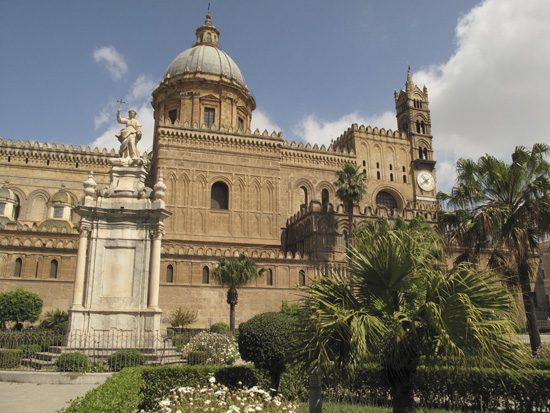
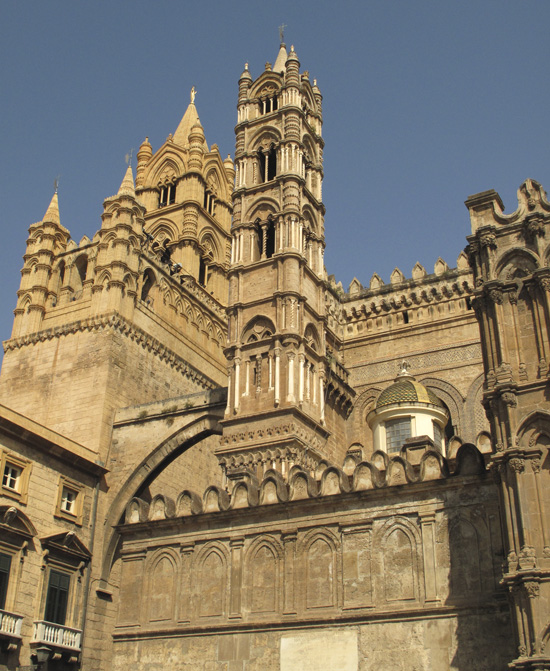
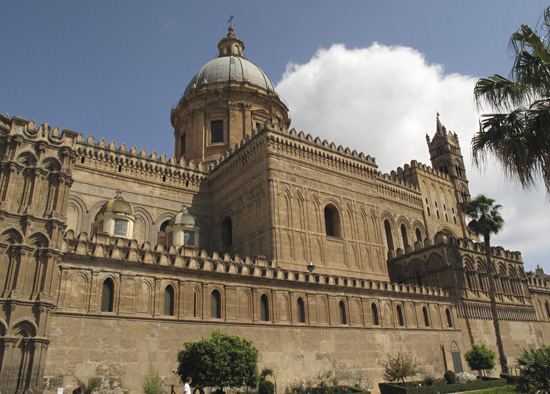
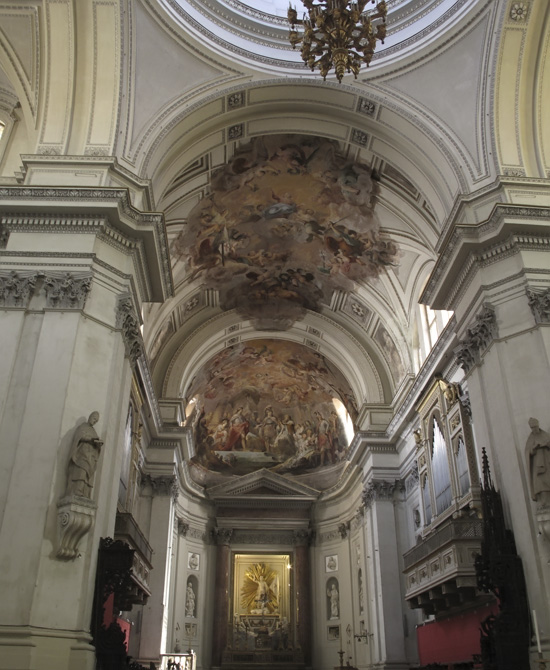
Some travelers have said they get tired of seeing “yet another church!” Right or wrong, the churches became the focus of creative and financial efforts, often over centuries of construction. These efforts yielded grand, physical monuments to artistic and architectural expression, engineering prowess, religious fervor, political power and regional positioning. Not “just another photo op”. And to this day, in the lives of a religious people, the central cathedral or duomo is the heart of the town, and the main piazza out in front is the “living room” and central gathering point. It is with this understanding that one should marvel at Italy’s remarkable cathedrals.
Palermo’s Cathedral is not far from the Palazzo Reale, the Royal Palace.
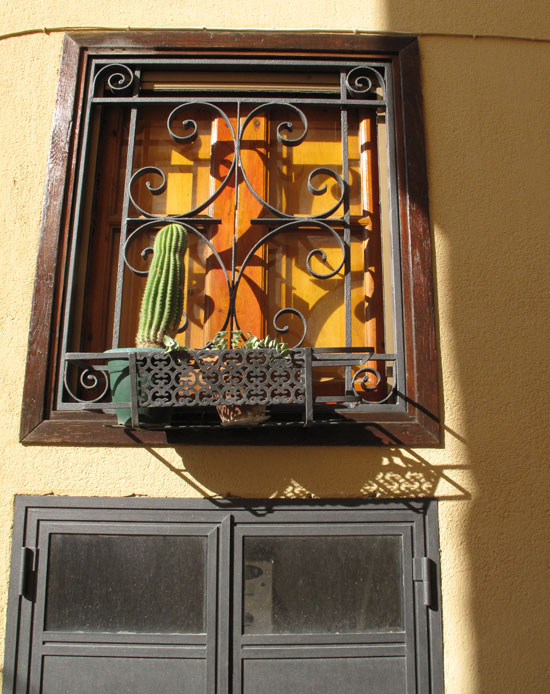
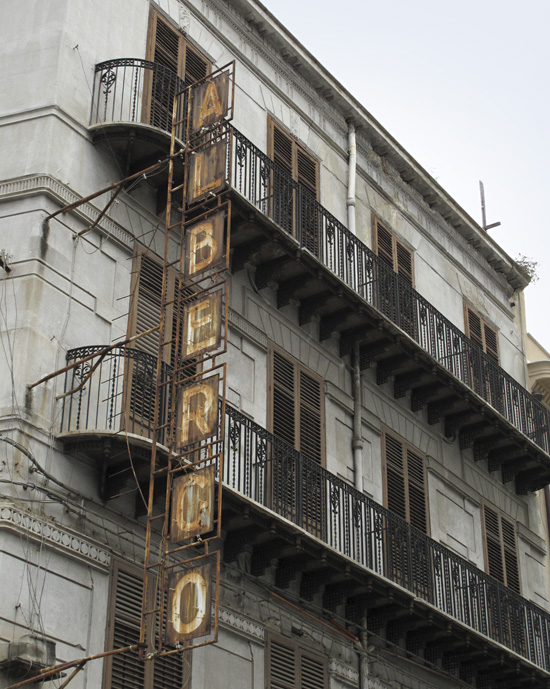
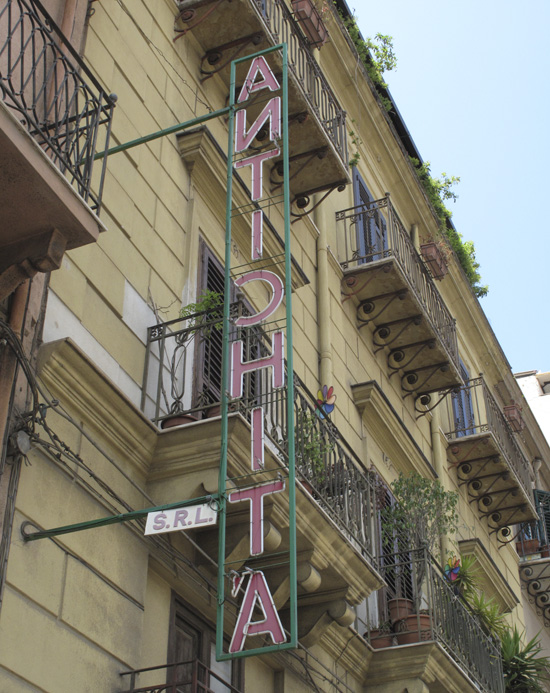
All over town there are visual details that caught my eye and stopped me. “Albergo” means “hotel”.
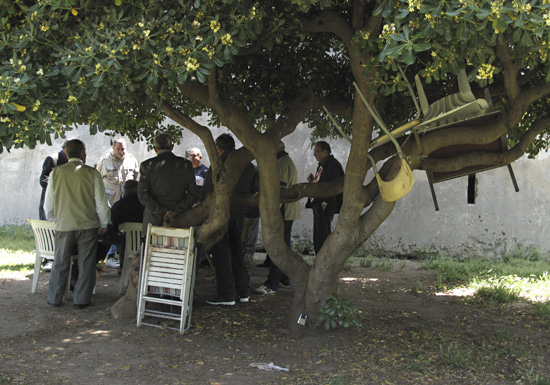
Out in front and along the wall of the Palazzo Reale, there were several groups of men intensely playing cards.
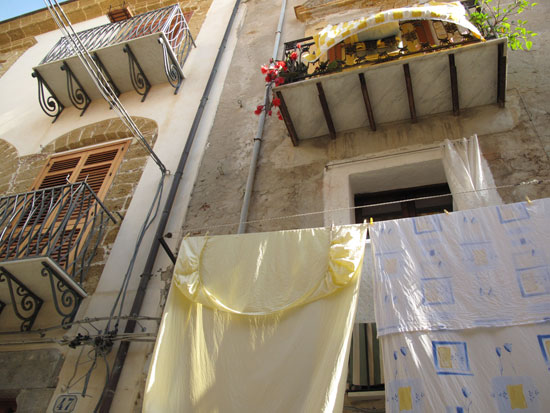
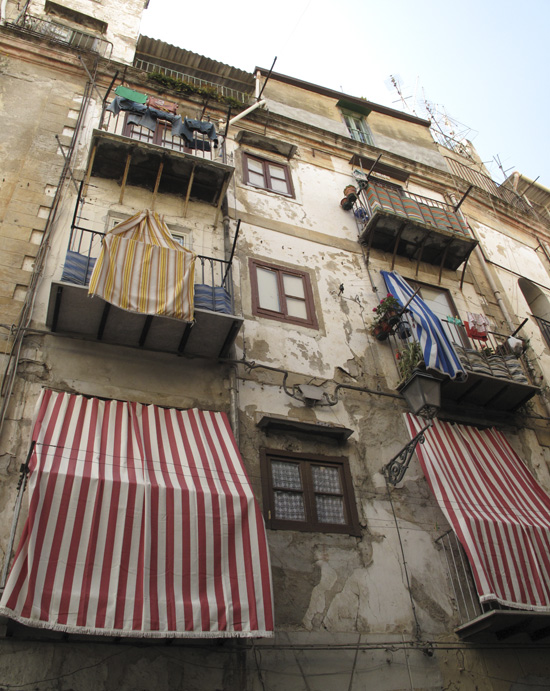
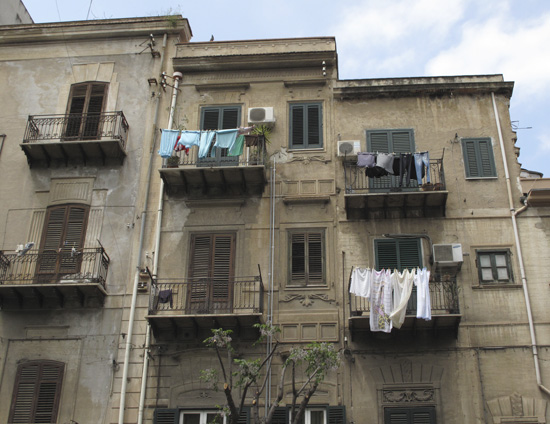
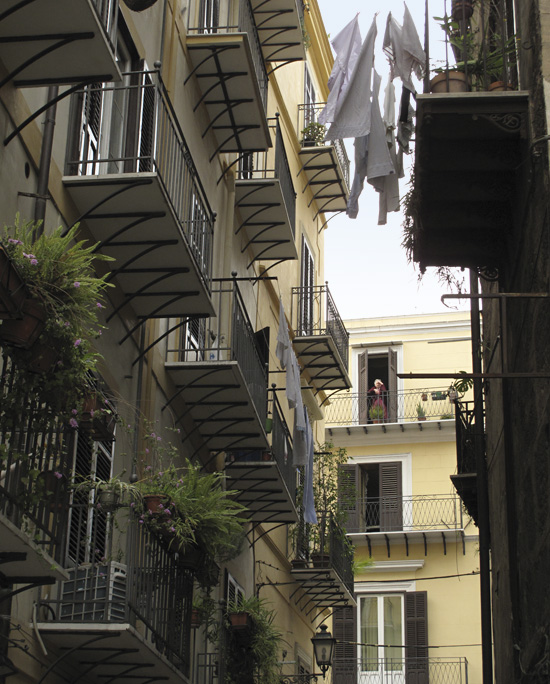
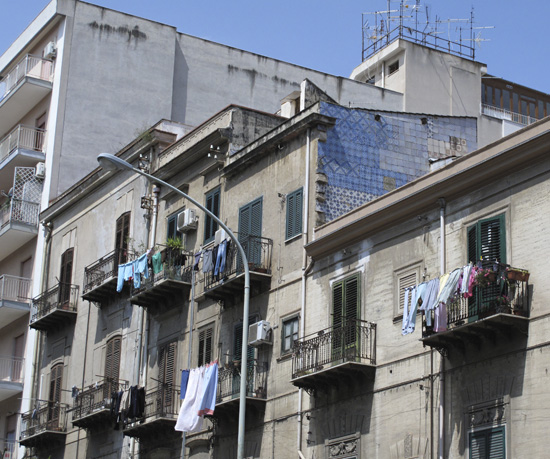
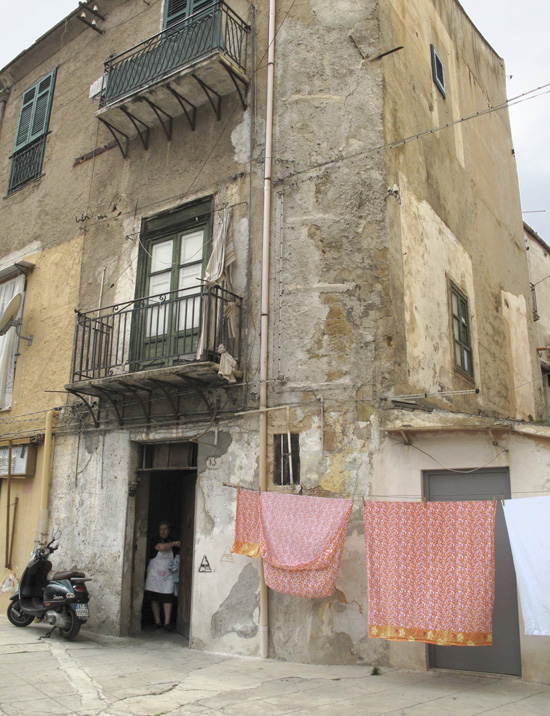
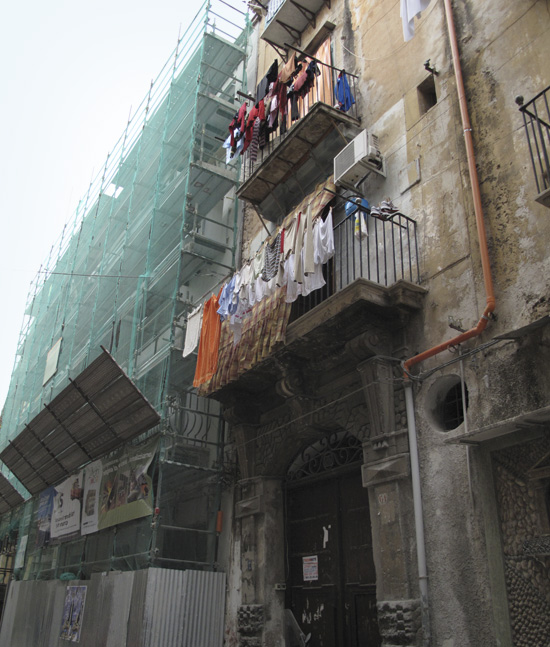
As Americans, we think that the hanging laundry is picturesque and quaint. (Granted, from a visual standpoint, I enjoy it, too.) But it’s simply functional. There are no clothes dryers here.
How clean will that laundry remain when hung to dry next to a construction site? But what other options are there?
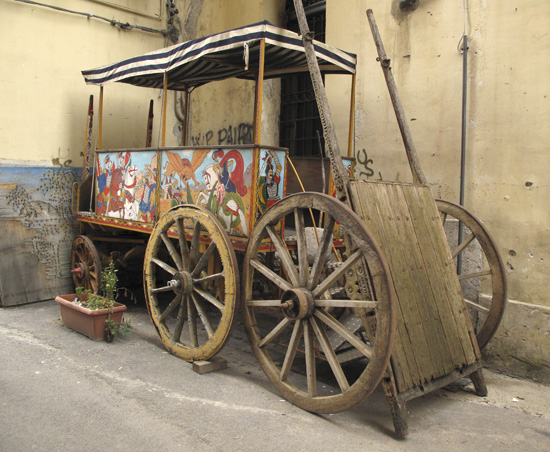
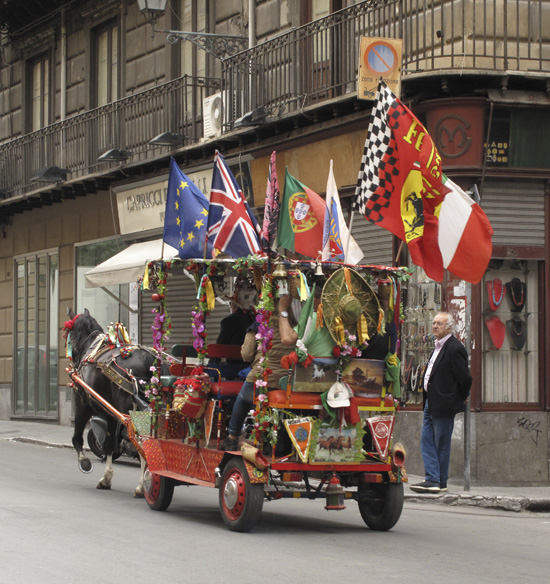
Decorated carts, Carretti de Gara, were used for weddings and parades, a variation of the simpler, traditional work carts. Tucked into a narrow alley way, I found the repository of carts-in-waiting.
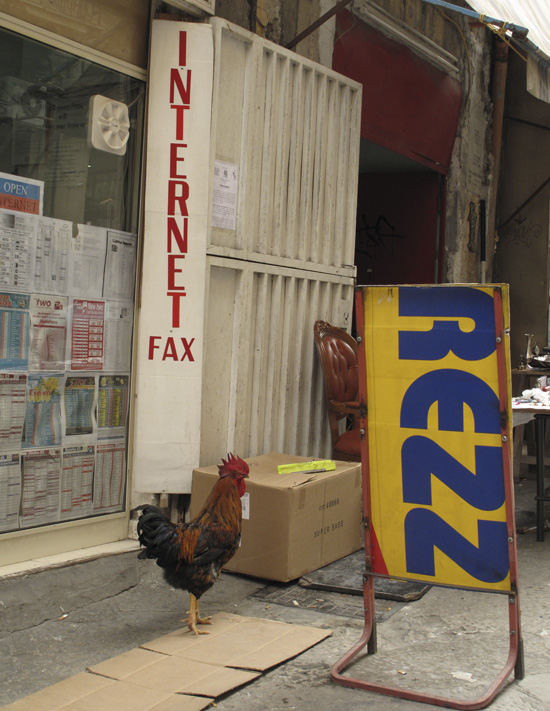
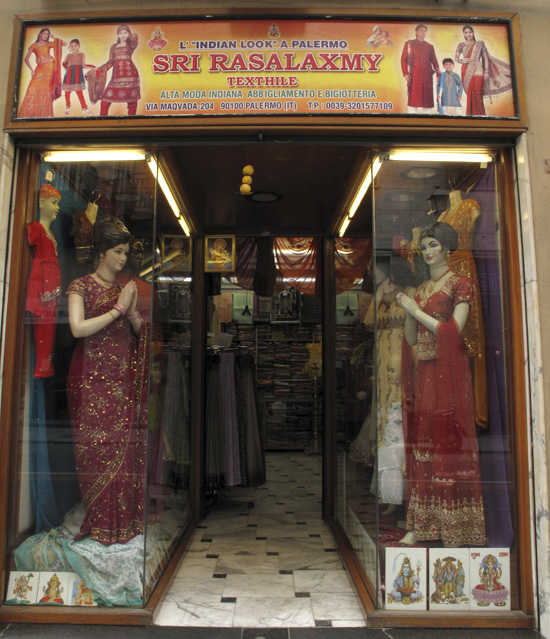
Surf the net, send a fax, buy a rooster.
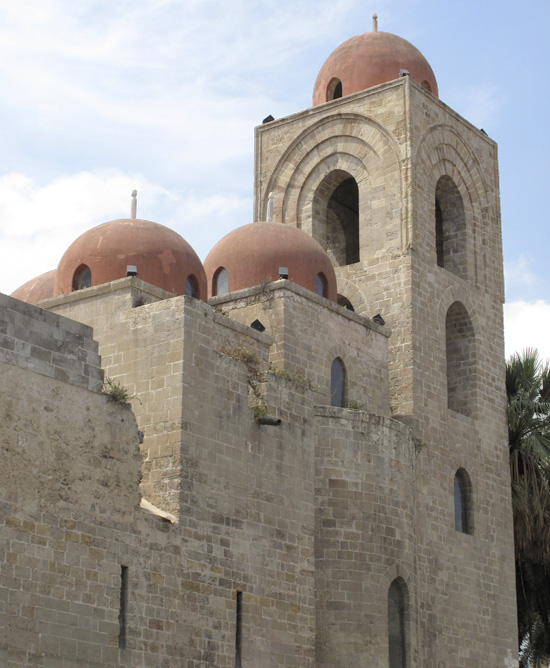
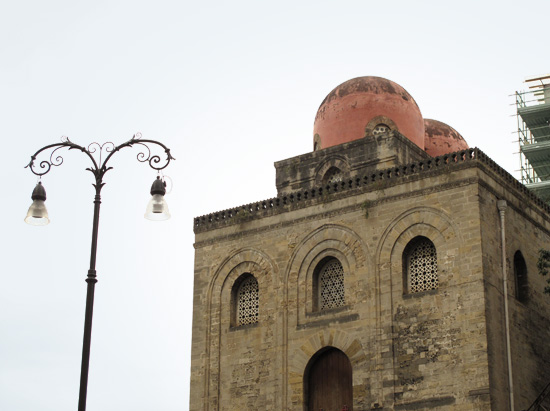
St. John of the Hermits. The red domes show up in several places around town.
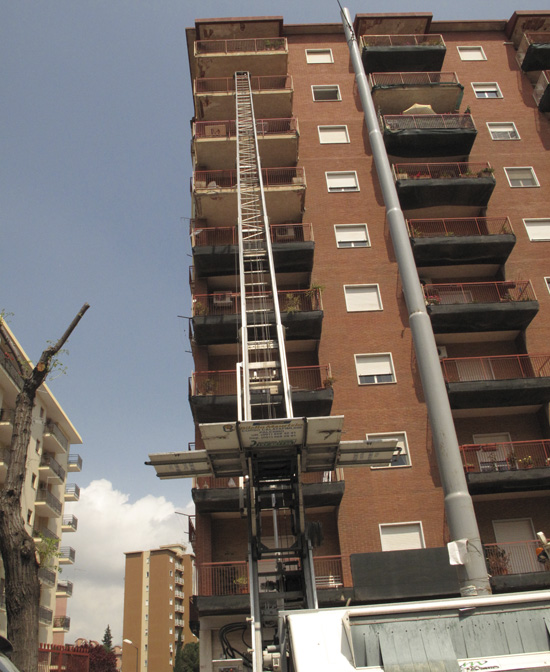
Considering most “lifts”, when present, are only big enough to carry 3 people and a vertical stack of suitcases, HOW does one move into an upper floor apartment? Moving services elevate all the household belongings on an exterior platform and go in through the balcony door.
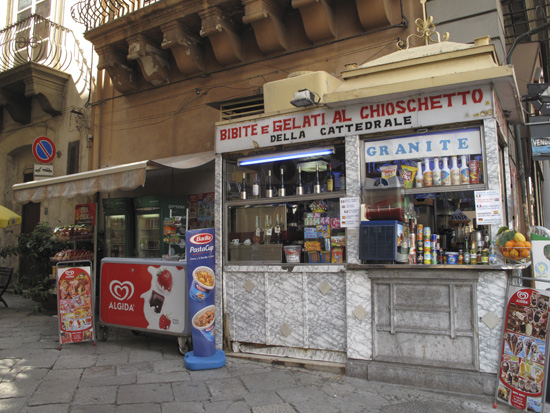
Drinks and gelato near the cathedral.
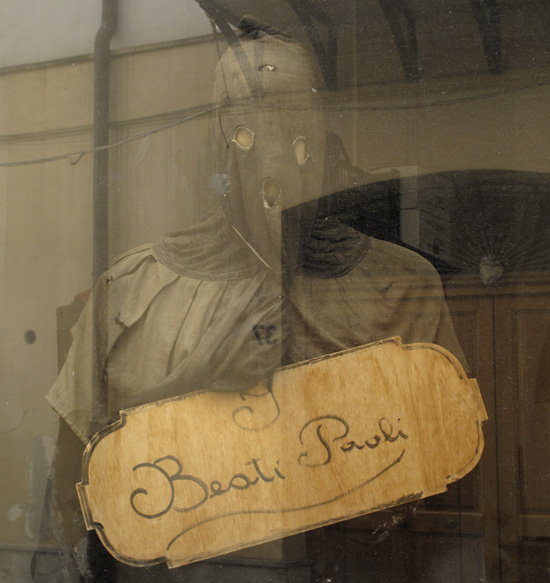
Just down the narrow road from the Capo market, I saw this grim figure in a window and was stunned. It wasn’t until I looked it up later that I learned more about the history/legend of the Beati Paoli.
From Wikipedia: Beati Paoli is the name of a secretive sect thought to have existed in medieval Sicily. The sect resembles an order of knights fighting for the poor and the commoners. The Beati Paoli have the same connotation to many Sicilians as Robin Hood has to Northern Europeans. Today you will find traces of the Beati Paoli in the Capo district of Palermo, where a square, a street and even a restaurant bear their name. In Sicily the Beati Paoli came to be seen – both in the popular imagination and in the ideology of mafia groups – as a proto-manifestation of the Mafia.
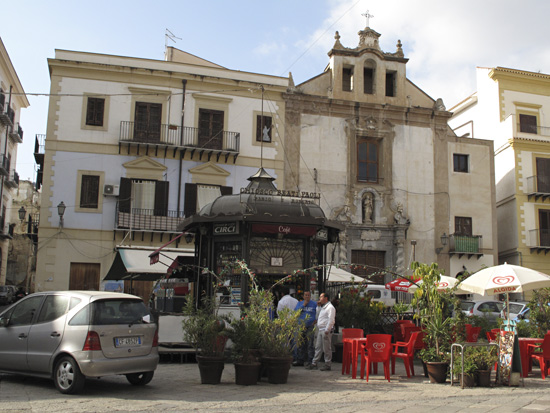
Note that this snack kiosk is named after the Beati Paoli.
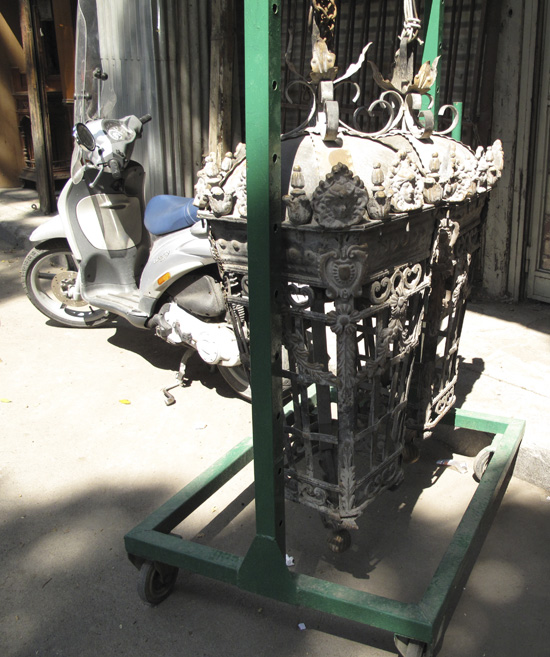
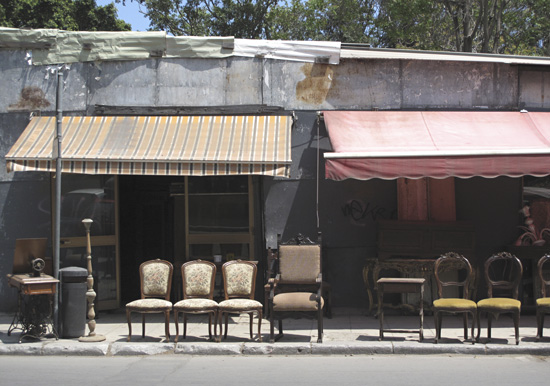
Antiques for sale near the Mercato delle Pulci, in the “restoration district”.
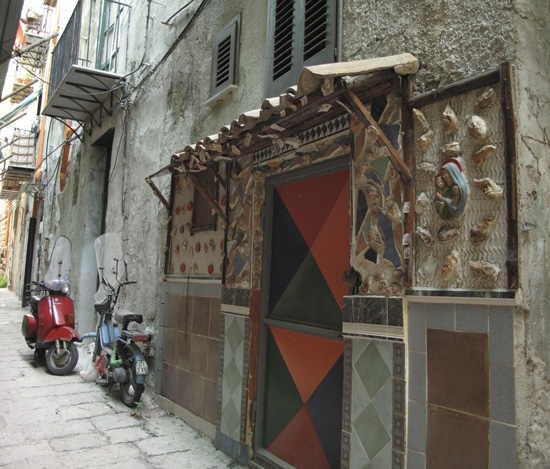
Don’t artists everywhere personalize their homes and spaces?!
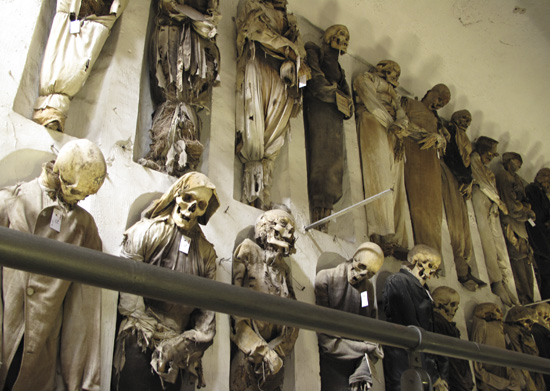
I walked up, up, up the road to the Catacombs of the Capuchin Monks, begun in the 16th century. Sections were later created for priests, lay men, women, professionals, artists and children. Photos are not allowed.
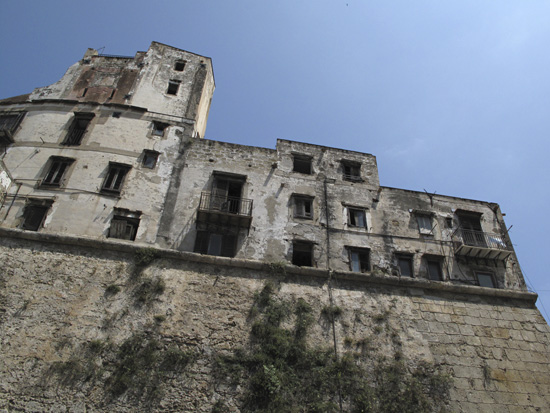
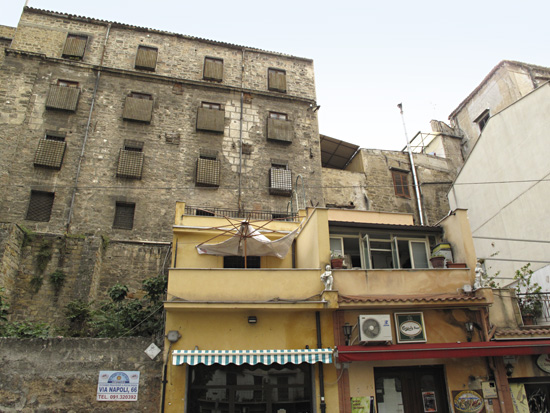
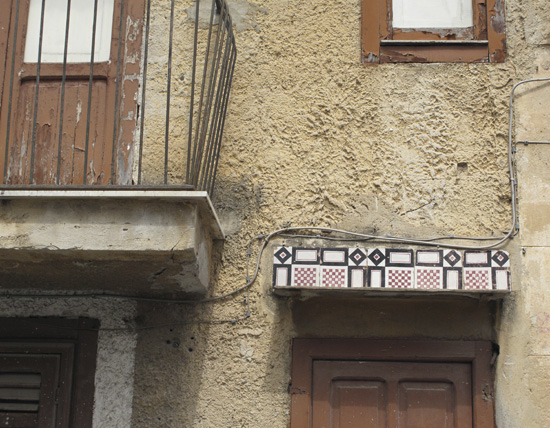
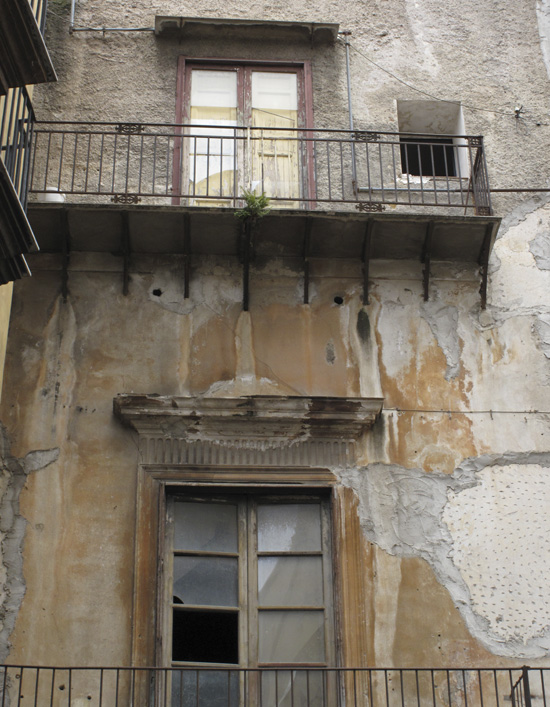
I’ve traveled in much of Italy and something I’ve seen in every region and admire greatly is the evidence of “mend and reuse”. Rather than tearing down a building and starting over, I see patches and revisions, layering up the centuries of history in a structure. Closed-up doorways and windows leave traces, and their styles tell us when it was that they were open.
This old mattress frame is an innovative gate and doorway.
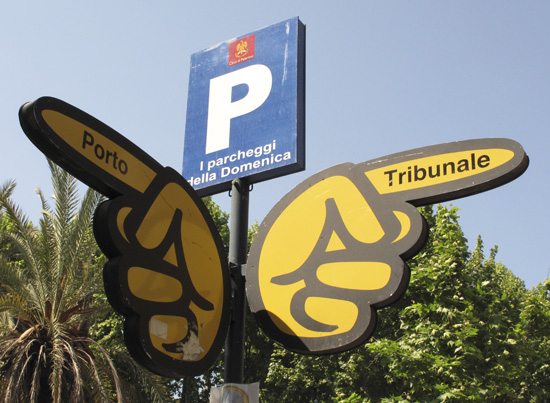
Bold, modern wayfinding signage. (Looks like the “Zapf Dingbats” font to me, but I like it.)
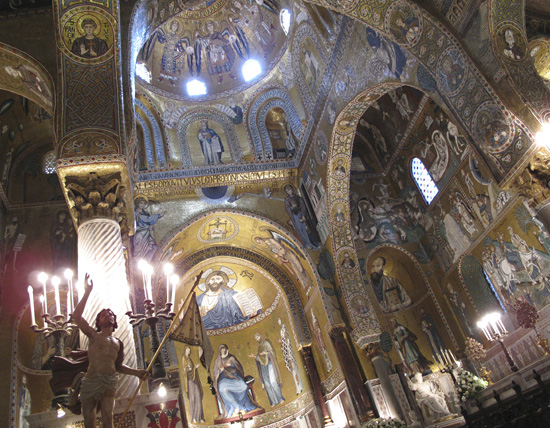
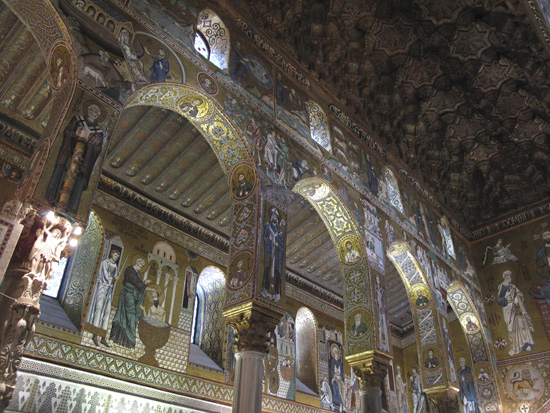
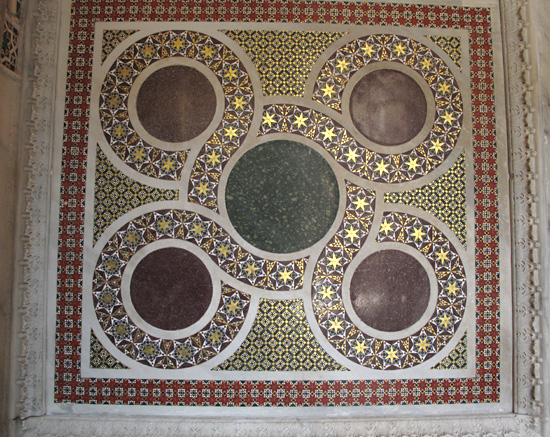
La Capella Palatina, the Palatine Chapel, quite simply, is stunning. The fineness, the modeling, the extensiveness of the mosaic-work that covers the interior astounds. (Much like the duomo of Monreale.)
From Wikipedia: The Palatine Chapel is the royal chapel of the Norman kings of Sicily situated on the ground floor at the center of the Palazzo Reale in Palermo, southern Italy.
The chapel was commissioned by Roger II of Sicily in 1132 to be built upon an older chapel (now the crypt) constructed around 1080. It took eight years to build and many more to decorate with mosaics and fine art. The sanctuary, dedicated to Saint Peter, is reminiscent of a domed basilica. It has three apses, as is usual in Byzantine architecture, with six pointed arches (three on each side of the central nave) resting on recycled classical columns.
The mosaics of the Palatine Chapel are of unparalleled elegance… The oldest are probably those covering the ceiling, the drum, and the dome. The shimmering mosaics of the transept, presumably dating from the 1140s and attributed to Byzantine artists… The rest of the mosaics, dated to the 1160s or the 1170s, is executed in a cruder manner and feature Latin (rather than Greek) inscriptions. Probably a work of local craftsmen… This may be the only substantial passage of secular Byzantine mosaic extant today.
The chapel combines harmoniously a variety of styles: the Norman architecture and door decor, the Arabic arches and scripts adorning the roof, the Byzantine dome and mosaics. For instance, clusters of four eight-pointed stars, typical for Muslim design, are arranged on the ceiling so as to form a Christian cross.
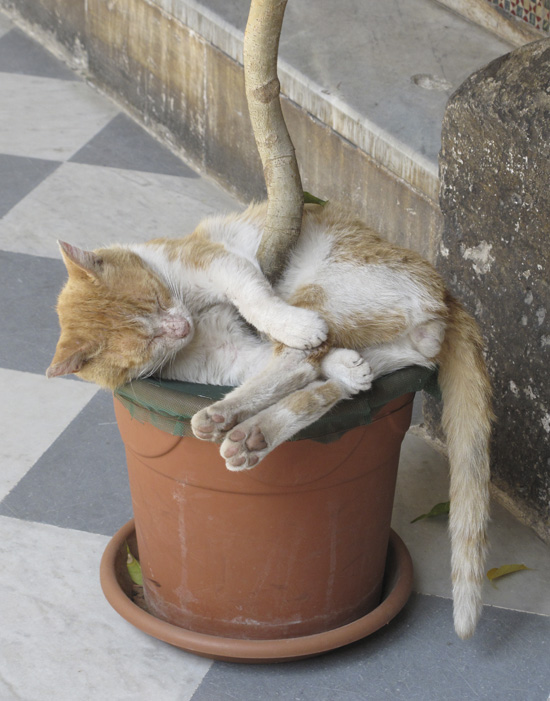
Immediately at the entrance to the Capella Palatina, with groups of foreign tourists and school kids streaming by, is a tough tom cat, sleeping wrapped around the trunk of a potted tree. He is imperturbable. Everyone watched to see that he was, indeed, still breathing. The kids were more enrapt with “Tom” than with the mosaics.
Traveling here in Sicily, I’ve most enjoyed Palermo because of the people I’ve met, “just plain folks” going about their days. They’ve been open, expressive, engaging, willing to get into conversation about work and life.
Cerainly, there’s Riccardo, the owner of the B&B Kemonia who was so helpful and friendly that I changed my stay from two nights to four. He was right-on with restaurant and itinerary recommendations, such that that it was “worth the price of admission” to have him as a guide.
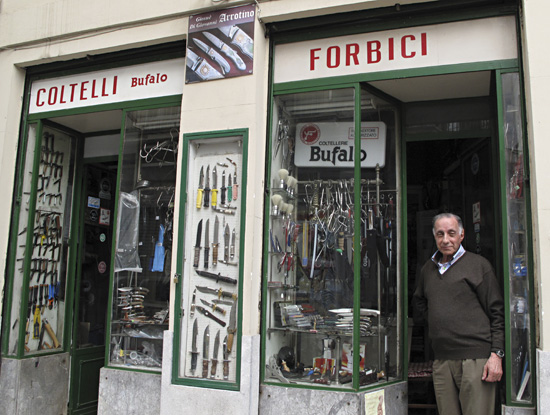
There’s Giosué, the knife and scissors seller. He took over the little shop from his father and grandfather – their photos mounted on the wall next to the saints – but has no one to pass the store onto.
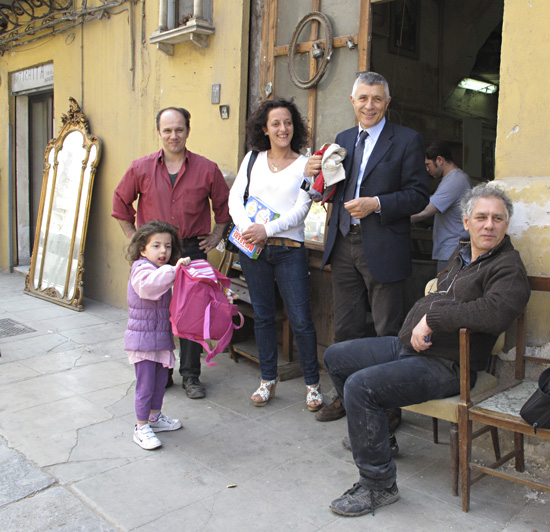
Marilena and her daughter met me along the sidewalk in the “restoration district”. She drew in two furniture restorers and a city manager to the conversation and talk of Palermo’s history. (We were friends on Facebook by nightfall.)
At the Mercato delli Pulci, I stopped to talk to Bruno in his dusty, sparse, antique shop, one of those wrapped around the tree trunks. I picked up a crystal lamp’s tear drop and told him of a “worry stone” given to me by an elderly, veteran friend… That the stone is symbolic and nice to carry around. He gave me the crystal tear drop and I told him I’d remember him when I saw it. I shot his picture holding it.
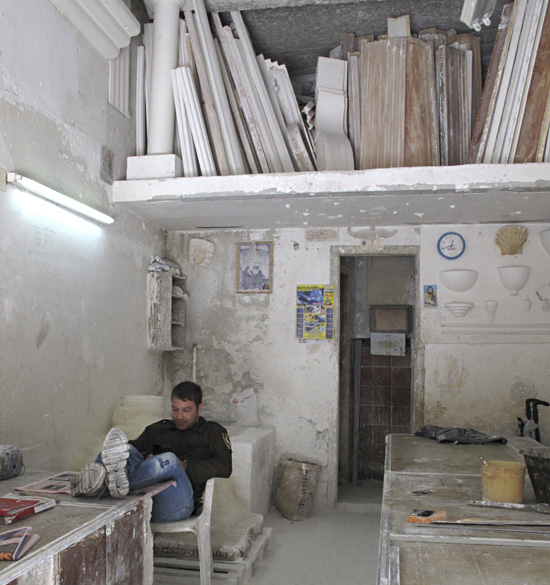
Then there’s the young plasterer, feet on his desk, surrounded by white plaster on the walls, fallen to the floor and thrown to the ceiling. He makes plaster moldings and decorative cornices.
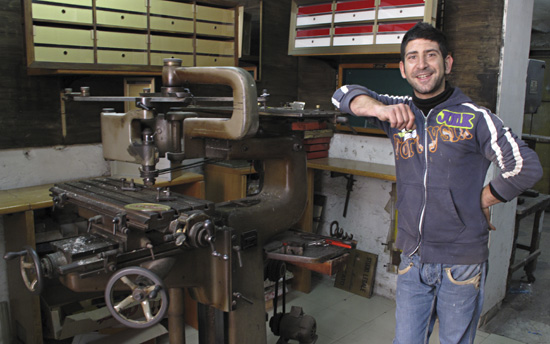
In my quest for old signs, I stopped into bright-eyed Vittorio’s sign shop to inquire. His workshop was old and oversprayed, yet tidy. He dug through his old samples and found a new elliptical sign to give to me, then posed alongside his old “pantografo” machine. We chatted, then I left and got l one block down the road when I heard my name being called. Vittorio had run after me because I had forgotten to take the little sign he had given to me.
Increasingly in my travels, my most treasured souvenirs are the faces of the people I’ve met along the way, and recollections of the conversations we’ve had. Without language, this would not be possible.
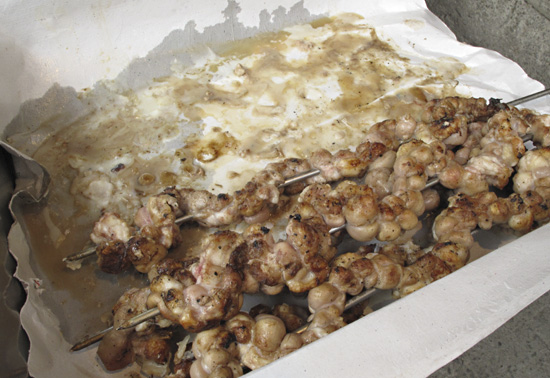
Coming back from a day trip up the hill to Monreale, I got off the bus at Piazza Indipendenza and started walking home to my B&B. Off on a low side road, I saw smoke and smelled grilling meat. “Milza“? (Sicilian, cooked organ meats.) No. It was skewered veal intestines and they smelled great.
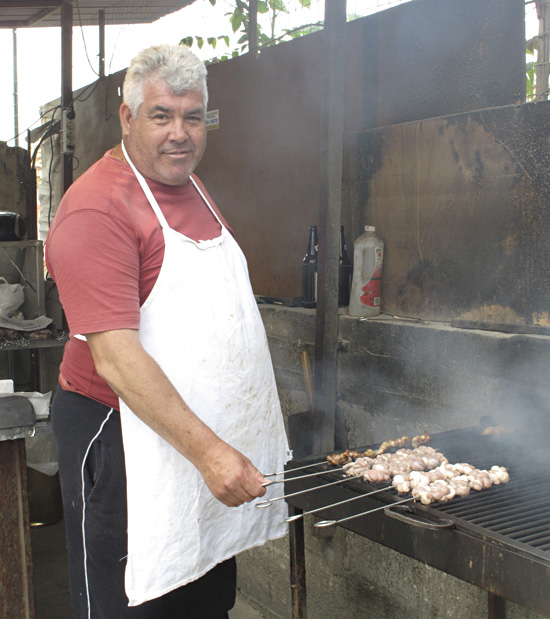
The guy had a little cart on the sidewalk in a torn up construction zone. NOT the kind of place any germophobe would eat! No running water, but rather a gallon bucket with water that had oil floating on top.
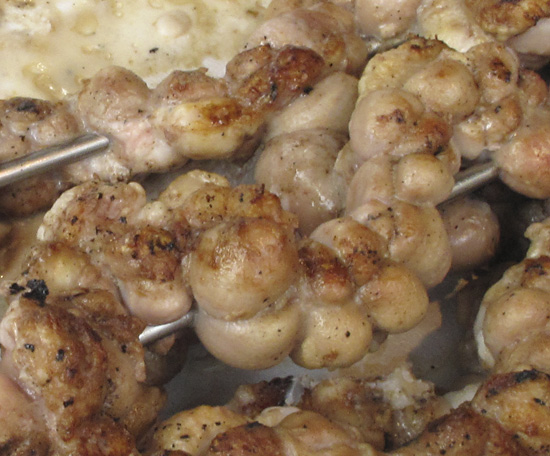
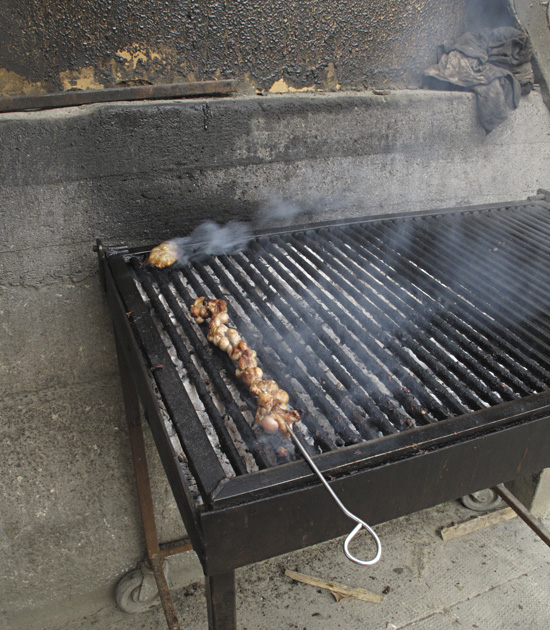
The bowels had been zig-zag plucked onto the metal skewers and partly precooked. I ordered one: “Budello… Stiglione”
The grill was smoking hot… A good sign.
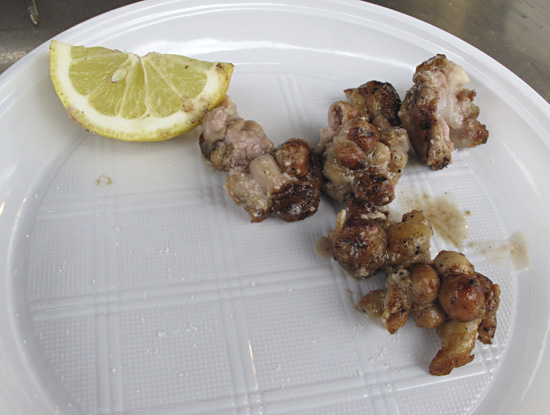
The “chef” cooked the skewered gut until it was hot through, then skimmed it off the metal rod onto a cutting board that’s been working all afternoon. He motioned me to stand aside while he cut the fatty gut into bite-sized chunks, splurting grease as he did so. He swept them with his knife onto a plastic plate, added a wedge of lemon, then showed me the tub of salt that at least a hundred hands have visited just today.
I wagered the risks, paid my 1.50 euro, then started eating with my post-public-bus fingers. A mouth experience much like fatty liver: that consistency and flavor with pockets of hot, grilled grease.
My Siciliano-Palermitano adventure left veal guts in my teeth and a smile on my face. Italy has made me far less cautious about the foods I eat, and the FDA would think I’m tempting fate by trying it all. But bring it on! Yum.
In pushing myself to “pack light, pack light, pack light”… in wanting to ease any worry about leaving my laptop behind in my hotel room while out exploring for the day… and in urging myself to go as “unplugged and off-the-grid” as I can stand, I left my laptop with a friend in Milan and am traveling around the south of Italy with just an iPad.
This is a great experiment for me on many counts, not the least of which is the technical limitations of the device and my ability to interact with the blogging interface. So far, I haven’t figured out how to upload photos from my iPad to the blog, but I may figure that out along the way, during my “spare time” when I’m not out wandering the little back streets or sitting in a trattoria eating spaghetti with sardines.
Rest assured, I’m gathering lots of images and also lots of experiences, meeting people every step of the way. Perhaps after I return to Milan I’ll have a marathon photo upload session and go back to add photos to my Sicilian and Pugliese posts. Stay tuned!
Journal entry from my lunch table: “In piccolo Trattoria Tira Casciuni a Palermo. Stare qui in Sicilia, in Italia, e veramente una droga che mi sento in tutto il mio corpo. E perche no? Perche non prendere questa droga?”
In the little Trattoria Tira Casciuni in Palermo. To be here in Sicily, in Italy, is truly a “drug” that I feel in my whole body. And why not? Why not take this drug?
It’s intoxicating to be here, to simply have my eyes open. And the constancy of the dusty city traffic, the impatient accelerations, the gratuitous horns, prevent any sense of calm. There is a frenetic motion to this tight living, these close quarters.
Riding into Palermo from the airport I looked out to the tiny stamp-sized lots, some barren, some isolated garden oases, and thought about the luxury that is my own divine home in Seattle. I truly could not be more blessed by a gift of space, beauty, privacy and silence.
So, is it contrast that makes this energetic buzz so fascinating? It’s also quite exhausting, as I find in Milano. I find that I seek a pause after a time, a respite of stillness.
In this little Trattoria, the daytime TV is hardly a talk show, but rather a shouting match – truly – as scooters whiz by the open door 10 feet away. How is it to know little other than this relentless frenzy?
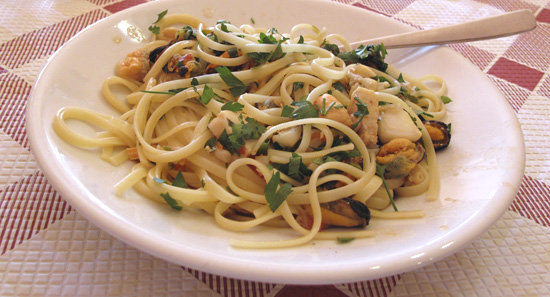
I ordered Spaghetti allo Scoglio, with mussels, sword fish, clams, squid, parsley and a light broth. The house wine, in this case, was pretty rank, but it’s often a good option.
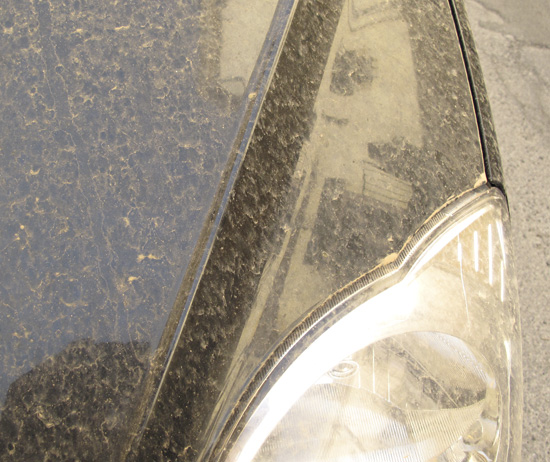
Every car here in Palermo is covered with a spattered gritty film. Is it the air? Is it the surrounding countryside blowing in? Does the literal gritty nature give hint to a figurative grittiness?
(The restaurant owner just explained, in answer to my question, that they’ve been building a new train station for several years and will finish in 2012. Before the construction, everything was “clean”.)
How fabulous that I can HAVE such conversations!!! I’m thrilled.
Always an exercise in “packing light”, I keep removing things from my one-and-only carry-on bag for two weeks in the south of “The Boot”. After a week in Milano, I’m heading to south to wander around. First, I’ll explore Sicilia for a week. Then I’ll take a train along the “sole of the boot”, to Puglia, right at “the heel”. I’ll stay for a couple of nights in a traditional Trullo in Alberobello (Google: trulli alberobello italy), then a couple of nights in Lecce, close to the tippy-tip of “the heel”. (I always like going to the most distant points of a place. What is there about that?)
After Puglia, I’ll train up along the Adriatic sea coast to Le Marché, and stay in Marotta for a couple of nights. Swimming pools and the seashore. Ahh.
During this time, I’m leaving my laptop and external harddrive behind. (Gasp!) I’ll be mostly unplugged and “off the grid”. (Double gasp!) But I’m experimenting with an iPad and will see what kind of wifi reception I have and whether I can get online or not. If so, there may be blog posts from the south. If not, there’ll be a loooooong silence.
After this two week flurry, I’ll head back north to Milano and get settled into an apartment for a month. I’ll be back to doing my client work, riding my bike along the canal, AND having twice-weekly tennis lessons!
Time to pack away the computer and zip up the suitcase. I’m off and away.
Given a beautiful, 70-degree, blue-sky, springtime day in Italy, it was a joy to get out on a bike again for a ride along the canal! It’s been 9 months, and I’ve missed it. That ride, and being on two wheels, invigorates me and makes me feel so alive. And I love the still and vast farm fields in contrast to the intensity of the city’s stimulation. One provides balance to the other.
The red poppies are blooming here and there along the canalside stone fences, and the rapeseed is sporadic, not filling the fields as it was last year. The distance of the bike path is fragrant with all sorts of blooming things and the cottonwood fluff is thick in the air and on the surface of the canal.
I had seen this woman selling fresh eggs at the Saturday Market last year, too, but neglected to shoot a video because I was standing there spellbound.
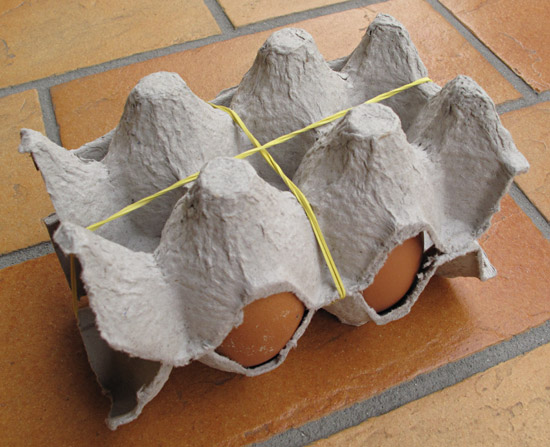
She grabs a large square of egg carton, slices the needed size, then plucks and places the eggs requested. I marvel at how fast her hands fly and at the intriguing and innovative ways she wraps the rubber bands, which is a bit hard to see because she moves so quickly. Watch for that second little wrap she puts on each short side.
How many sales every Saturday morning? How many times has she made this wrap?
She wraps any combination of 2 eggs. How about 10?
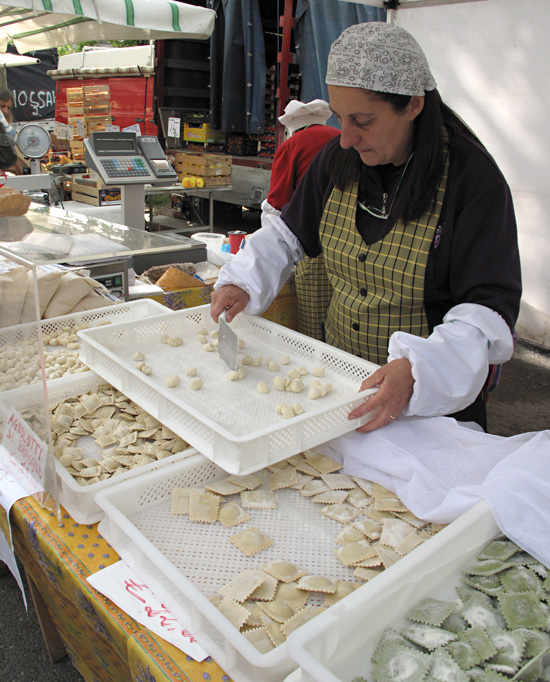
How can there be any other way to eat? The Saturday market is now just one block away from my apartment and it goes on for blocks. The selection of meats, cheeses, fruits, vegetables, and other delicious things makes the market a must-stop. Apparently everyone local thinks so, too.
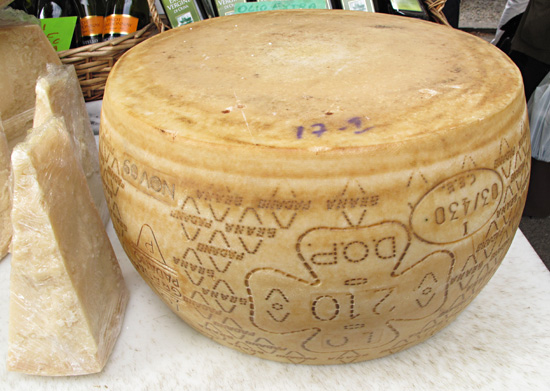
Ahh! Grana Padano! Note the pattern on the side of the cheese wheel. When you see that diamond-shaped imprint, you know it’s the real thing.
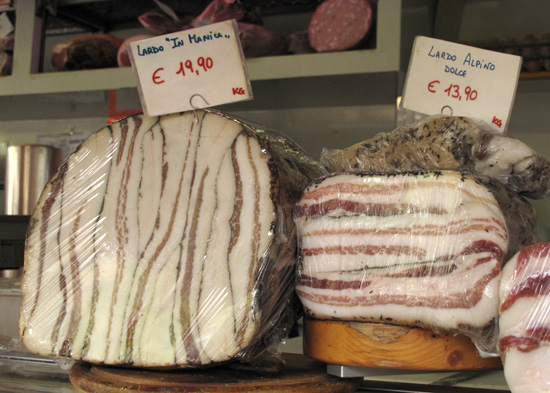
Why have butter when you can have lard (or olive oil)? Yum! A slice of lard on a good hunk of bread: Yes!
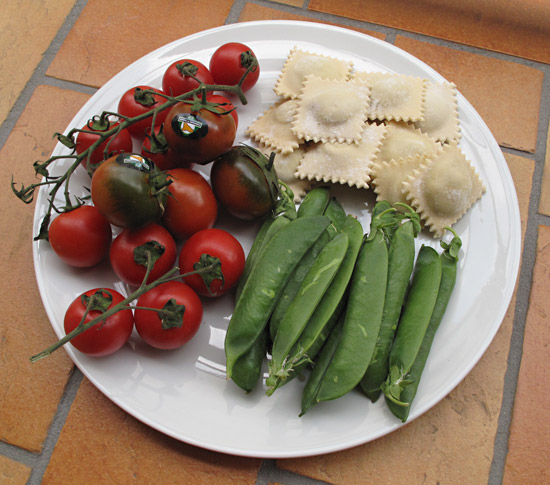
My purchases today included:
Bouquet of anemones for my friend, Ewa
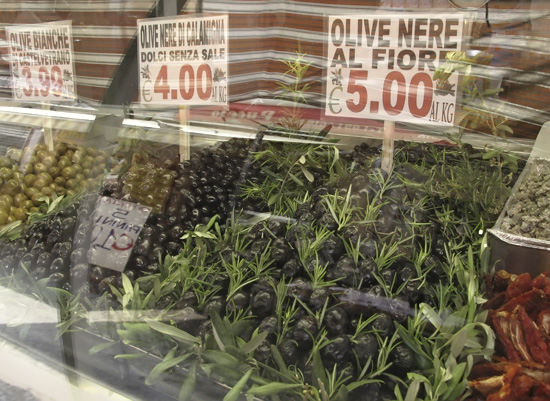
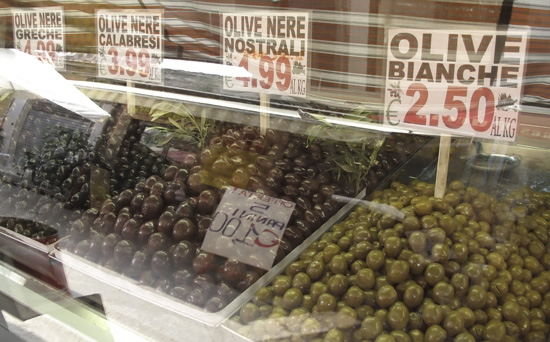
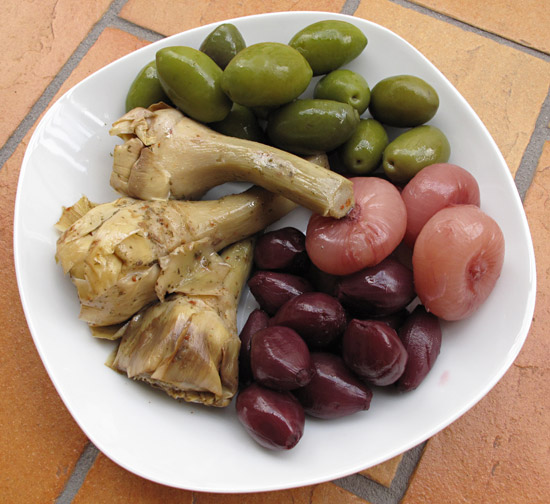
“Sweet” Olives from Puglia – Green and meaty
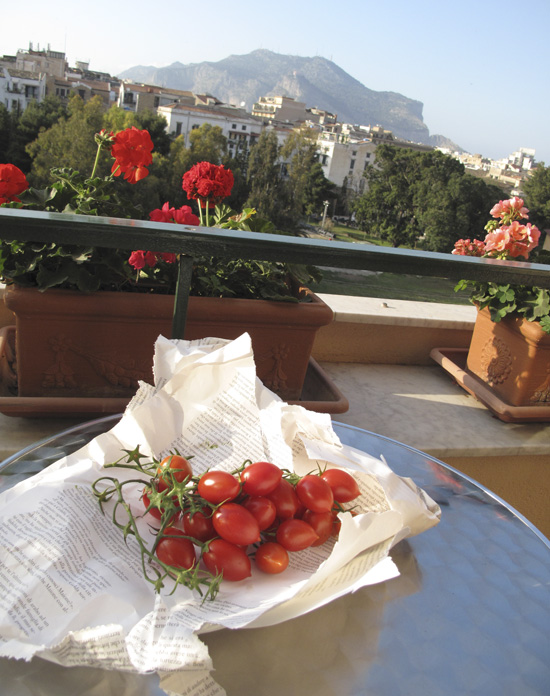
Cherry Tomatoes from Sicily
Pomodori di Pachino – Green and red skinned, crisp tomatoes
Pickled Artichoke Hearts and Onions
Ravioli stuffed with asparagus and fresh ricotta
Basil – dirt still on the roots
Eggs – handwrapped
Peas – fresh in the shell
Mozzarella – freshly made
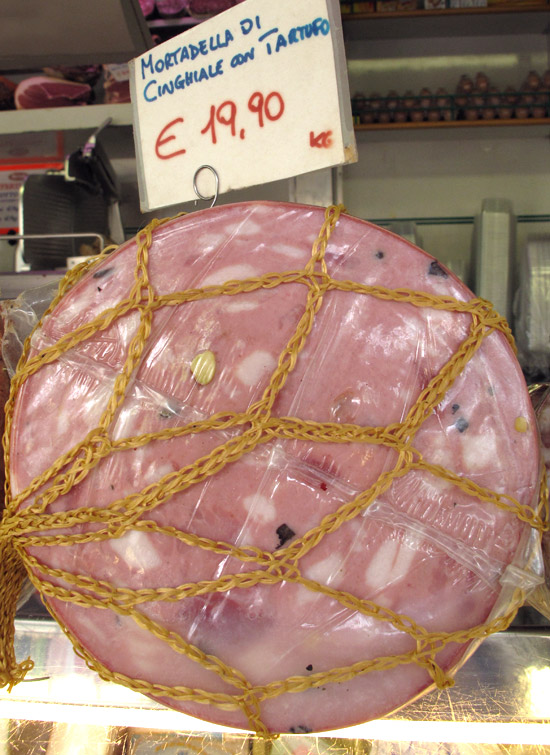
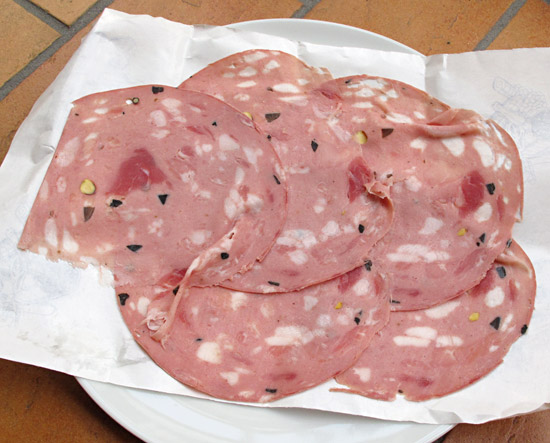
Mortadella of Wild Boar with Black Truffles and Pistachios (!!!)
I couldn’t wait to get home and shove it all in my mouth!
Oooo! The Mortadella with truffle!
The pickled onions and sweet olives!
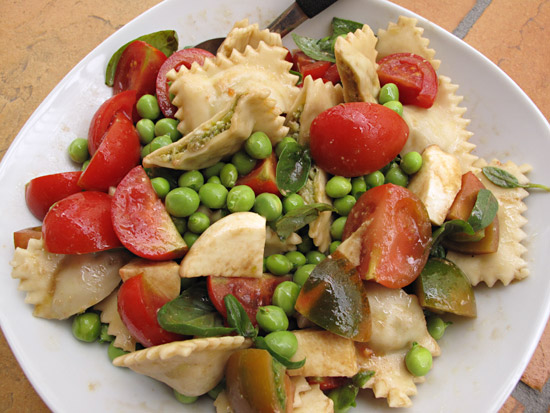
I cooked the ravioli while I cut up the tomatoes, basil and some of the mozzarella. When the pasta was finished, I shelled the fresh peas right onto the hot ravioli, then dumped everything together and drizzled it all with bright green extra virgin olive oil and some crema di balsamico, a reduced balsamic vinegar from Modena.
Oh… Wow. Mmm.
…And this food is not “gourmet”. And it’s not being sold at high-priced, specialty grocery stores. This is daily fare.
Friday, April 29. The Milanese are still wearing their winter jeans, puff jackets and scarves. I’m wearing black linen capris and sleeveless blouses. I arrived in Milano Wednesday at 9:00 a.m., to a morning warmer than Seattle… yet I’m glad to have brought a little summer jacket.
Robin-like birds started singing early this morning. By the time I looked at the clock, it was 5:00 and they had already roused a chorus. I slipped back into sleep, and when I awoke, it was then the doves I heard, cooing in the courtyard trees.
The sky is overcast. There’s a bit of a breeze, and we had both sprinkles and sunshine by day’s end. The church bells just started chiming. It’s a quarter-til-6:00 in the evening. Why aren’t they waiting ’til the hour?
– – – – –
On Wednesday, the short train ride from the airport brought me to Cadorna Station in central Milano. I caught a cab to the apartment I’ve rented for this week, in the hip-and-artsy Navigli district, just blocks away from my old apartment and one of the grocery stores I always used to shop at.
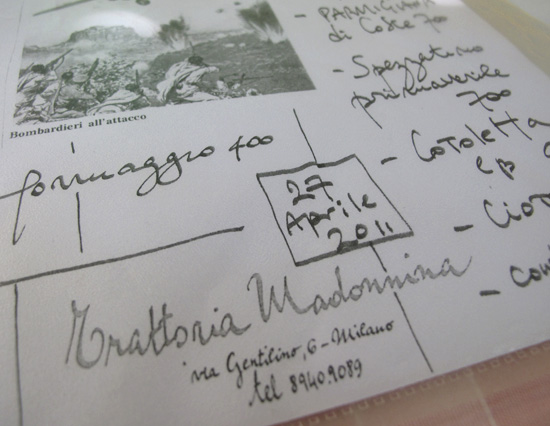
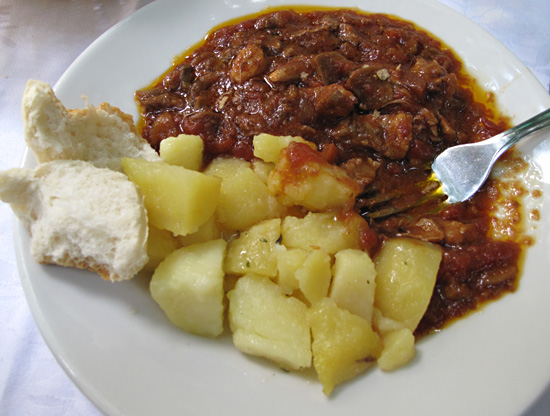
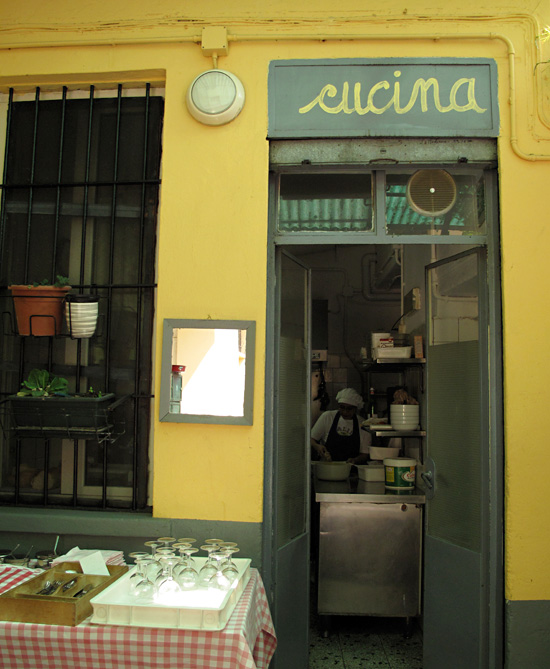
Late morning, drowsy from the long travel and a little hungry, I went across the street to Trattoria Madonnina with its city-wide reputation… for coffee and lunch served by an unhappy waitress. I sat on the courtyard-side, jasmine-covered patio, with red-checked tablecloths and red, plastic chairs. (The WC is an old-style pit toilet with white, ridged ceramic foot pads for accurate positioning.) The morning was slow and relaxed with a cool, mid-spring sun and Milano’s classic hazy-blue sky. Neighborhood locals passed through the courtyard with their big, round “ciaos”.
I stopped in to the grocery to see my friend, Justine, cutting prosciutto in the meat department. She’s the meat cutter at the store and has the most beautiful smile. It touched my heart that her face lit up to see me and we gave each other an excited, european, two-cheeked kiss and chatted between customers.
It feels as if it’s only been 2 weeks since I was last here. As if I was back in Seattle just to check on a few things and see family, friends and clients. Actually, 9 months have passed since I packed up and left Milano, but it feels like I’ve come home, as I walk these familiar streets and hear the city’s sounds of sirens and courtyard conversations, soccer cheers and scooter accelerations.
In planning these two months, I gave myself the luxury of a fairly unplanned first week here in Milano. I haven’t even told all my friends that I’m here yet, because I haven’t wanted this week to be a full flurry of gatherings. I’ve taken my naps and slept as needed to get over the late-nights’ crush to leave Seattle, the long travels and resulting jet lag. I’ve focussed on getting systems up and running. I reactivated my Italian cell phone with its rechargeable SIM card, unlocked my ancient (1st generation) iPhone (thanks to Luigi) and transferred the SIM card from one phone to the other. I was allowed use of the wifi at the Design School and have spent hours online, sitting amidst design students in the computer lab while I booked air and hotels for Sicily and Puglia for the coming two weeks.
Connectivity-hooked that I am, with no wifi in this apartment, and inconvenienced by only being online when the computer lab is open, I bought a “chiavetta” – little key – from TIM, one of the Italian carriers and the supplier of my cell phone SIM card service. Very patient Valentina at the TIM store on Corso San Gottardo explained my options and then waded through setup with me. I can now use the key modem independent of wifi availability throughout all of Italy (though it won’t work on my iPad because of device power issues).
Logistics. Though vastly less disruptive to my “life system” to come abroad for “just” 2 months rather than packing up and moving here, it’s still a big effort and taxing. How often do I figure on doing this? Once… twice a year? Would two weeks satisfy me? Will I always want a month or two or more? And to what end? Am I naive in feeling I have some sort of tie to Italy and her people, the friends I’ve made here? Am I holding a glamorized, fantasy of living partly in Italy? And where does that come from?
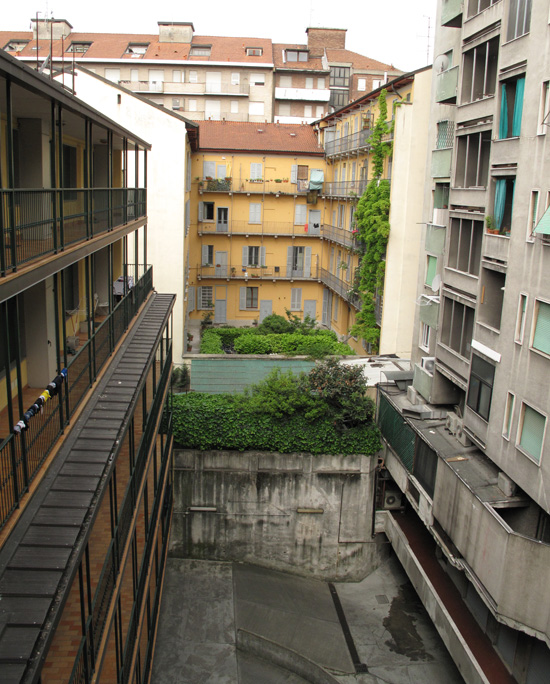
It’s Friday evening and there’s chatter in the courtyard, an enclosed canyon of a space between several of this big city’s 5-story apartment buildings.
Still moving slowly, I’m not compelled to go out tonight. Rather, I’ll make myself a salad of fresh greens, Sicilian tomatoes, long-missed bresaola, scamorza affumicata, some oil and vinegar. Maybe this weekend I’ll head down the bike path on an already-borrowed bike for some fresh ricotta cheese, and then later meet up with a girlfriend to check out the latest art museum show.
Here just two days so far, I’ve shopped for olive oil and intimates, cured meats and internet keys. At a quarter-til-eight in the evening, the doves are cooing again.
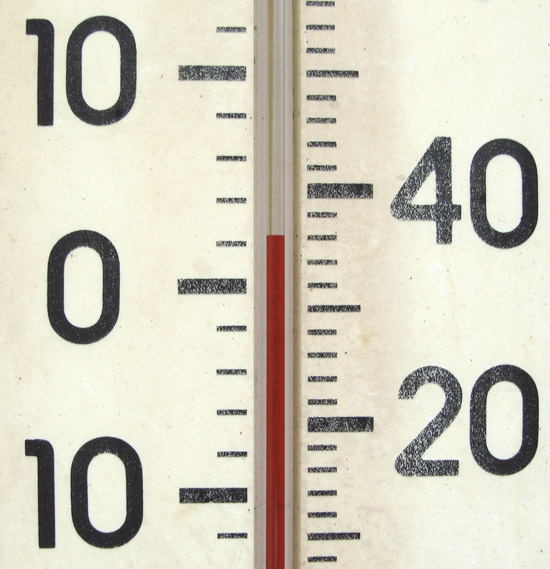
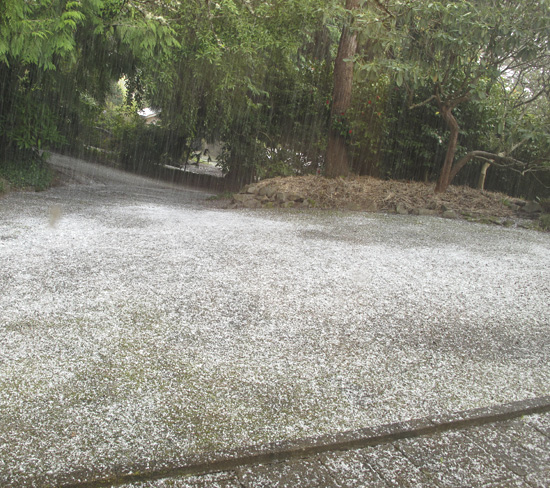
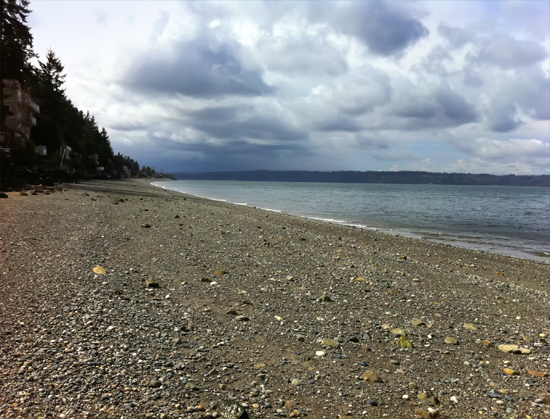
It’s mid-April and COLD! Every morning at about 9:00 I look out to the thermometer on my back porch and it says 40 degrees. That’s only 8 degrees above freezing! Yesterday it was even colder at 36! And we had a crashing dump of 1/4 inch hail in the afternoon.
Where is our springtime, warming weather? When can we put on shorts and t-shirts and get some sun on our faces? It’s been such a long, cold, rainy winter and spring that people are grouchy and impatient.
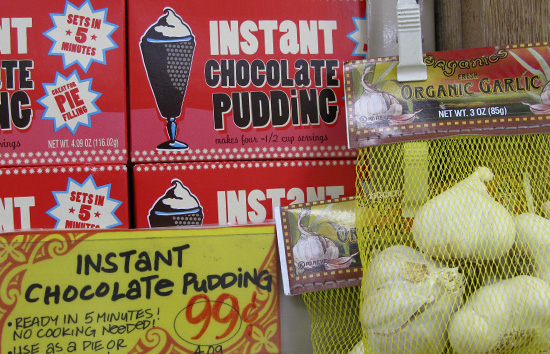
While you’re shopping for Chocolate Pudding Mix, don’t forget the garlic! Really? I’m still scratching my head over this one. I asked the guy stocking shelves and he said they hang garlic all over the store. OK…
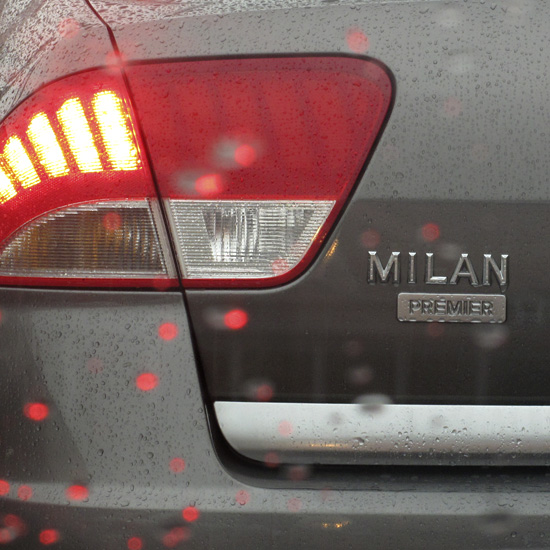
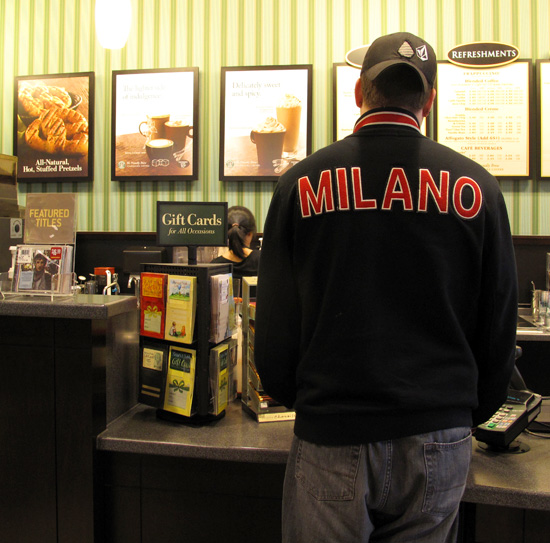
On a rainy day in Seattle – there have been so many lately – the car in front of me was branded “Milan” and my thoughts flew around the world. I’m 25 days away from returning to the land of “ciao” and dear friends that I look forward to sharing aperitivo with.
While all around the community people were wearing kelly green and mylar shamrocks on Thursday, a few friends of mine here, and a whole nation halfway around the world, added white and red to their color scheme.
March 17 was the celebration of the 150th anniversary of the unification of Italy. Happy Birthday, Italia! Auguri! Good wishes!
Italian unification (Italian: il Risorgimento, or “The Resurgence“) was the political and social movement that agglomerated different states of the Italian peninsula into the single state of Italy in the 19th century. Despite a lack of consensus on the exact dates for the beginning and end of this period, many scholars agree that the process began in 1815 with the Congress of Vienna and the end of Napoleonic rule, and ended sometime around 1871 with the Franco-Prussian War. The last città irredente however, did not join the Kingdom of Italy until after World War I.
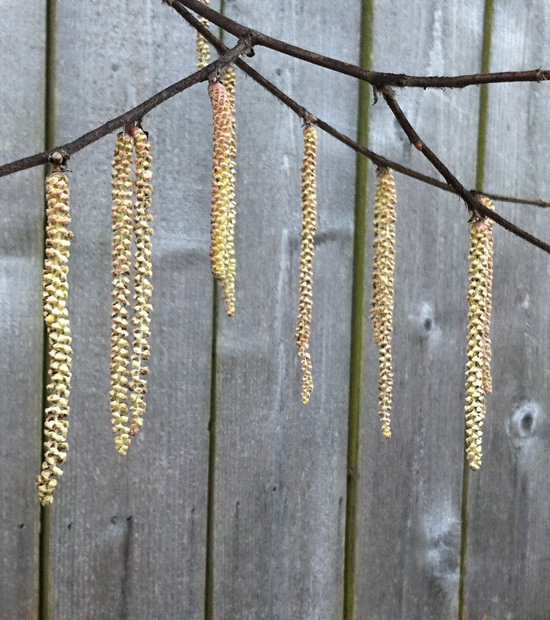
In spite of the snow and hail that keep passing through… and the continued temperatures in the 30s, signs of springtime surround the observant ones here in Seattle. Swelling buds on trees and daffodil stalks. Wild violets blooming. Lenten roses braving the cold. And deciduous catkins popped open, lengthening out and pendulous.
A year ago, after enduring a long, gray, cold, wet winter in Milano, I felt we had all earned our Spring! We’ve earned it here, too, and these little emissaries of warm-days-to-come thrill my spirit.
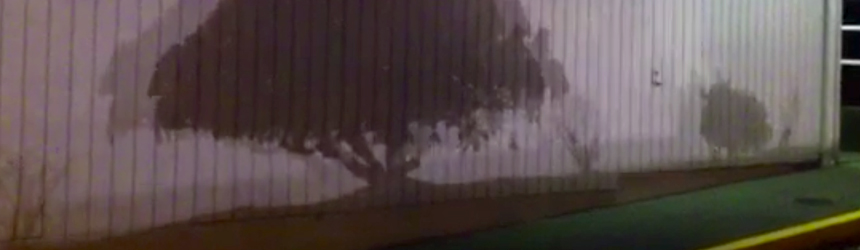
The scene: a building along the west of a busy mall parkway in south Seattle, with a drive through and plantings along the roadside. The headlights from westbound traffic in the right-hand turn lane across the street, are intercepted by this low, trimmed tree and then play across this wall as the cars turn to go northward.
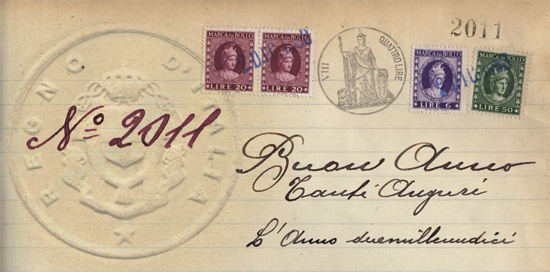
Buon Anno. Tanti Auguri. Happy New Year. Many Good Wishes.
L’anno duemilleundici. The year two thousand eleven.
Vi auguro buona salute, curiositá e contentezza nel anno nuovo!
Un abbraccio affettuoso a tutti i miei amici.
I wish you good health, curiosity and contentment in the New Year!
A warm hug to all my friends.
– – –
Some would think, “Wow, you found that written on some old paper somewhere in Italy?!” No. It’s a Photoshop collage of close to 100 different pieces. The individual letters and elements were scanned, selected and imported from correspondence, meeting notes and report cards from Italy in the 1940s. While there, I became enamored of the old and very distinctive Italian handwriting and collected penmanship manuals and old journals.
The embossed seal is from a child’s report card. It says “Regno d’Italia“, the “Kingdom of Italy”. Italy was unified in 1861 and on June 2, 1946, it became a republic.
Saturday. Past 10:00 in the evening and the house smells good of octopus cooking since 9:26. A few garlic cloves, a dozen peppercorns, a tablespoon of salt and maybe a gallon of water in a pot with an octopus that stretches out a couple of feet.
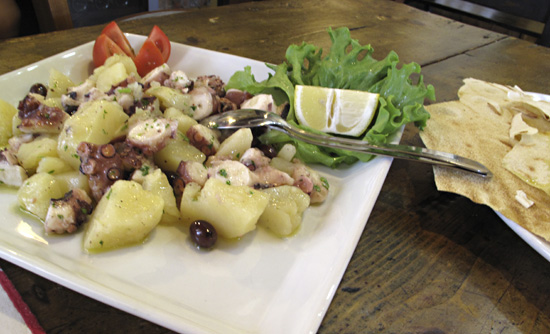
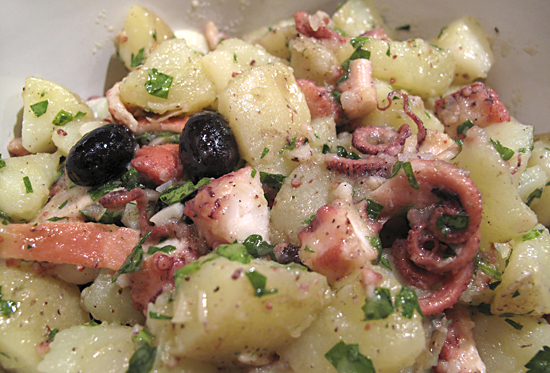
How DOES one cook an octopus? Yearning for my favorite dish at the Carlotta Cafe in Milano, the Piovra con Patate (Octopus with Potatoes. Octopus is also called “polpo“.), I set off on my first octopus-cooking experience. I’ve been watching videos on YouTube to get a sense of technique and the general consensus is, like squid, either cook it really short, or cook it really long. In between would be like eating rubber bands.
I trundled into holiday crowds at the Pike Place Market today to my favorite fishmonger, Pure Food Fish. (Ask for Rich and tell him I sent you.) For $3.99 per pound, I went home with a small octopus and excitement to try my hand at the simple, yet delicious, Sicilian dish. (When I got home and unwrapped my catch, I found a tiny little octopus in the bundle.)
While at the Market, I bought Yukon Gold Potatoes and Italian Parsley at a vegetable stall. I had a wonderful conversation with Theresa, the seller, and we exchanged some contact information and wild stories about my bold decision to pick up and move to Italy for a year.
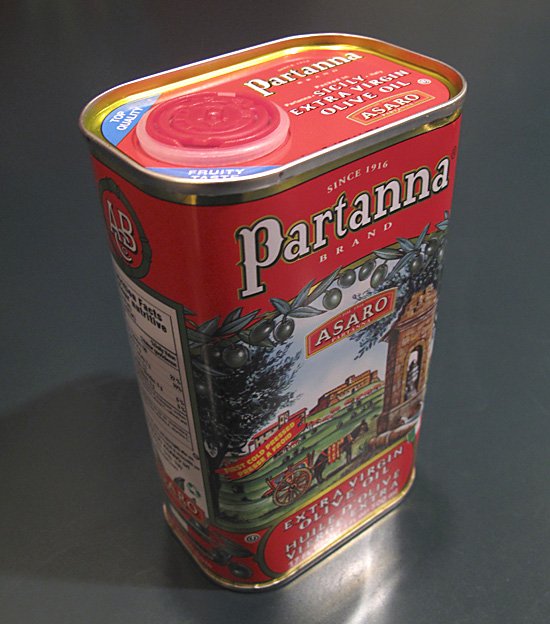
Next, I went to Seattle’s Italian food fixture, DeLaurenti, and bought a few other ingredients. I needed taggiasche olives, which they didn’t have except in a jar, so I bought the celina olives instead. I stepped upstairs and sampled vibrant, green olive oils at their tasting bar and selected the Partanna Sicilian oil for its full flavor. While I was at the store, I couldn’t help but buy two fresh mozzarella balls… (even though they’re from Wisconsin.)
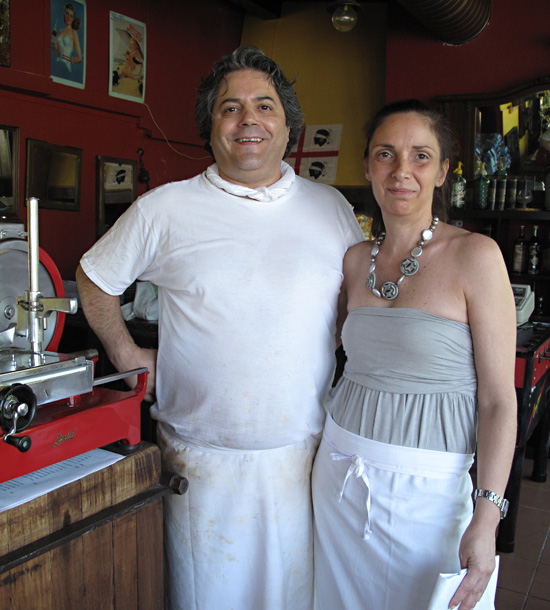
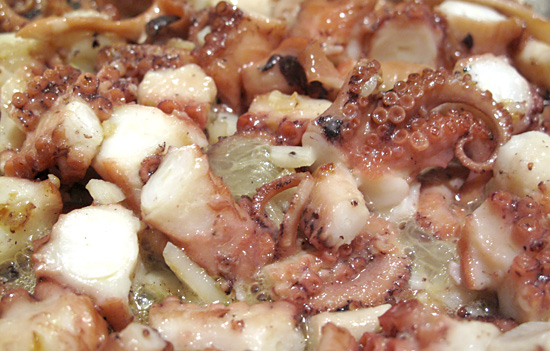
It’s now 10:37 and the octopus has cooked for a little over an hour. I put the timer on for another 15 minutes. Better tender than not. What I’m thinking is that I’ll pull it out of the cook pot and let it cool. Tomorrow, I’ll cook the potatoes, and will cut up the octopus parts and maybe sauté them a bit. (Yes? No?) Then I’ll toss everything together and hope that it looks and tastes something like what I had at Ninni and Agnese’s fabulous little café, named after their daughter, Carlotta.
Ninni and Agnese had offered to let me come into their kitchen to learn how to cook this, my favorite meal. Friday, the day before I left Milano to return to the U.S., I hired a taxi to take me to the café. (It’s not very walkable.) When I arrived on Friday at lunchtime, they were closed! I was so disappointed, and rode the same taxi home. I never got my chance for a lesson from them but will always remember their incredible meal.
11:06 p.m. The octopus is out of the pot after about an hour and 15 minutes. It cooked down to not much, really. I think I could select a bigger octopus next time, or one-per-person. It’s tender and perhaps needs only one hour. The outer skin is loose and slippery, so I’ve fingered most of it away.
Guess what’s for dinner tomorrow? I’ll cook my potatoes, lightly warm my octopus in a sauté pan, drizzle my oil and some fresh-squeezed lemon, and add my olives and parsley. A little sea salt and some pepper. Done! Maybe it’ll approximate Ninni and Agnese’s dish, and if I close my eyes I’ll think I’m at their cafe alongside the canal, sipping a Sicilian wine and whiling away the time.
Wednesday morning. Post-Octopus…twice! I prepped the octopus as I described, for my dinner late on Sunday. A girlfriend stopped by just in time and we both relished it.
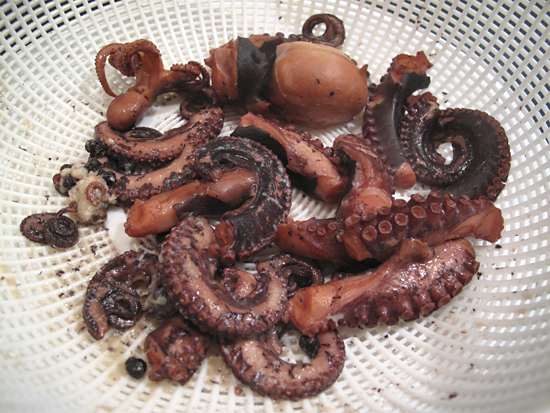
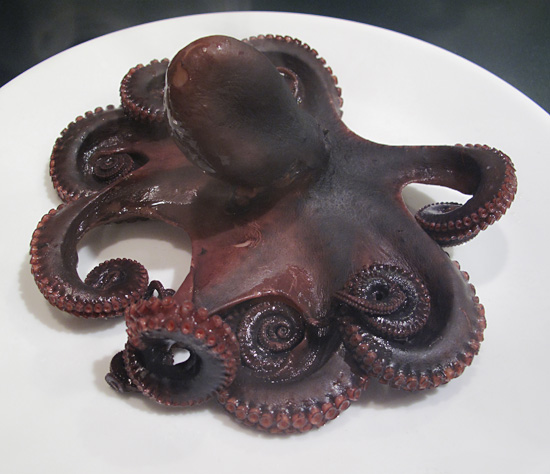
My hunch-of-a-method approximated that of the Carlotta Café enough so that I decided to cook it for two friends on Monday night, too. I went back to the Pike Place Market, got two octopus from Rich and started all over again. This time I threw more veggies into the cooking broth and cooked the octopus whole. It ended as a deep aubergine color, but the skin was more troublesome this time. I may need to do more research, but my friends devoured it, nonetheless. Piovra con Patate may be my new “potluck dish”.
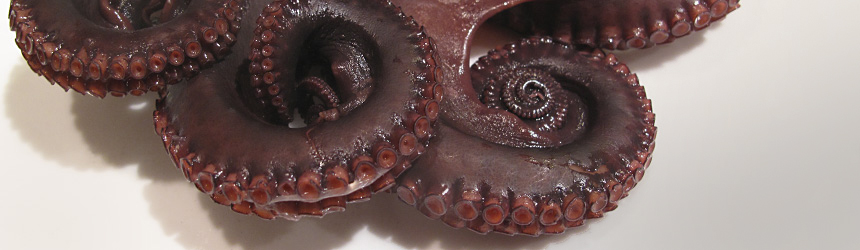
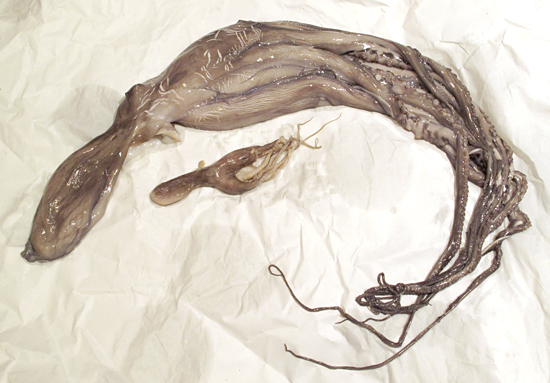
A little side note: One friend was puzzled by the long, pale gray, glistening octopus that I bought (seen above) and the deeply-colored, ruddy-purple, curled, firm octopus seen below. It’s “before and after”! Before cooking, the octopus is limp and pale. One web site recommended holding it by the head and dipping the tentacles a few times into the boiling water so that they curl uniformly, then dropping the whole animal into the pot to cook. Almost immediately, the skin color darkens, and by the end of cooking, (in this case about an hour), the octopus has taken on this dark coloration. Some enjoy eating the skin, some do not. Depending on the length of time in the boiling pot, the dark skin can be brushed or scrubbed off, ideally leaving white cylinders of meat. Personally, I like to have the suction cups remain because they are the clue to the meat on the plate! But the skin at the top of the tentacles and around the body/head is thick and viscous and I haven’t developed that preference yet.
One year ago, late November, I was riding my beloved bike route along the Naviglio Pavese, one of the several canals radiating from the center of Milano. In the near-14-months that I rode this paved path, I couldn’t guess how many times I covered part of these 33 kilometers between Milano and Pavia, to the south.
Some days I went only as far as the roundabout joining two highways near Binasco, and turned back, not having the guts that day to do that dangerous circle on two wheels. Other days I veered off west into the farm land, and wound the one-lane roads amidst the rice paddies and corn fields on my way to buy fresh ricotta cheese at Cascina Femegro. There were times I talked to and raced with the lycra-clad jock cyclists on their training rides and I surprised them by keeping up with their pace.
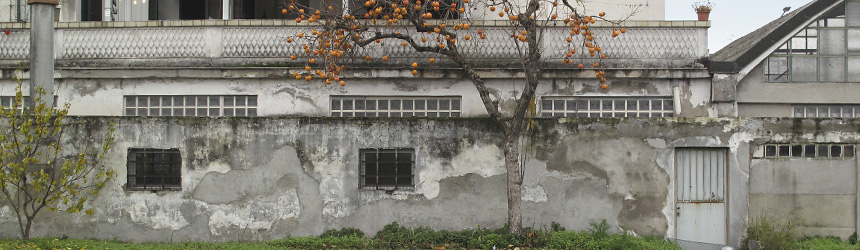
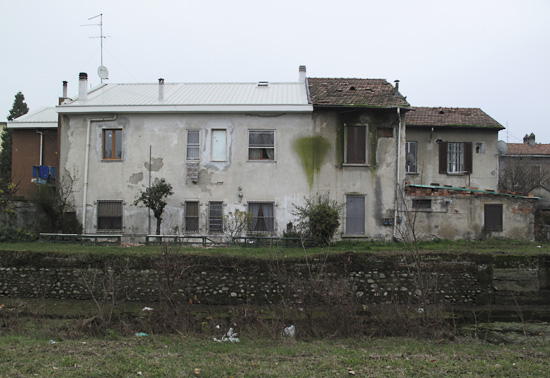
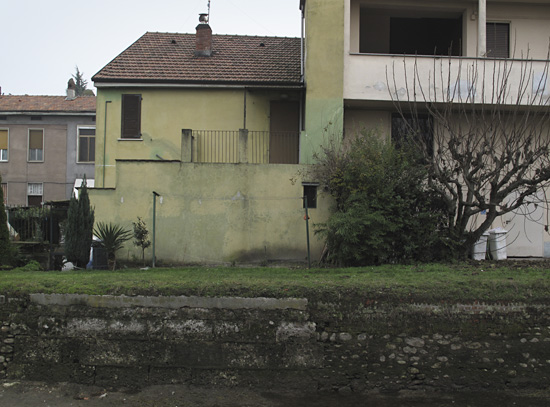
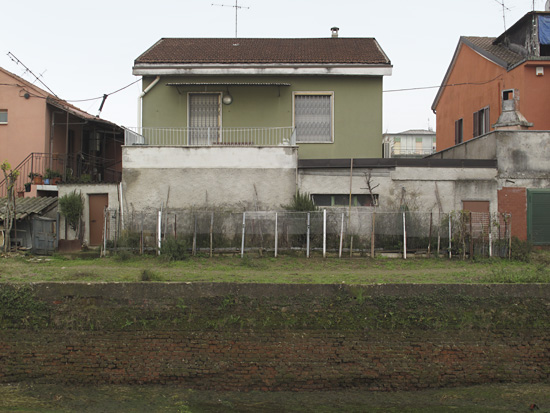
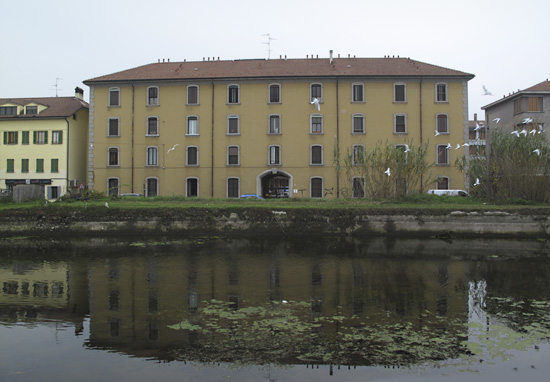
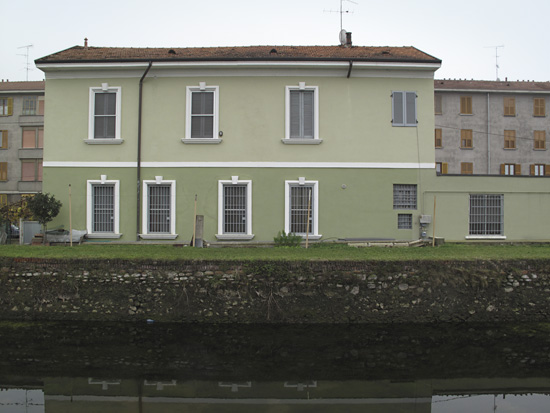
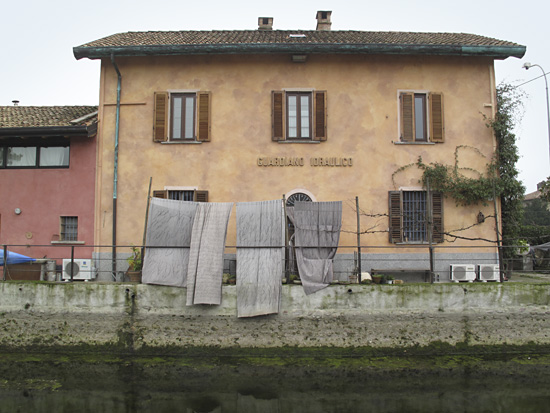
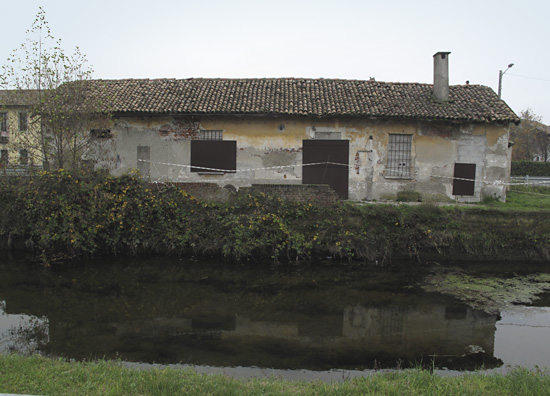
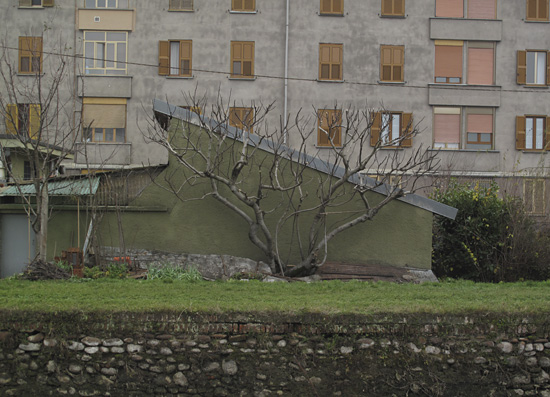
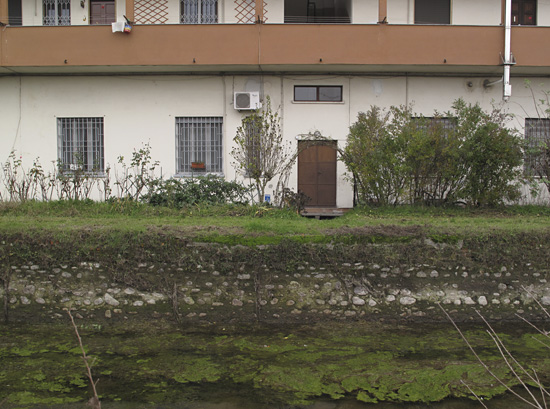
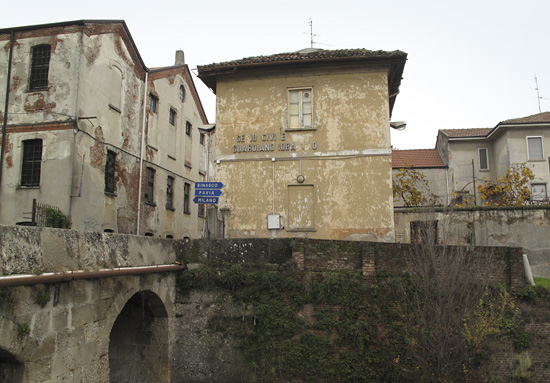
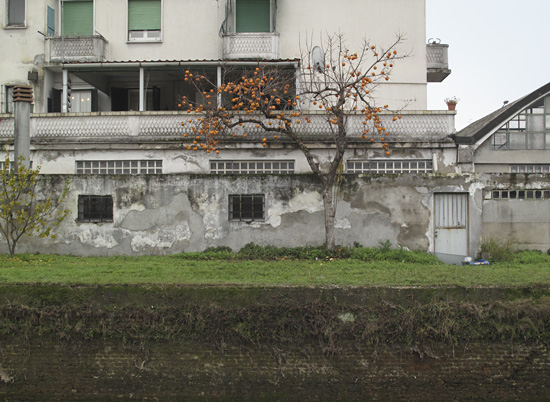
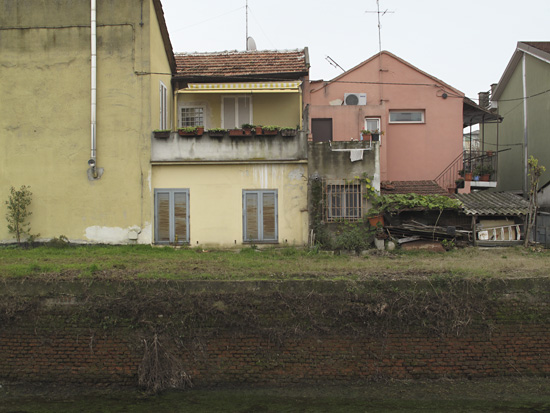
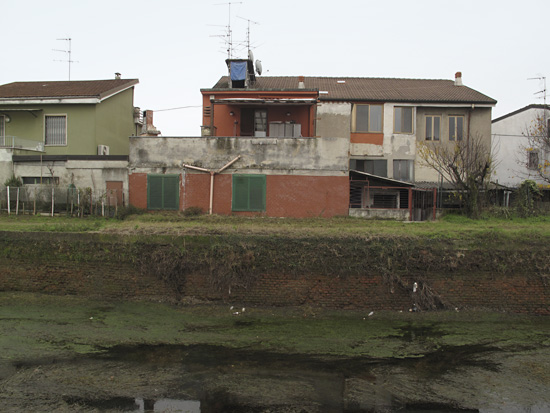
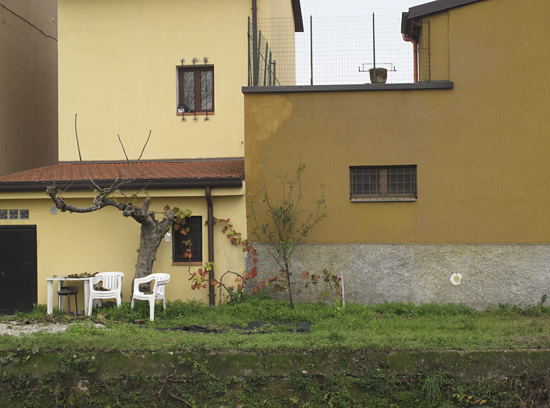
In the course of my long year, I witnessed the full cycle of seasons along the canal. I rode in the humid heat of summer under a blazing sky, and continued riding in the cold, hazy gray of the long, Milanese winter. I was intrigued by the dull hues and disrepair of the backside facades overlooking the canal. Along this route, I saw the frostburnt remnants of summer gardens, moss and algae, stucco and tile begging for repair and persimmons left to hang.
The canalside is more often left untended; it is the non-public face of the home or business, unlike the streetside front that presents a more polished view, (akin to a beautiful woman ironing only the front of her blouse). But there’s something very direct and appealing about the canalside facade, even quaint, and certainly without pretense. It called for a sleepy, early-winter portrait from the water’s edge.
.
.
.
.
.
.
.
.
.
.
.
.
.
Among the many, here are a few other stories I’ve written about the canal:
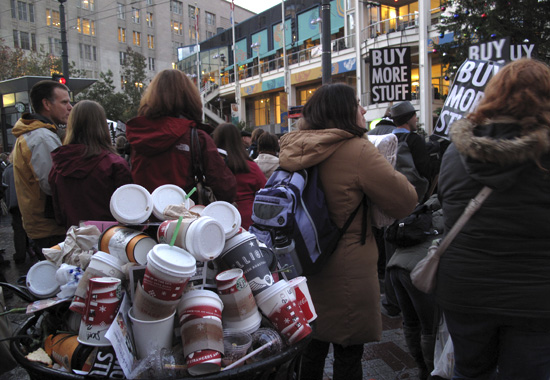
“Black Friday”. THE day upon which retailers place their hopes and base their projections for their year’s sales and their holiday “retail success”. The day after Thanksgiving, when much of the country is turkey-drugged, stuffed with carbs, off-from-work and feeling the pressure of the looming Christmas gift list. The thing to do? Join the frenzy. Get in line at 4:00 a.m. and shop!
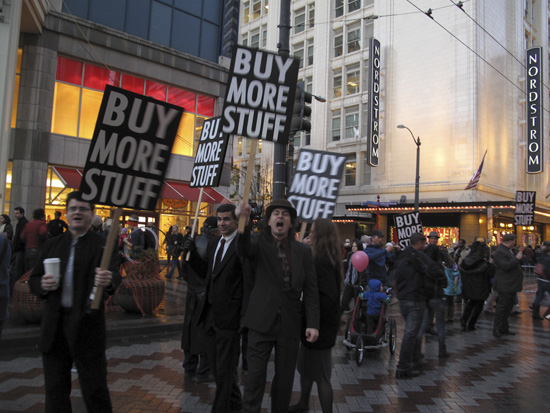
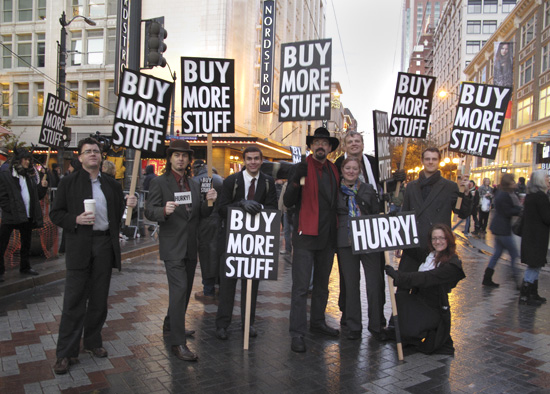
Some friends and I met in downtown Seattle this evening at Westlake Center, the closest place this city has to a central cathedral’s main plaza. (I guess it IS a cathedral of sorts…) The streets were barricaded and filled with people awaiting the lighting of the tall Christmas Tree out in front of Macy’s department store.
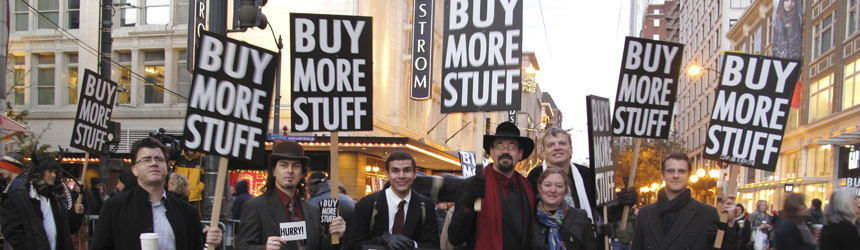
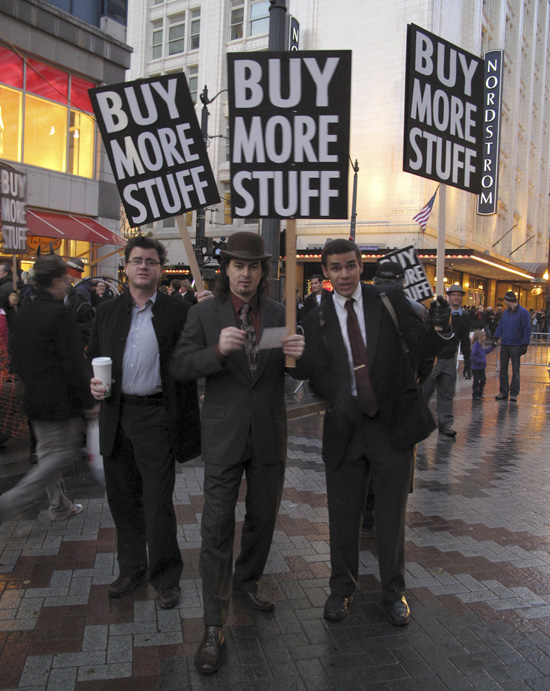
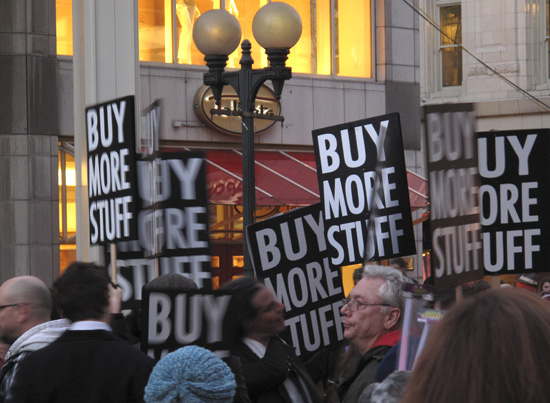
What caught my attention most, were the simple, stark, white-on-black signs carried by smartly-dressed, friendly men and women. “Buy More Stuff”, the signs said. And “Hurry!”.
.
.
.
.
Some people were sure that these folks had been hired by the retailers to ramp up sales. Others understood the facetiousness of the message. It turns out that there’s a group named “BuyMoreStuff.Org” who states its foundation as: “We’re here to encourage people to buy more stuff. If you don’t hurry, they’ll run out of stuff or you’ll run out of time.”
“It’s interesting: Americans in particular are hyper-attuned to advertising and marketing, which all comes down to Buy More Stuff, and when you reduce it down to its primary thing it becomes very weird. When the message is pared down to its essence is when it confuses people the most.” said Michael Holden, who founded Buy More Stuff with fellow performance artist Cody Strauss.
Yes. There’s been plenty written about our having been hoodwinked into feeling compelled to buy, buy, buy. But one thing I mused over, having recently returned from Italy, was “WOULD this be allowed in Italy, and if so, would anyone actually DO this there?” These simple signs are a clean, inoffensive, provoke-thought-and-get-under-the-skin manifestation of “Freedom of Speech”. Bravo!
I like that they can walk around town with bold signs. I like that they did (and do). I like their message. (And I like their graphics.)
As a designer and photographer, one of the most stimulating aspects of being in Italy was its visual lushness. Every surface and every structure caught my eye. (Hence, the 16,300 photos I shot in my almost-14-months there!) Before leaving Milano, I told a few friends back home that I was concerned I’d be visually bored once I returned to Seattle.
One friend, David, “The Computer Guy”, offered to take me on a tour of 100 quirky and wonderful things to see in Seattle. It would be a way of seeing Seattle, my birthplace, with fresh eyes. Now that I’m finally coming up for air from resettling, and blessed with blue sky Fall days here, we had our tour last Friday.
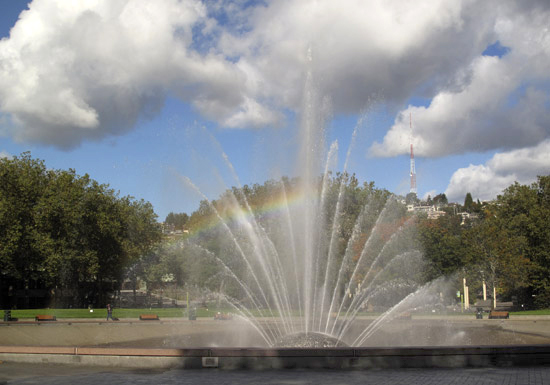
David and I met up at the International Fountain at the Seattle Center, ready to begin our 4-hour, fast-paced whirlwind through the city. (This is a tour he used to make with his son when he was little.)
After checking out the rainbow arching over the fountain, we walked through the Center House food court to the Monorail entrance. We bemoaned the absence of the old Bubbleator that used to rise through the middle of the Center House floor.
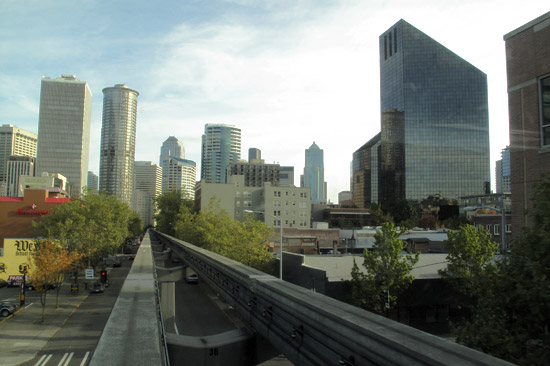
The Monorail’s elevated tracks snake the short distance from the Seattle Center in the lower Queen Anne neighborhood, into the city, past the “Darth Vader” building (on the right, below). (Seattle also has the “Norelco Shaver” and “Ban Roll-On” Buildings, named for their evocative shapes.)
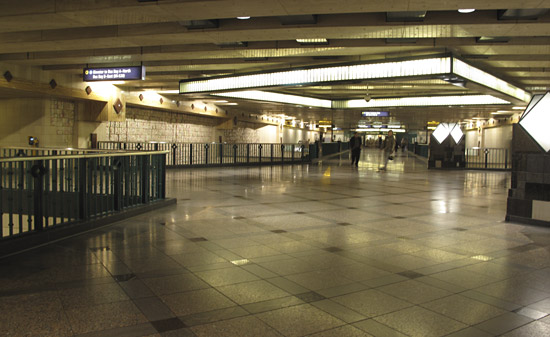
After a short ride, we arrived at Westlake Center, a 4-story shopping hub just a few blocks from the Pike Place Market. We wound through the lunch crowd for a quick pit stop before we began at Westlake Station for our ride through the Seattle Transit Tunnel.
Every tourist and every local should take a free ride through this well-rendered tunnel.
From King County’s Web Site: “The tunnel has five stations. One of the first mysteries of station design was which came first, the art or the architecture? It’s difficult to separate the two. That’s because a lead artist worked with a lead architect to develop the distinctive art and architecture for each station.
“Metro eventually commissioned 25 artists to create more than 30 artworks for the tunnel, stations, surface streets, and sidewalks. The artists worked with Metro’s tunnel project consultant-Parson Brinckerhoff Quade and Douglas Inc. and architecture subconsultant TRA. Together they created the ‘art-itecture’.
“Each station is a representative slice of the neighborhood it serves. The architects and artists wanted people traveling through the tunnel to know where they were below the city by looking at the architecture and design features of the station they were in.
“The designers achieved that goal by studying surrounding businesses, buildings and uses, then creating designs reflecting those elements. Some features are subtle, and others much more noticeable.”
Design and aesthetic details found in the Transit Tunnel are too numerous to list. The roster of artists and architects, and their contributions, is lengthy. There is both “Art with a capital A”, as well as visuals inconsequential to most but artful to me.
(Click through the left-hand side navigation on this Station Art page to read discussions about the art and treatments of each transit station.)
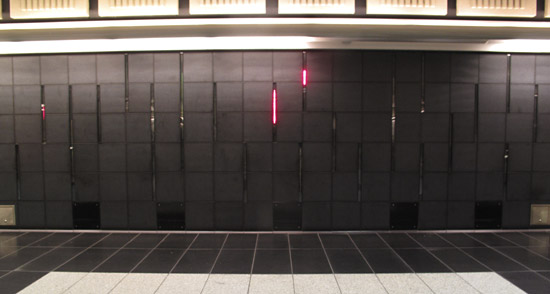
At the University Street Station, beneath Benaroya Hall, is “Saccodoscopoeia” by Bill Bell, perhaps the most intriguing thing I saw all afternoon. Easily dismissed as just a granite wall with vertical rows of LED lights, with a little further exploration, this piece surprises the mind and eye with imagery and words revealing themselves through a “persistence of vision” trick. Move your head back and forth quickly and Seattle-specific icons appear, hovering in front of the wall. David’s trick is to stand 20 or 30 feet away from the wall and twirl on your toes a couple of times. The resulting dizziness causes the eyes to flicker and the images appear readily! (I was amused to think of the security cameras capturing our spinning in circles.)
Here’s the wall, at a glance. When I stood close to the lights and held my camera up, the images flashed quickly in my screen several times, but I wasn’t successful at getting a shot.
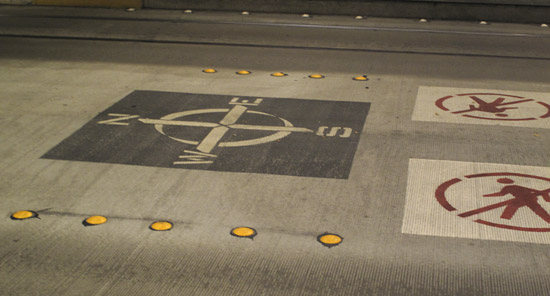
We saw big clocks, distinct at each station and all set to high noon. I appreciated the stenciled compass roses painted on the roadway. How appropriate and helpful for knowing “which end is up”.
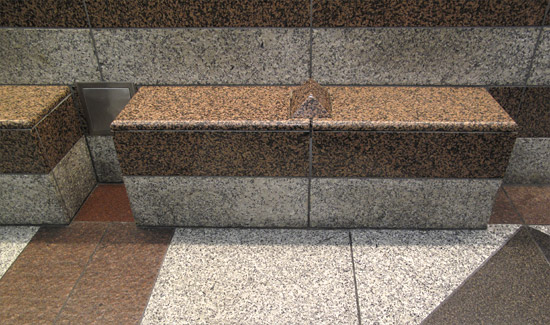
Benches, of course, are all “sit but don’t lie” in their design, discouraging naps and nighttime lodging by those without a better place to sleep.
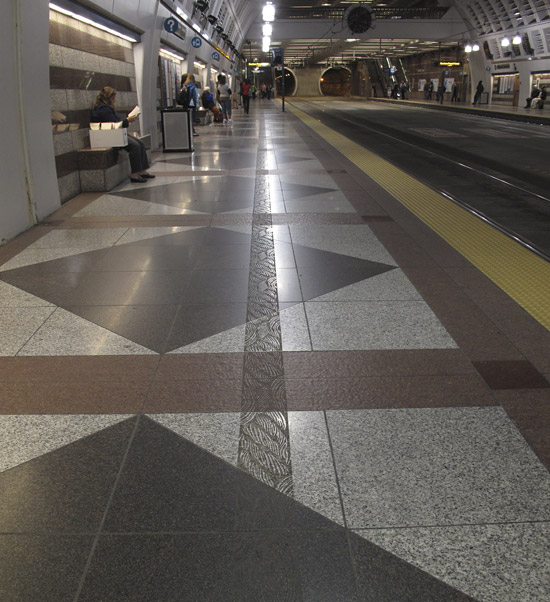
Though each station features distinctly different artwork, one element that unites all stations is the sandblasted braid created by artist, Norie Sato. It’s meant to be part of the cueing system for the visually-impaired, but I found it so subtly low-relief that I question its effectiveness for that purpose. I loved it’s visual addition to the tunnel stations, though. And the varied, patterned stone paving reminded me of what I’ve seen in Italy, France, China and Nicaragua. I’m all for visually-rich floors, sidewalks and roadways instead of monotonous gray concrete expanses.
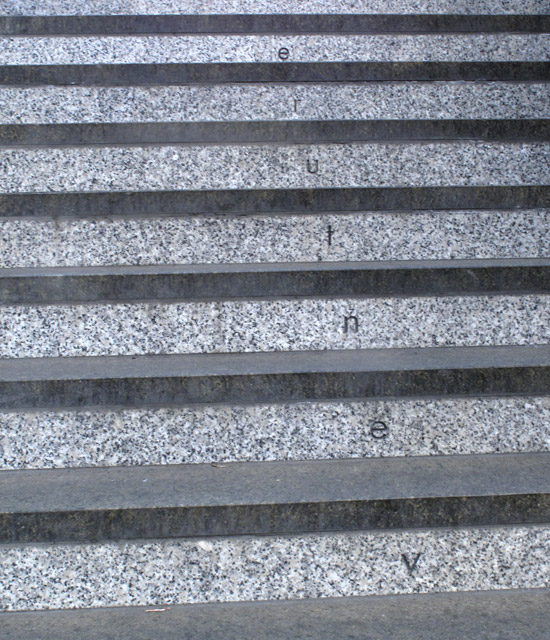
We rode Metro through the tunnel from Westlake Station to the International District, popping up at the other stations along the way. Rising up out of the tunnel at “Chinatown“, poetry was sandblasted into the stair risers. This word “venture” seemed appropriate for our day’s tour.
Immediately out of the station, we were greeted into Chinatown by the 45 foot high Chinese Gate, completed in December of 2007, and adorned with the characters saying “Zhong Hua Men”, meaning “Chinese Nationality”. It is typical of the traditional city gates of China and reminded me of a gate I photographed in Xi’an, China, years ago.
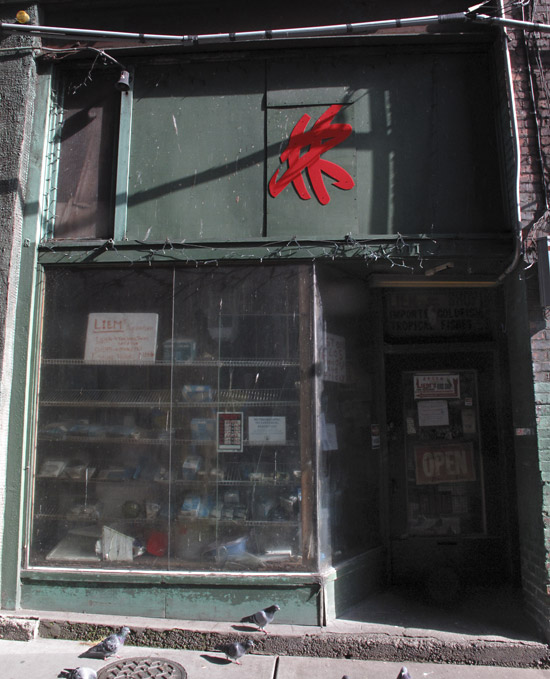
We were on a mission, heading to one of David’s favorite spots in Seattle, Liem’s Pet Shopin the Maynard Alley. Unfortunately, they were closed, so there was no visiting with the diverse menagerie.
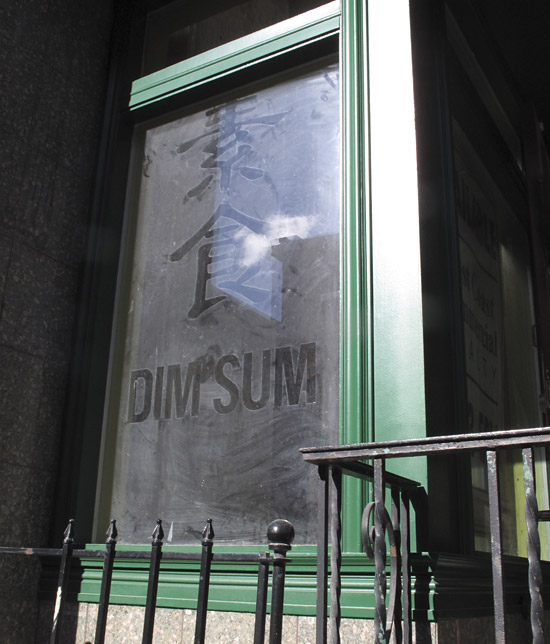
We wandered around, smelling good food, but not stopping to eat. (Why?) We passed the relic of an old dim sum shop and stepped into an art studio and gallery on Jackson Street. The painter’s calligraphy had a sort of Parkinsonian jitter to it, which made it quite distinct.
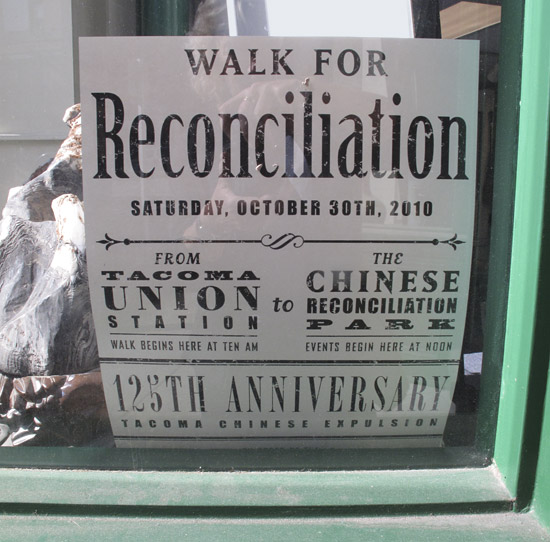
Though contemporary, this poster harkens WAY back.
We returned to the station, reboarded Metro, and headed north back through town. Intending to get off at University Street, we overshot our stop and so, got off back at Westlake Center. We arose to street level and walked over to the Rainier Tower, designed by Minoru Yamasaki. It was completed in 1977, and I remember that people were freaked out because it appears to be like a pencil standing on its point; all were convinced it would fall over.
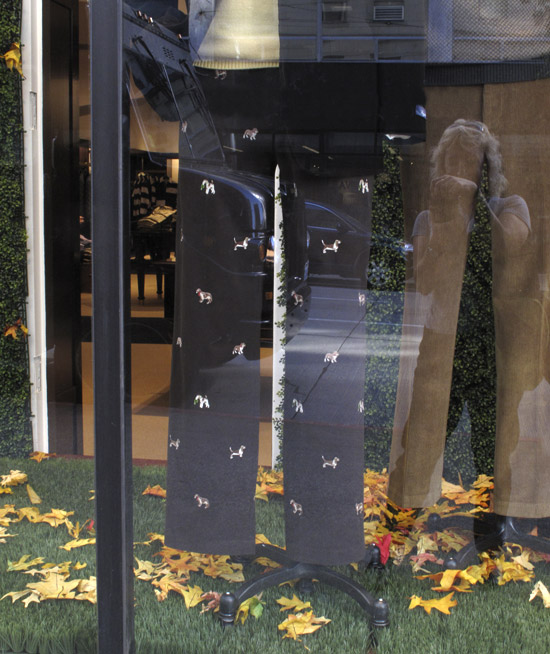
There is a long tunnel under the Tower, filled with historic photos of Seattle, Boeing and the local neighborhoods. After coming up from under the Rainier Tower, we started walking toward the waterfront along Union Street. One of the most ridiculous things I saw on our tour was a pair of pants displayed in the window at Brooks Brothers. They were embroidered with silly little doggies from top to bottom! Tell me, WHO would buy such pants? (Who would conceive of them and put them into production?!) Seeing these pants in the window stopped me in my tracks and had me laughing. Looks like this dog has his leash and is ready for a walk.
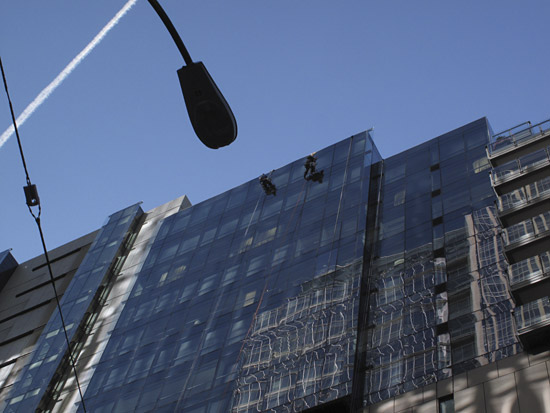
Here’s a job for the not-s0-faint-of-heart… We looked up and saw window washers on a beautiful afternoon.
At the west end of Union Street is one of hilly Seattle’s many stairways, this one leading down toward Western Avenue and the waterfront. We climbed down, arriving at the Seattle City Light power station with its metal, floral-reminiscent barrier (instead of razor wire), and then stepped into the south end of Post Alley.
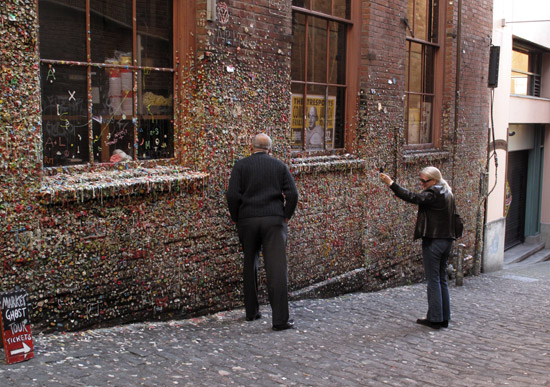
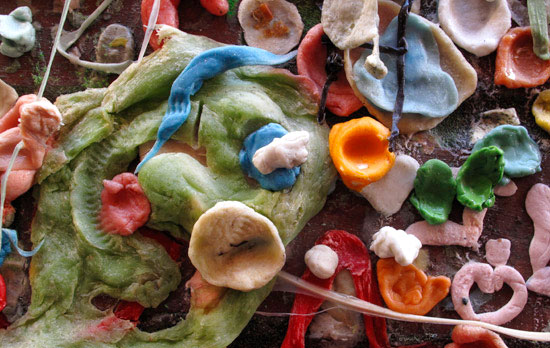
Arrive at… The Bubble Gum Wall! David had told me about it months before leaving Milano, so I was looking forward to seeing it, to which he responded: “You have blown it up beyond all expectations. It is only a 20 foot section of a brick wall between two doors on a brick roadway, with 30,000?? bubblegum wads up to thirty feet from the ground, in every color imaginable, with sculptures of gum and inserted objects. That’s all.”
The Bubble Gum Wall is at the south end of Post Alley at the Pike Place Market, accessed through a short “tunnel” roughly under The Pig by the flying fish stall.
It’s grown since David last saw it, and far outmeasures his 20 foot estimate. It’s a draw for tourists and locals alike. One girl was taking a picture of her friend who wanted to LOOK like she was licking the wall, but was terrified of accidentally touching her tongue to the wall in the process. This is THE place for portraits, cell phone cameras always at the ready.
.
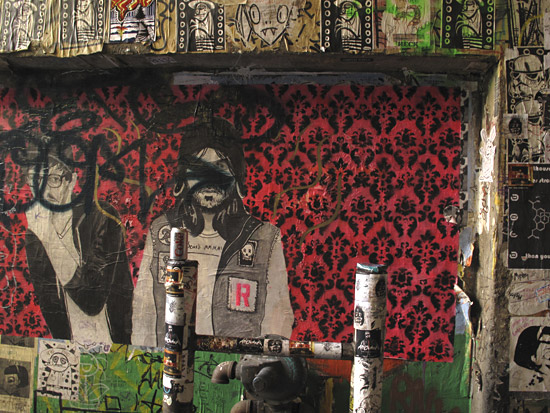
What is any city without it’s share of graffiti? Love it or hate it, there are times when it’s just plain gorgeous. This is rich like fabric, with its step-and-repeat stencil.
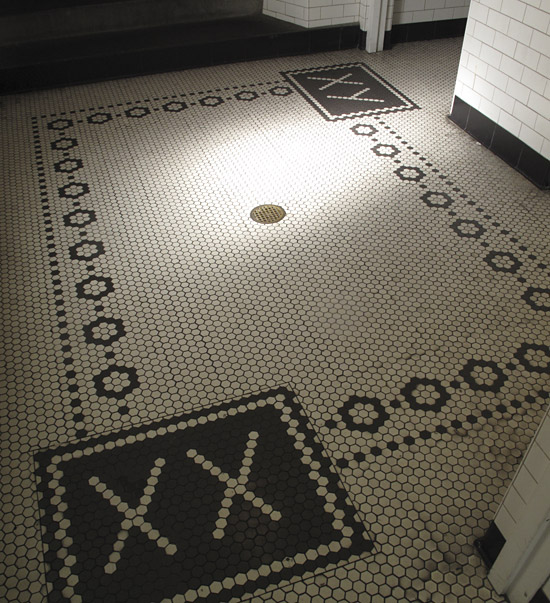
Of course, after covering Seattle, end-to-end, on foot, it was time for another pit stop and the Market was a perfect spot. There are several public restrooms hidden in the rabbit warren maze that is the Market. We went to the two that are just down the stairs from the flying fish. Black and white tile male and female figures stand outside the doors. Inside the doorway, the icons become more scientific: “XX” and “XY” figures indicate gender. (I wonder what percentage of the population knows the significance of those letter combinations.)
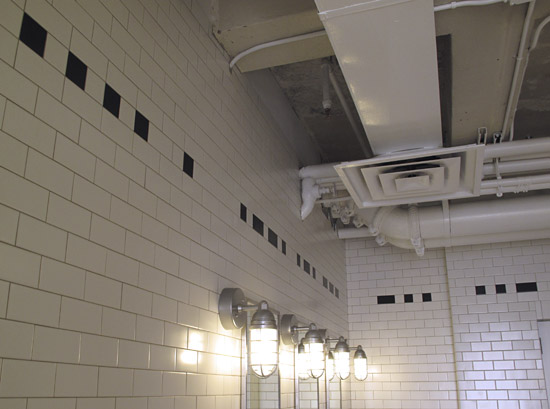
And it wasn’t until I was leaving that I realized that the wall tiles inside the bathrooms form Morse Code! Too bad I didn’t photograph the whole message.
(Update, December 21, 2010. The last time I was at the Pike Place Market (a couple weeks ago) I went back into the restroom and wrote down the full morse code message. I had only photographed the first portion of it before, which was enough to guess the meaning, but my second visit confirmed it: “Meet the producer.”Ahhh. That’s what it says over one of the fruit stands, regarding meeting and buying directly from the growers. How many people have 1) ever noticed that it’s Morse Code, and 2) if they’ve noticed, have decoded the message?)
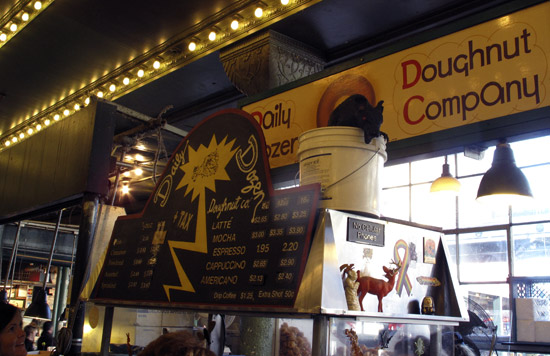
Time for a mid-afternoon bite to eat while we strolled: a half-dozen deep-fried morsels from the Daily Dozen Doughnut Company (right across from DeLaurenti’s). They tumble directly out of the hot oil, and into bowls of powdered or cinnamon sugar.
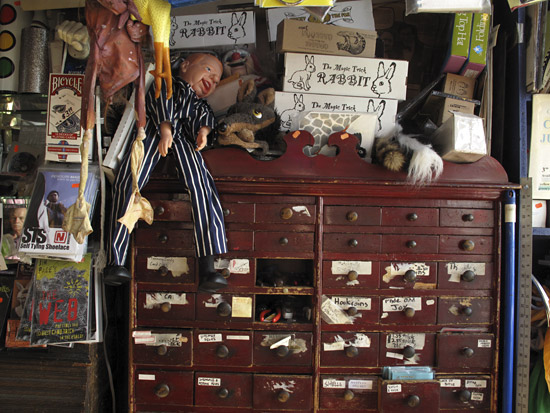
Gobbling piping hot doughnuts, we wandered to Tenzing Momo… a neighboring toy store… the belly dancers’ clothing store… and the Magic Shop. I’d been wanting to buy one of those trick balls that won’t roll in a straight line but rather wobbles aimlessly. (It’s a physical representation of how I’m feeling these days, still needing to re-establish my direction.)
As a teenager I used to go to the Pike Place Market and wander its historic “bowels”… the many unlevel walks, ramps and stairs leading to tucked-away shops selling oddities. I still have the long strand of glass African trading beads that I bought for a quarter each. They’re worth a fortune now.
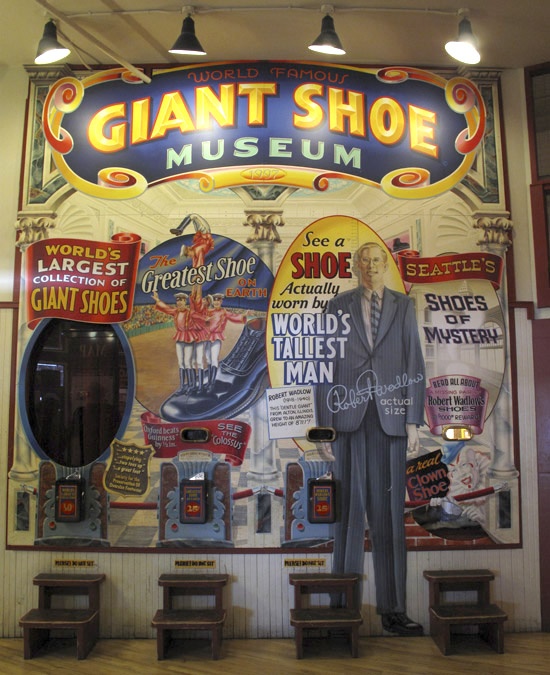
The Giant Shoe Museum is marked by a great example of the classic circus-style bills.
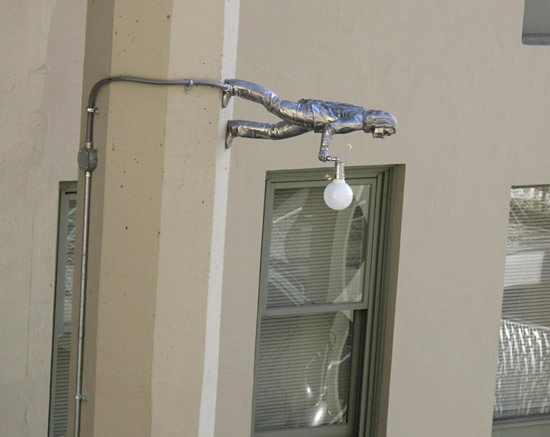
I’m amused by the visual treats that we encountered from one end of our Seattle tour to the other. Look at this light fixture near one of the Market stairways. These touches add humor and visual flavor to a city.
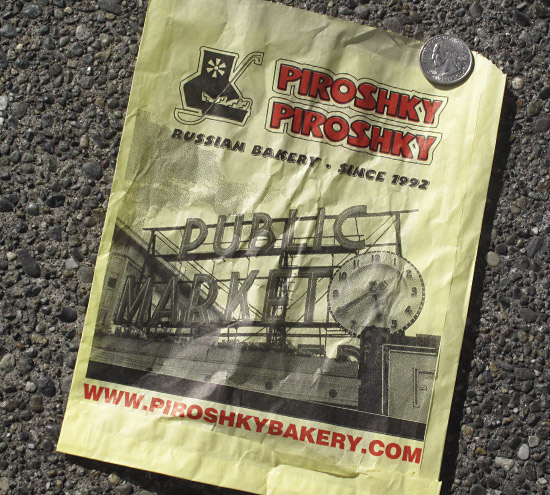
After our doughnuts had settled and we had walked past the endless food, craft and flower vendors, it was time for a real lunch. David took me to the Piroshky Russian Bakery, where we bought smoked salmon piroshky.
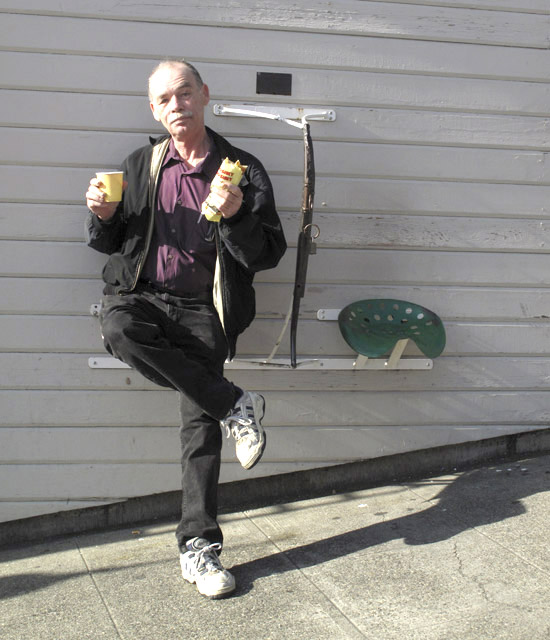
We walked to the wall-mounted tractor seats and perched there to eat and chat.
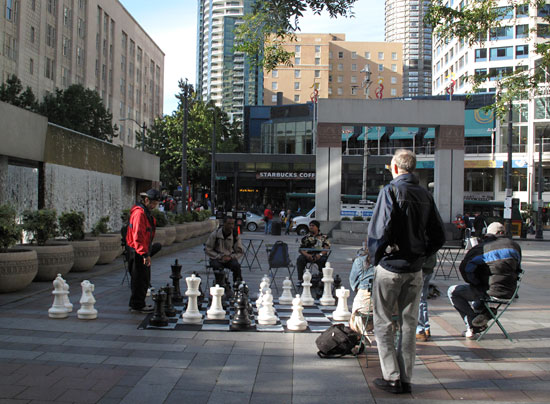
The tour was winding down, and we walked back over to Westlake Center where there was a giant chess game in progress. The fountain (to the left, below) was now flowing, so we both splashed through the tunnel of water. It’s a good thing I had put my camera away beforehand! It was much wetter than David had remembered, and I was drenched afterward.
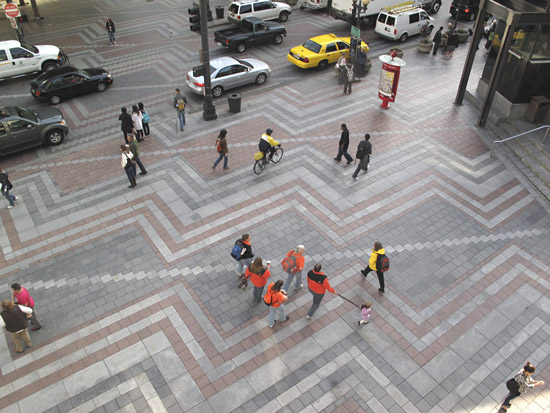
We had lucked out with a sunny, fresh Autumn day in Seattle. David and I stood on the south balcony of Westlake Center’s food court and watched the people go by.
The paving pattern is derived from a Northwest Coast Salish basket from the collection of Dr. Allan Lobb, first executive director of Swedish Medical Center (now deceased). He was the one that let me walk out of his condo 20 years ago with 4 of his 100-year-old baskets to use as photographic references for my paper models. I am thrilled every time I see this broad and beautiful paving that enlivens this plaza and roadway. (It reminds me, again, of the foreign pavers I’ve loved.)
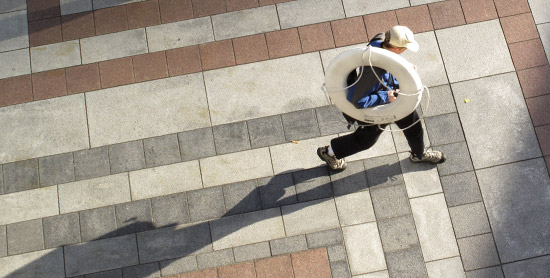
OK. Tell me. WHY would a woman be walking through the middle of downtown Seattle carrying a lifering?
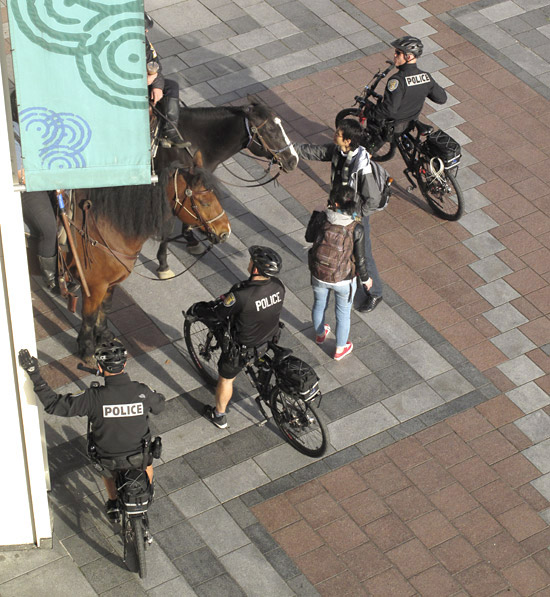
Seattle cops have two types of saddles to choose from.
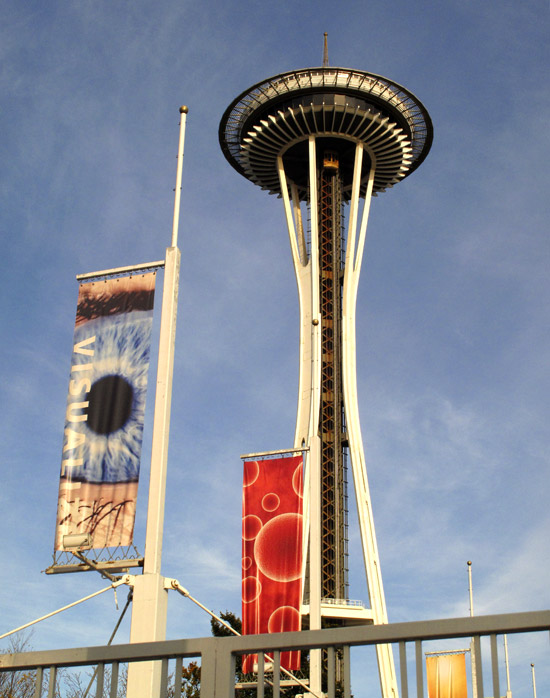
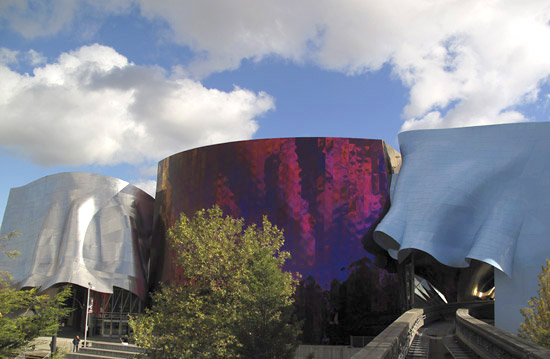
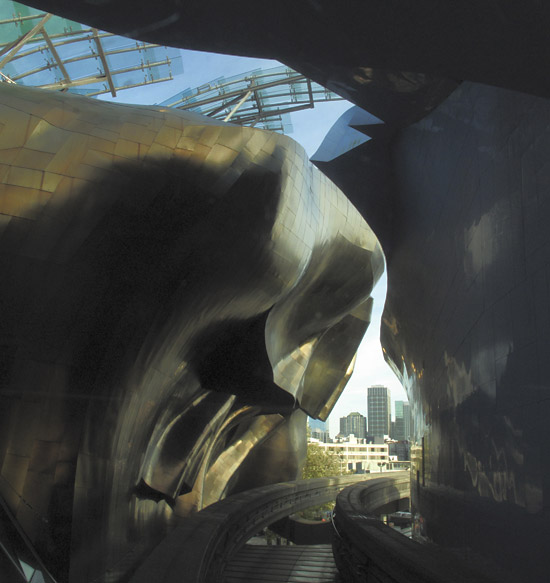
We rode the Monorail back through town, hovering over the city streets, and emerged again through EMP. The afternoon light bounced off the deep violet tiles of the museum, and colored the structures across the way. The tour was finished with a slow amble around the Seattle Center, viewing the scattered artwork in the shadow of the Space Needle.
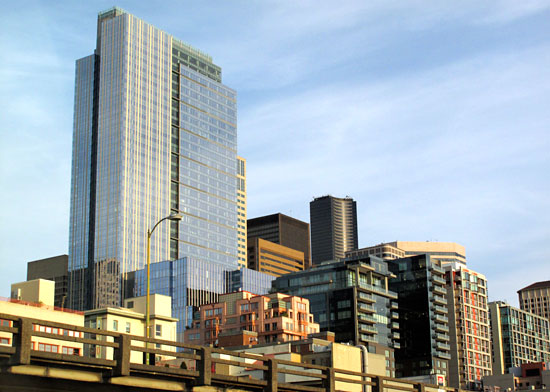
I was leaving town on a Friday evening at 5:00, getting onto the Viaduct with the rest of traffic. It reminded me of why I’m glad I no longer commute, but also pleased me with the waterside view, looking up from the roadway.
And my impression of Seattle after the day’s tour? There’s ART everywhere! “Art-with-a-capital-A”, and art in small, informal, spontaneous ways. With Seattle’s awareness of and commitment to Public Art, the city has created a visually rich flavor. Go for a walk with eyes wide open.
– – –
For those of you needing computer disaster prevention or rescue, get in touch with David. He’s saved me and my friends countless times over the years!
David Anders – The Computer Guy, Seattle
TEL: 206-286-8438 • davidanders@gmail.com • webpresenceseattle@gmail.com
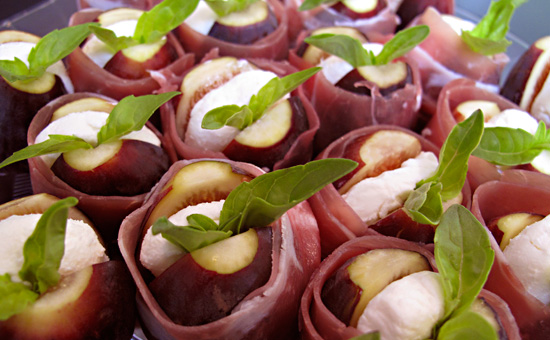
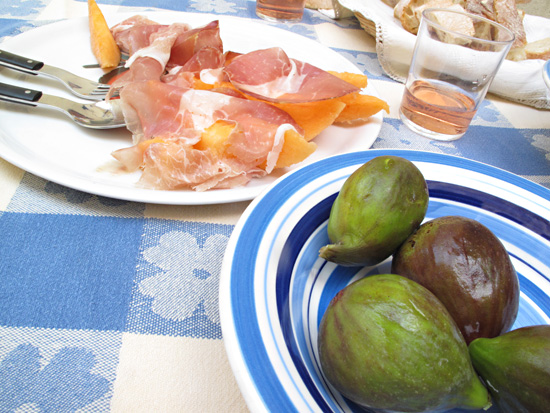
The inspiration of living in Italy will likely continue on for a very long time. I recently split fresh figs and stuffed them with a wedge of goat cheese. I wound them with jackets of prosciutto slices and garnished them with young leaves of basil. The plate of appetizers disappeared in 30 seconds. Late-comers were out of luck.
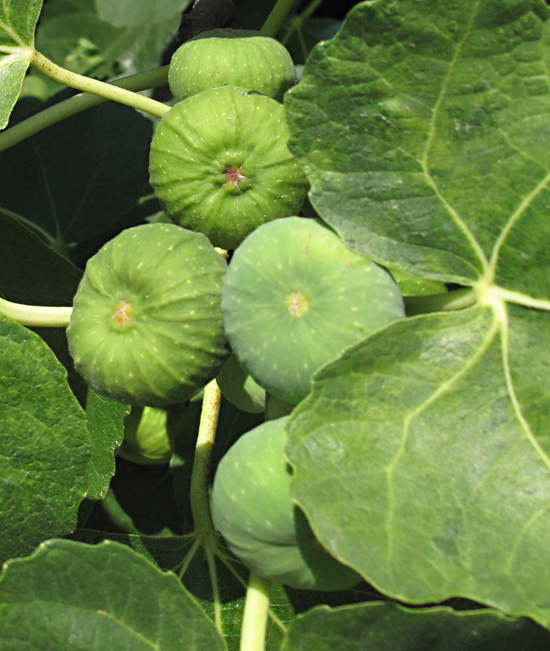
When in Milano in late July, riding my bike alongside the canal, I passed many fig trees heavy with ripening fruit. I kept watching the progress, wondering if the figs would be ready before my departure on July 31. They weren’t. But at half-ripe, they were already twice the size of the the California figs I recently bought here.
Eating figs here in Seattle reminds me of eating figs for lunch with friends in Sanremo along the Italian Riviera in early July.

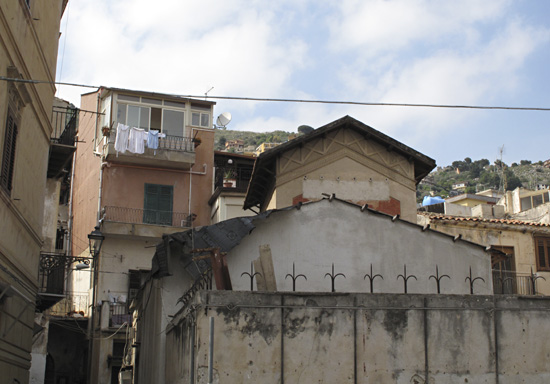
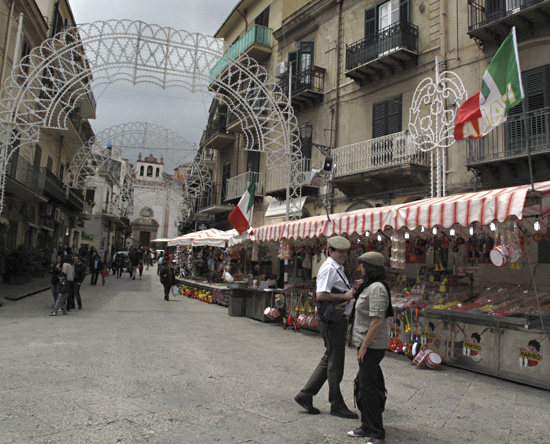
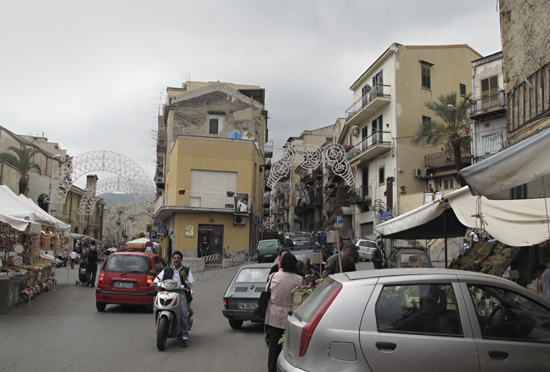
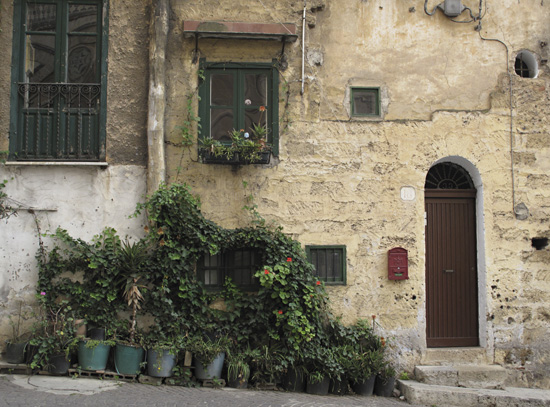
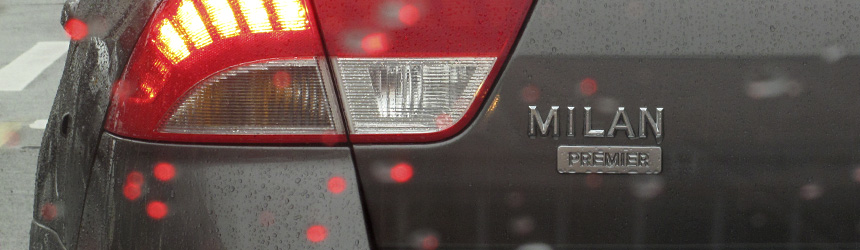 On a rainy day in Seattle – there have been so many lately – the car in front of me was branded “Milan” and my thoughts flew around the world. I’m 25 days away from returning to the land of “ciao” and dear friends that I look forward to sharing aperitivo with.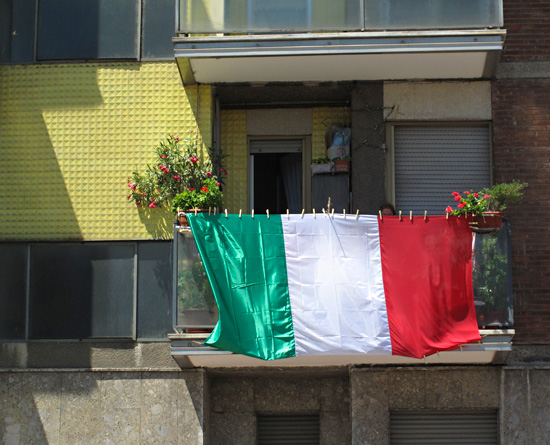

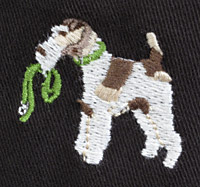 There is a long tunnel under the Tower, filled with historic photos of Seattle, Boeing and the local neighborhoods. After coming up from under the Rainier Tower, we started walking toward the waterfront along Union Street. One of the most ridiculous things I saw on our tour was a pair of pants displayed in the window at Brooks Brothers. They were embroidered with silly little doggies from top to bottom! Tell me, WHO would buy such pants? (Who would conceive of them and put them into production?!) Seeing these pants in the window stopped me in my tracks and had me laughing. Looks like this dog has his leash and is ready for a walk.